Direkt zum Inhalt
Merck

Fortfahren mit

AM80

Anti-PAR (Ab-1) Mouse mAb (10H)

liquid, ≥95% (SDS-PAGE), clone 10H

Synonym(e):

Anti-Poly (ADP-Ribose)

Anmelden zur Ansicht der Organisations- und Vertragspreise.

Größe auswählen

Ansicht ändern
PackungsgrößeSKUVerfügbarkeitPreis
100 μg
Warenkorb auf Verfügbarkeit prüfen
€ 518,00

Über diesen Artikel

NACRES:
NA.41
UNSPSC Code:
12352203
Clone:
10H, monoclonal
Species reactivity:
human, Drosophila, rat, mouse
Application:
Citations:
31

€ 518,00


Warenkorb auf Verfügbarkeit prüfen

Großbestellung anfragen
Technischer Dienst
Benötigen Sie Hilfe? Unser Team von erfahrenen Wissenschaftlern ist für Sie da.
Unterstützung erhalten


biological source

mouse

Quality Level

antibody form

purified antibody

antibody product type

primary antibodies

clone

10H, monoclonal

assay

≥95% (SDS-PAGE)

form

liquid

contains

≤0.1% sodium azide as preservative

species reactivity

human, Drosophila, rat, mouse

manufacturer/tradename

Calbiochem®

storage condition

OK to freeze, avoid repeated freeze/thaw cycles

dilution

(Immunoblotting (2.5 µg/mL)
Immunocytochemistry (5-20 µg/mL))

isotype

IgG3

shipped in

wet ice

storage temp.

−20°C

target post-translational modification

unmodified

General description

Protein A purified mouse monoclonal antibody. Recognizes poly-ADP-ribose.
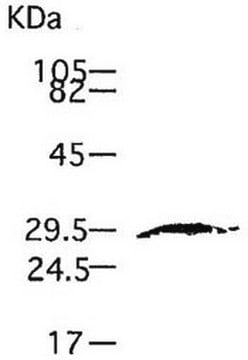
Recognizes poly(ADP)-ribose (PAR) in etopside-treated HL-60 cells.
This Anti-PAR (Ab-1) Mouse mAb (10H) is validated for use in Immunoblotting, Immunocytochemistry for the detection of PAR (Ab-1).

Immunogen

Bovine
purified poly(ADP-ribose)

Application

Immunoblotting (2.5 µg/ml)

Immunocytochemistry (5-20 µg/ml)

Packaging

Please refer to vial label for lot-specific concentration.

Physical form

In 100 mM NaCl, 50 mM HEPES, 1% BSA, pH 7.4.

Preparation Note

Following initial thaw, aliquot and freeze (-20°C).

Analysis Note

Negative Control
Normal mouse IgG
Positive Control
Etoposide-treated HL-60 cells

Other Notes

Kawamitsu, H., et al. 1984. Biochemistry23, 3771.
PAR can be induced in HL-60 cells by treatment with 67 µM etoposide for 3.5 h. Antibody should be titrated for optimal results in an individual system.

Legal Information

CALBIOCHEM is a registered trademark of Merck KGaA, Darmstadt, Germany

Disclaimer

Toxicity: Standard Handling (A)

Ähnliche Artikel vergleichen

Vollständigen Vergleich anzeigen

Unterschiede anzeigen

1 of 1

Dieser Artikel
IM29LOP44IM40
antibody form

purified antibody

antibody form

purified antibody

antibody form

purified antibody

antibody form

purified antibody

clone

10H, monoclonal

clone

2, monoclonal

clone

FE9, monoclonal

clone

141-7B2, monoclonal

species reactivity

human, Drosophila, rat, mouse

species reactivity

human

species reactivity

rat, human, mouse

species reactivity

human

biological source

mouse

biological source

mouse

biological source

mouse

biological source

mouse

Quality Level

100

Quality Level

100

Quality Level

100

Quality Level

100

form

liquid

form

lyophilized

form

liquid

form

liquid


Still not finding the right product?

Probieren Sie unser Produkt-Auswahlhilfe, um Ihre Auswahl einzugrenzen


Lagerklasse

11 - Combustible Solids

wgk

WGK 1

flash_point_f

Not applicable

flash_point_c

Not applicable


Analysenzertifikate (COA)

Suchen Sie nach Analysenzertifikate (COA), indem Sie die Lot-/Chargennummer des Produkts eingeben. Lot- und Chargennummern sind auf dem Produktetikett hinter den Wörtern ‘Lot’ oder ‘Batch’ (Lot oder Charge) zu finden.

Besitzen Sie dieses Produkt bereits?

In der Dokumentenbibliothek finden Sie die Dokumentation zu den Produkten, die Sie kürzlich erworben haben.

Die Dokumentenbibliothek aufrufen


Laura Maggi et al.
European journal of immunology, 40(8), 2174-2181 (2010-05-21)
We have previously shown that human Th17 lymphocytes are characterized by the selective expression of IL-23 receptor (IL-23R), CCR6, CD161, and the transcription factor retinoic acid-related orphan receptor C (RORC), and originate from a CD161(+)CD4(+) naïve T-cell precursor in response
Gautier Stoll et al.
Oncoimmunology, 8(6), e1571389-e1571389 (2019-05-10)
The expression of two metabolic enzymes, i.e., aldehyde dehydrogenase 7 family, member A1 (ALDH7A1) and lipase C, hepatic type (LIPC) by malignant cells, has been measured by immunohistochemical methods in non-small cell lung carcinoma (NSCLC) biopsies, and has been attributed
Young-Ok Son et al.
Toxicology and applied pharmacology, 255(3), 287-296 (2011-07-20)
Cadmium is a toxic heavy metal which is environmentally and occupationally relevant. The mechanisms underlying cadmium-induced autophagy are not yet completely understood. The present study shows that cadmium induces autophagy, as demonstrated by the increase of LC3-II formation and the


Global Trade Item Number

SKUGTIN
AM80-100UG04055977228052

Questions

Reviews

No rating value

Active Filters