
AM63

Anti-A20 Mouse mAb (59A426)
liquid, clone 59A426, Calbiochem®
Größe auswählen
| Packungsgröße | SKU | Verfügbarkeit | Preis |
|---|---|---|---|
| 100 μg | Warenkorb auf Verfügbarkeit prüfen | € 529,00 |
Über diesen Artikel
biological source
mouse
Quality Level
antibody form
purified antibody
antibody product type
primary antibodies
clone
59A426, monoclonal
form
liquid
contains
≤0.1% sodium azide as preservative
species reactivity
human
manufacturer/tradename
Calbiochem®
storage condition
OK to freeze, avoid repeated freeze/thaw cycles
dilution
(Immunoblotting (1:500-1:2000)
Immunoprecipitation (2 µg/mg))
isotype
IgG1
shipped in
wet ice
storage temp.
−20°C
target post-translational modification
unmodified
Gene Information
human ... TNFAIP3(7128)
General description
Immunogen
Application

Immunoblotting (1:500-1:2000)
Immunoprecipitation (2 g/mg)
Packaging
Physical form
Preparation Note
Analysis Note
Daudi cells
Other Notes
May, M.J. et al. 1997. Seminars in Cancer Biology.2, 63.
Tewari, M., et al. 1995. J. Immunol.154, 1699.
Opipari, A.W., et al. 1990. J. Biol. Chem.265, 14705.
Legal Information
Disclaimer
1 of 1
Dieser Artikel | |||
|---|---|---|---|
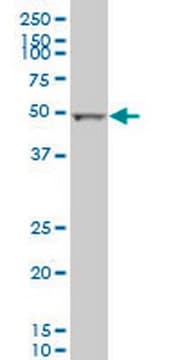
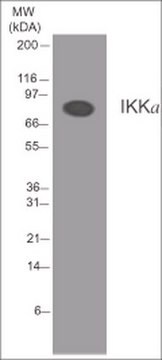
| clone 59A426, monoclonal | clone 1E5, monoclonal | clone 14A231, monoclonal | clone MS13, monoclonal |
| species reactivity human | species reactivity human | species reactivity monkey, human, mouse | species reactivity human |
| biological source mouse | biological source mouse | biological source mouse | biological source mouse |
| antibody form purified antibody | antibody form purified antibody | antibody form affinity isolated antibody | antibody form purified antibody |
| Gene Information human ... TNFAIP3(7128) | Gene Information human ... ALDH2(217) | Gene Information human ... CHUK(1147) | Gene Information human ... BRCA1(672) |
| form liquid | form liquid | form liquid | form liquid |

Still not finding the right product?
Probieren Sie unser Produkt-Auswahlhilfe, um Ihre Auswahl einzugrenzen
Lagerklasse
11 - Combustible Solids
wgk
WGK 1
flash_point_f
Not applicable
flash_point_c
Not applicable
Analysenzertifikate (COA)
Suchen Sie nach Analysenzertifikate (COA), indem Sie die Lot-/Chargennummer des Produkts eingeben. Lot- und Chargennummern sind auf dem Produktetikett hinter den Wörtern ‘Lot’ oder ‘Batch’ (Lot oder Charge) zu finden.
Besitzen Sie dieses Produkt bereits?
In der Dokumentenbibliothek finden Sie die Dokumentation zu den Produkten, die Sie kürzlich erworben haben.
Verwandter Inhalt
Global Trade Item Number
| SKU | GTIN |
|---|---|
| AM63-100UG | 04055977228021 |