Direkt zum Inhalt
Merck

Fortfahren mit

ABN76

Anti-Neurofilament H (200 kDa)-Antikörper

rabbit polyclonal

Synonym(e):

Neurofilament heavy polypeptide, Neurofilament H

Anmelden zur Ansicht der Organisations- und Vertragspreise.

Größe auswählen

Ansicht ändern
PackungsgrößeSKUVerfügbarkeitPreis
100 μg
Warenkorb auf Verfügbarkeit prüfen
€ 401,00

Über diesen Artikel

UNSPSC Code:
12352203
eCl@ss:
32160702
NACRES:
NA.41
Clone:
polyclonal
Species reactivity:
mouse, human, rat, bovine
Application:
IHC, WB
Citations:
3

€ 401,00


Warenkorb auf Verfügbarkeit prüfen
Für Ihr Target ist ein rekombinanter, konservierungsmittelfreier Antikörper verfügbar. Probieren Sie ZRB1347

Großbestellung anfragen
Technischer Dienst
Benötigen Sie Hilfe? Unser Team von erfahrenen Wissenschaftlern ist für Sie da.
Unterstützung erhalten


Produktname

Anti-Neurofilament H (200 kDa)-Antikörper, from rabbit, purified by affinity chromatography

biological source

rabbit

Quality Level

antibody form

affinity isolated antibody

antibody product type

primary antibodies

clone

polyclonal

purified by

affinity chromatography

species reactivity

mouse, human, rat, bovine

technique(s)

immunohistochemistry: suitable (paraffin), western blot: suitable

NCBI accession no.

UniProt accession no.

shipped in

wet ice

target post-translational modification

unmodified

Gene Information

bovine ... Nefh(528842)
human ... NEFH(4744)
mouse ... Nefh(380684)
rat ... Nefh(24587)

General description

Neurofilamente sind eine Art von Intermediärfilamenten, die als wichtige Elemente des Zytoskeletts fungieren und das Zytoplasma von Axon stützen. Sie sind die am reichlichsten vorhandenen Faserkomponenten in Axon und durchschnittlich 3–10-Mal häufiger vorhanden als axonale Mikrotubuli. Neurofilamente (Durchmesser 10 nm) werden aus drei verschlungenen Protofibrilen gebildet, die wiederum selbst aus zwei tetrameren Protofilament-Komplexen aus monomeren Proteinen bestehen. Die Neurofilament-Triplett-Proteine (68/70, 160 und 200 kDa) kommen im zentralen und peripheren Nervensystem vor und sind in der Regel neuronenspezifisch. Das 68/70-kDa-NF-L-Protein kann sich selbst zu einer filamentösen Struktur assemblieren, für die Co-Assemblierung der 160-kDa-NF-M und 200-kDa-NF-H-Proteine muss jedoch das 68/70-kDa-NF-L-Protein vorhanden sein. Neurome, Ganglioneurome, Gangliogliomen, Ganglioneuroblastomen und Neuroblastomen weisen eine positive Färbung für Neurofilamente auf. Neurofilamente sind zwar in der Regel auf Neuronen beschränkt, wurden jedoch auch in Paragangliomen, adrenalen und extra-adrenalen Pheochromozytomen, Karzinoiden, neuroendokrinen Hautkarzinomen und Oat-Zell-Karzinomen der Lunge nachgewiesen. Weitere Informationen finden Sie in der Tabelle mit Zelltyp-spezifischen Markern für das Nervensystem auf der Millipore-Website.
~ 200 kDa gemessen

Immunogen

GST-markiertes rekombinantes Protein, das bovinem Neurofilament H entspricht.

Application

Dieser Anti-Neurofilament H (200 kDa)-Antikörper ist für die Verwendung in WB und IH(P) zum Nachweis von Neurofilament H (200 kDa) validiert.
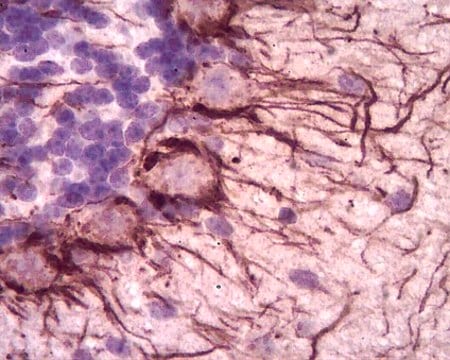
Immunhistochemische Analyse: Mit einer repräsentativen Charge in einer Verdünnung von 1 µg/ml wurde Neurofilament H in normalem Cerebellum-Gewebe von Ratten nachgewiesen.

Analysis Note

Beurteilt mittels Western Blot an Gewebelysat aus dem bovinen Cerebellum.

Western-Blot-Analyse: Mit 0,1 µg/ml dieses Antikörpers wurde Neurofilament H in Gewebelysat aus dem bovinen Cerebellum nachgewiesen.
Kontrolle
Bovines Cerebellum-Gewebelysat

Other Notes

Ersetzt: AB1982
Konzentration: Die chargenspezifische Konzentration entnehmen Sie bitte dem Analysenzertifikat.

Ähnliche Artikel vergleichen

Vollständigen Vergleich anzeigen

Unterschiede anzeigen

1 of 1

Dieser Artikel
MAB5266AB1989AB1991
Quality Level

100

Quality Level

100, 300

Quality Level

100

Quality Level

100

antibody form

affinity isolated antibody

antibody form

purified immunoglobulin

antibody form

serum

antibody form

serum

biological source

rabbit

biological source

mouse

biological source

rabbit

biological source

rabbit

technique(s)

immunohistochemistry: suitable (paraffin), western blot: suitable

technique(s)

immunohistochemistry: suitable, western blot: suitable

technique(s)

immunohistochemistry: suitable, western blot: suitable

technique(s)

immunohistochemistry (formalin-fixed, paraffin-embedded sections): suitable, western blot: suitable

Gene Information

bovine ... Nefh(528842)
human ... NEFH(4744)
mouse ... Nefh(380684)
rat ... Nefh(24587)

Gene Information

human ... NEFH(4744)
mouse ... Nefh(380684)
pig ... Nefh(100156492)
rat ... Nefh(24587)
rhesus monkey ... Nefh(717705)

Gene Information

bovine ... Nefh(528842)
human ... NEFH(4744)
mouse ... Nefh(380684)
pig ... Nefh(100156492)
rat ... Nefh(24587)

Gene Information

human ... NEFH(4744)

shipped in

wet ice

shipped in

wet ice

shipped in

dry ice

shipped in

dry ice


Still not finding the right product?

oder

Probieren Sie unser Produkt-Auswahlhilfe, um Ihre Auswahl einzugrenzen


Lagerklasse

12 - Non Combustible Liquids

wgk

WGK 1

flash_point_f

Not applicable

flash_point_c

Not applicable


Analysenzertifikate (COA)

Suchen Sie nach Analysenzertifikate (COA), indem Sie die Lot-/Chargennummer des Produkts eingeben. Lot- und Chargennummern sind auf dem Produktetikett hinter den Wörtern ‘Lot’ oder ‘Batch’ (Lot oder Charge) zu finden.

Besitzen Sie dieses Produkt bereits?

In der Dokumentenbibliothek finden Sie die Dokumentation zu den Produkten, die Sie kürzlich erworben haben.

Die Dokumentenbibliothek aufrufen


Greg A Weir et al.
Brain : a journal of neurology, 140(10), 2570-2585 (2017-10-04)
See Basbaum (doi:10.1093/brain/awx227) for a scientific commentary on this article. Peripheral neuropathic pain arises as a consequence of injury to sensory neurons; the development of ectopic activity in these neurons is thought to be critical for the induction and
Ana Feliú et al.
The Journal of neuroscience : the official journal of the Society for Neuroscience, 37(35), 8385-8398 (2017-07-29)
The failure to undergo remyelination is a critical impediment to recovery in multiple sclerosis. Chondroitin sulfate proteoglycans (CSPGs) accumulate at demyelinating lesions creating a nonpermissive environment that impairs axon regeneration and remyelination. Here, we reveal a new role for 2-arachidonoylglycerol
Allison M Barry et al.
Pain, 164(10), 2196-2215 (2023-06-15)
Dorsal root ganglia (DRG) neurons have been well described for their role in driving both acute and chronic pain. Although nerve injury is known to cause transcriptional dysregulation, how this differs across neuronal subtypes and the impact of sex is


Global Trade Item Number

SKUGTIN
ABN7604053252632051

Questions

Reviews

No rating value

Active Filters