Direkt zum Inhalt
Merck

Fortfahren mit

ABN20

Anti-Dopamine D(1A) Receptor Antibody

from rabbit, purified by affinity chromatography

Synonym(e):

dopamine receptor D1, D(1A) dopamine receptor

Anmelden zur Ansicht der Organisations- und Vertragspreise.

Größe auswählen

Ansicht ändern
PackungsgrößeSKUVerfügbarkeitPreis
100 μg
Warenkorb auf Verfügbarkeit prüfen
€ 545,00

Über diesen Artikel

UNSPSC Code:
12352203
NACRES:
NA.41
eCl@ss:
32160702
Conjugate:
unconjugated
Clone:
polyclonal
Application:
ELISA, IHC, WB
Citations:
5

€ 545,00


Warenkorb auf Verfügbarkeit prüfen

Technischer Dienst
Benötigen Sie Hilfe? Unser Team von erfahrenen Wissenschaftlern ist für Sie da.
Unterstützung erhalten


biological source

rabbit

Quality Level

conjugate

unconjugated

antibody form

affinity isolated antibody

antibody product type

primary antibodies

clone

polyclonal

purified by

affinity chromatography

species reactivity

rat

species reactivity (predicted by homology)

bovine (based on 100% sequence homology)

technique(s)

ELISA: suitable, immunohistochemistry: suitable, western blot: suitable

NCBI accession no.

UniProt accession no.

shipped in

wet ice

target post-translational modification

unmodified

Gene Information

rat ... Drd1(24316)

General description

Dopaminergic signals are thought to modulate corticostriatal synapses onto medium spiny projection neurons, and this plasticity is, in turn, thought to alter patterns of activity during learning. Subversion of these processes in clinical and rodent models is hypothesized to contribute importantly to addiction to psychostimulants, seizures, and movement disorders in Huntington’s (HD) and Parkinson’s disease (PD). Dopamine receptor D1, also known as DRD1, is the most abundant dopamine receptor (of the five types D1-D5) in the central nervous system and is critically involved in these processes and the modulation of D2 receptor mediated events. Coupled with G-protein, the D1a receptor stimulates adenylyl cyclase and activates cyclic AMP-dependent protein kinases including the key molecular switch, DARPP-32.
~ 55 kDa is observed

Immunogen

Epitope: Cytoplasmic Domain
KLH-conjugated linear peptide of rat dopamine D(1A) receptor at and around the cytoplasmic domain.

Application

Anti-Dopamine D(1A) Receptor Antibody detects level of Dopamine D(1A) Receptor & has been published & validated for use in IH, WB, ELISA.
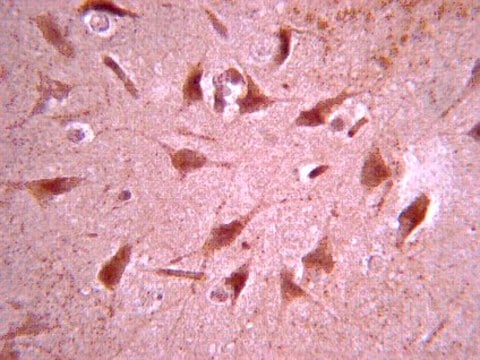
Immunohistochemistry Analysis: A 1:300 dilution from a previous lot detected D(1A) dopamine receptor in rat brain tissue.

ELISA Analysis: Tested in ELISA against antigen-coated plate. A 1:100 dilution from a previous lot detected dopamine D(1A) receptor peptide.
Research Category
Neuroscience
Research Sub Category
Neurotransmitters & Receptors

Biochem/physiol Actions

This antibody recognizes D(1A) dopamine receptor.

Physical form

Affinity purified
Purified rabbit polyclonal in buffer containing 0.1 M Tris-Glycine (pH 7.4, 150 mM NaCl) with 0.05% sodium azide.

Preparation Note

Stable for 1 year at 2-8°C from date of receipt.

Analysis Note

Control
Rat testis tissue lysate
Evaluated by Western Blot in rat testis tissue lysate.

Western Blot Analysis: 2 µg/ml of this antibody detected dopamine D(1A) receptor in 10 µg of rat testis tissue lysate.

Other Notes

Concentration: Please refer to the Certificate of Analysis for the lot-specific concentration.
Replaces: AB1765P;

Disclaimer

Unless otherwise stated in our catalog or other company documentation accompanying the product(s), our products are intended for research use only and are not to be used for any other purpose, which includes but is not limited to, unauthorized commercial uses, in vitro diagnostic uses, ex vivo or in vivo therapeutic uses or any type of consumption or application to humans or animals.

Ähnliche Artikel vergleichen

Vollständigen Vergleich anzeigen

Unterschiede anzeigen

1 of 1

Dieser Artikel
D2944SAB4500671AB5084P
antibody form

affinity isolated antibody

antibody form

purified immunoglobulin

antibody form

affinity isolated antibody

antibody form

affinity isolated antibody

biological source

rabbit

biological source

rat

biological source

rabbit

biological source

rabbit

Quality Level

100

Quality Level

200

Quality Level

100

Quality Level

100

conjugate

unconjugated

conjugate

unconjugated

conjugate

unconjugated

conjugate

unconjugated

clone

polyclonal

clone

1-1-F11 s.E6, monoclonal

clone

polyclonal

clone

polyclonal

UniProt accession no.

P18901

UniProt accession no.

P21728

UniProt accession no.

P21728

UniProt accession no.

P14416


Still not finding the right product?

Probieren Sie unser Produkt-Auswahlhilfe, um Ihre Auswahl einzugrenzen


Lagerklasse

12 - Non Combustible Liquids

wgk

WGK 1

flash_point_f

Not applicable

flash_point_c

Not applicable


Analysenzertifikate (COA)

Suchen Sie nach Analysenzertifikate (COA), indem Sie die Lot-/Chargennummer des Produkts eingeben. Lot- und Chargennummern sind auf dem Produktetikett hinter den Wörtern ‘Lot’ oder ‘Batch’ (Lot oder Charge) zu finden.

Besitzen Sie dieses Produkt bereits?

In der Dokumentenbibliothek finden Sie die Dokumentation zu den Produkten, die Sie kürzlich erworben haben.

Die Dokumentenbibliothek aufrufen


Gregory N Ruegsegger et al.
FASEB journal : official publication of the Federation of American Societies for Experimental Biology, 31(12), 5371-5383 (2017-08-11)
Prenatal overnutrition affects development into adulthood and influences risk of obesity. We assessed the transgenerational effect of maternal Western diet (WD) consumption on offspring physical activity. Voluntary wheel running was increased in juvenile (4-7 wk of age), but decreased in
Silvana Obici et al.
Molecular metabolism, 4(10), 692-705 (2015-10-27)
Melanocortin-4 receptors (MC4Rs) are highly expressed by dopamine-secreting neurons of the mesolimbic tract, but their functional role has not been fully resolved. Voluntary wheel running (VWR) induces adaptations in the mesolimbic dopamine system and has a myriad of long-term beneficial
Andrea Stojakovic et al.
Brain sciences, 11(4) (2021-04-04)
Evidence suggests that nicotine and alcohol can each serve as a gateway drug. We determined whether prior nicotine and alcohol treatment would alter amphetamine reward. Also, we examined whether age and dopaminergic neurotransmission are important in this regard. Male and


Global Trade Item Number

SKUGTIN
ABN2004053252737930

Questions

Reviews

No rating value

Active Filters