
ABC940

Anti-SNX18 Antibody
from rabbit, purified by affinity chromatography
Synonym(e):
Sorting nexin-18, SH3 and PX domain-containing protein 3B, Sorting nexin-associated Golgi protein 1, SNX18
Größe auswählen
| Packungsgröße | SKU | Verfügbarkeit | Preis |
|---|
Über diesen Artikel
biological source
rabbit
Quality Level
conjugate
unconjugated
antibody form
affinity isolated antibody
antibody product type
primary antibodies
clone
polyclonal
purified by
affinity chromatography
species reactivity
human, canine
technique(s)
immunocytochemistry: suitable, immunoprecipitation (IP): suitable, western blot: suitable
NCBI accession no.
1 of 1
Dieser Artikel | |||
|---|---|---|---|
| Quality Level 100 | Quality Level - | Quality Level 100 | Quality Level 100 |
| conjugate unconjugated | conjugate unconjugated | conjugate unconjugated | conjugate unconjugated |
| biological source rabbit | biological source goat | biological source rabbit | biological source rabbit |
| antibody form affinity isolated antibody | antibody form affinity isolated antibody | antibody form affinity isolated antibody | antibody form affinity isolated antibody |
| shipped in dry ice | shipped in wet ice | shipped in wet ice | shipped in wet ice |
| UniProt accession no. | UniProt accession no. | UniProt accession no. | UniProt accession no. |


General description
Immunogen
Application
Apoptosis & Cancer
Apoptosis - Additional
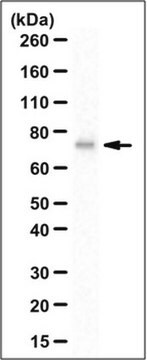
Western Blotting Analysis: A representative lot detected endogenous SNX18 in MDCK cell lysates (Li, D., et al. (2014). EMBO J. 15(4):428-437).
Immunoprecipitation Analysis: A representative lot immunoprecipitated endogenous SNX18 in MDCK cell lysates (Willenborg, C., et al. (2011). J Cell Biol. 195(1):71-86).
Immunocytochemistry Analysis: A representative lot detected SNX18 in filter-grown, polarized MDCK cells, as well as polarized MDCK cells grown in 3D cultures (Willenborg, C., et al. (2011). J Cell Biol. 195(1):71-86).
Biochem/physiol Actions
Physical form
Preparation Note
Analysis Note
Western Blotting Analysis: 1.0 µg/mL of this antibody detected SNX18 in 10 µg of MDCK cell lysate.
Other Notes
Disclaimer
Sie haben nicht das passende Produkt gefunden?
Probieren Sie unser Produkt-Auswahlhilfe. aus.
Lagerklasse
12 - Non Combustible Liquids
wgk
WGK 2
flash_point_f
Not applicable
flash_point_c
Not applicable
Analysenzertifikate (COA)
Suchen Sie nach Analysenzertifikate (COA), indem Sie die Lot-/Chargennummer des Produkts eingeben. Lot- und Chargennummern sind auf dem Produktetikett hinter den Wörtern ‘Lot’ oder ‘Batch’ (Lot oder Charge) zu finden.
Besitzen Sie dieses Produkt bereits?
In der Dokumentenbibliothek finden Sie die Dokumentation zu den Produkten, die Sie kürzlich erworben haben.
Verwandter Inhalt
A major focus of breast cancer research is to understand the mechanisms responsible for disease progression and drug resistance. Toward that end, it has been found that approximately two thirds of all human breast carcinomas overexpress the Estrogen Receptor α (ERα) protein and it remains the primary pharmacological target for endocrine therapy1,2. The normal cellular function of ERα is as a transcription factor that mediates a wide variety of physiological processes, many of which are dependent upon phosphorylation of the receptor at specific amino acid residues3,4. Indeed, ERα is known to be phosphorylated at a multitude of different sites, yet how these all correlate to disease remains unclear5. Here, we interrogated multiple sites of ERα for phosphorylation status by screening an extensive panel of different breast cancer patient samples and other non-breast cancer tissue microarray (TMA) slide samples to determine their relevance to disease.
Global Trade Item Number
| SKU | GTIN |
|---|---|
| ABC940 | 04055977173413 |
Active Filters
Unser Team von Wissenschaftlern verfügt über Erfahrung in allen Forschungsbereichen einschließlich Life Science, Materialwissenschaften, chemischer Synthese, Chromatographie, Analytik und vielen mehr..
Setzen Sie sich mit dem technischen Dienst in Verbindung