
AB1506

Anti-Glutamatrezeptor 2/3-Antikörper
Chemicon®, from rabbit
Synonym(e):
AMPA-selective glutamate receptor 2, AMPA-selective glutamate receptor 2, glutamate receptor 2, glutamate receptor, ionotropic, AMPA 2
Größe auswählen
| Packungsgröße | SKU | Verfügbarkeit | Preis |
|---|---|---|---|
| 50 μg | Warenkorb auf Verfügbarkeit prüfen | € 463,00 |
Über diesen Artikel
€ 463,00
biological source
rabbit
Quality Segment
conjugate
unconjugated
antibody form
affinity isolated antibody
antibody product type
primary antibodies
clone
polyclonal
purified by
affinity chromatography
species reactivity
hamster, mouse, human, guinea pig, monkey, gerbil, rat
manufacturer/tradename
Chemicon®
technique(s)
immunocytochemistry: suitable, immunohistochemistry (formalin-fixed, paraffin-embedded sections): suitable, immunoprecipitation (IP): suitable, western blot: suitable
NCBI accession no.
UniProt accession no.
shipped in
wet ice
target post-translational modification
unmodified
Gene Information
human ... GRIA2(2891)
General description
Immunogen
Application
Neurowissenschaft
Neurotransmitter & Rezeptoren
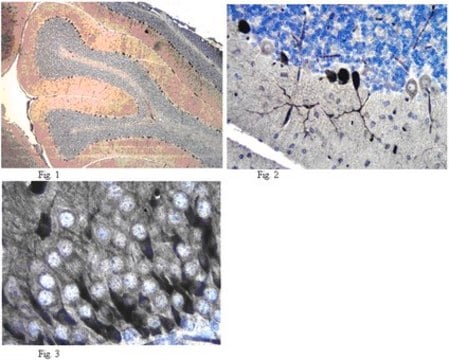
Eine frühere Charge wurde unter Verwendung von in Paraformaldehyd oder Paraformaldehyd/Glutaraldehyd fixiertem Gewebe mit Licht- und Elektronenmikroskopie verwendet. Cryostat- und Vibratomschnitte können mit oder ohne Triton X-100-Behandlung verwendet werden. Die verwendeten Endkonzentrationen lagen bei 1-3 µg/ml.
Immunpräzipitation:
Bei Verknüpfung mit immobilisiertem Protein A immunpräzipitierte eine frühere Charge dieses Antikörpers detergenslöslichen Rezeptor vom Hirn oder von transfizierten Zellen.
Biochem/physiol Actions
Physical form
Preparation Note
Mit destilliertem Wasser auf 500 μl rekonstituieren. Gefroren (-20 °C oder -80 °C ) in unverdünnten Aliquoten bis zu 6 Monate haltbar. Verdünnter Antikörper mit 0,1 % Natriumazid für die Western-Blot-Analyse kann mehrere Wochen lang bei +2-8 °C gelagert und wiederholt wiederverwendet werden.
Empfohlene Handhabung: Das Fläschchen nach dem ersten Auftauen und vor dem Entfernen der Kappe zentrifugieren und die Lösung vorsichtig mischen. In Mikrozentrifugenröhrchen aliquotieren und bei -20 °C aufbewahren. Wiederholte Einfrier-/Auftauzyklen sind zu vermeiden, da sie das IgG beschädigen und die Produktleistung beeinträchtigen können.
Analysis Note
Western-Blot-Analyse:
Mit einer Verdünnung im Verhältnis 1:1.000 dieses Antikörpers wurde Glutamatrezeptor 2 und 3 in 10 μg Rattenhirnlysat nachgewiesen.
Menschliches Hirngewebe und Extrakte von Maushirn- und Rattenhirngewebe.
Legal Information
Disclaimer
1 of 1
Dieser Artikel | |||
|---|---|---|---|
| Quality Level 100 | Quality Level 100 | Quality Level 100 | Quality Level 100 |
| biological source rabbit | biological source mouse | biological source rabbit | biological source mouse |
| conjugate unconjugated | conjugate unconjugated | conjugate unconjugated | conjugate unconjugated |
| antibody form affinity isolated antibody | antibody form purified antibody | antibody form affinity isolated antibody | antibody form purified antibody |
| shipped in wet ice | shipped in wet ice | shipped in wet ice | shipped in dry ice |
| clone polyclonal | clone L21/32, monoclonal | clone polyclonal | clone 3B3, monoclonal |



Still not finding the right product?
Probieren Sie unser Produkt-Auswahlhilfe, um Ihre Auswahl einzugrenzen

signalword
Warning
hcodes
Hazard Classifications
Acute Tox. 4 Dermal - Acute Tox. 4 Inhalation - Acute Tox. 4 Oral - Aquatic Chronic 3
Lagerklasse
13 - Non Combustible Solids
wgk
WGK 3
flash_point_f
Not applicable
flash_point_c
Not applicable
Analysenzertifikate (COA)
Suchen Sie nach Analysenzertifikate (COA), indem Sie die Lot-/Chargennummer des Produkts eingeben. Lot- und Chargennummern sind auf dem Produktetikett hinter den Wörtern ‘Lot’ oder ‘Batch’ (Lot oder Charge) zu finden.
Besitzen Sie dieses Produkt bereits?
In der Dokumentenbibliothek finden Sie die Dokumentation zu den Produkten, die Sie kürzlich erworben haben.
Verwandter Inhalt
Glutamate is an excitatory neurotransmitter found in the synaptic vesicles of glutamatergic synapses. The post-synaptic neurons in these synapses contain ionotropic and metabotropic glutamate receptors. Glutamate binds to AMPA (α-amino-3-hydroxy-5- methylisoxazole-4-propionic acid) subtype glutamate receptors, leading to sodium influx into the post-synaptic cell and resulting in neuronal excitability and synaptic transmission. The NMDA (N-methyl-d-aspartate) subtype glutamate receptors, on the other hand, regulate synaptic plasticity, and can influence learning and memory. The metabotropic g-protein coupled mGluRs modulate downstream calcium signaling pathways and indirectly influence the synapse’s excitability. The synaptic architecture includes intracellular scaffolding proteins (PSD-95, GRIP), intercellular cell adhesion molecules (NCAMs, N-Cadherins), and a variety of signaling proteins (CaMKII/PKA, PP1/PP2B). Processes critical for synaptic transmission and plasticity are influenced by these molecules and their interactions. When the function of these molecules is disrupted, it leads to synaptic dysfunction and degeneration, and can contribute to dementia as seen in Alzheimer’s disease.
Global Trade Item Number
| SKU | GTIN |
|---|---|
| AB1506 | 04053252272974 |