
17-683

ChIPAb+-Acetyl-Histon H3 (Lys27) - durch ChIP validiertes Antikörper- und Primer-Set
clone CMA309, from mouse
Synonym(e):
H3K27Ac, Histone H3 (acetyl K27), Histone H3K27Ac
Größe auswählen
| Packungsgröße | SKU | Verfügbarkeit | Preis |
|---|
Über diesen Artikel
biological source
mouse
Quality Level
antibody form
purified immunoglobulin
clone
CMA309, monoclonal
species reactivity
vertebrates, human
manufacturer/tradename
ChIPAb+, Upstate®
technique(s)
ChIP: suitable, immunoprecipitation (IP): suitable, western blot: suitable
isotype
IgG
NCBI accession no.
shipped in
dry ice
General description
Das ChIPAb+-Acetyl-Histon-H3(Lys27)-Set enthält den Anti-Acetyl-Histon-H3(Lys27)-Antikörper, einen Negativkontrolle-Antikörper (aufgereinigtes Maus-IgG) und qPCR-Primer, die eine 178-bp-Region innerhalb des Promotors des humanen RPL10-Gens amplifizieren. Das Acetyl-Histon H3 (Lys27) und die Negativkontrolle-Antikörper werden in skalierbarer „je ChIP“-Reaktionsgröße geliefert und können verwendet werden, um die Ausfällung von Acetyl-Histon-H3(Lys27)-assoziiertem Chromatin funktionell zu validieren.
Immunogen
Application
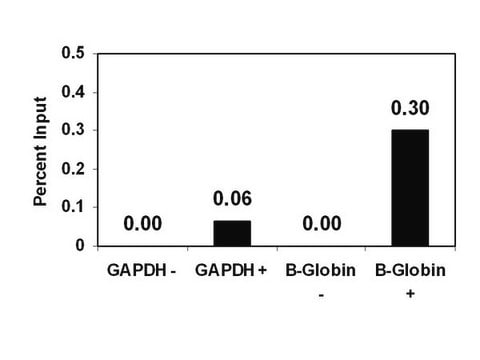
Beschalltes Chromatin aus HeLa-Zellen (1 x 10⁶ Zelläquivalente je IP) wurde einer Chromatin-Immunpräzipitation mit entweder 2 µg normalem Maus-IgG oder Anti-Acetyl-Histon-H3(Lys27)-Antikörper und dem Magna ChIP G (Katalognr. 17-611) unterzogen. Die erfolgreiche Immunpräzipitation von mit Acetyl-Histon H3 (Lys27) assoziierten DNA-Fragmenten wurde durch qPCR mit β-Globin-Promotor-ChIP-Primern gegenüber RPL10-Promotor-Primern verifiziert (siehe Abbildungen). Die Daten werden als prozentuale Eingabe jeder IP-Probe relativ zur Chromatin-Eingabe für jedes Amplikon und jede ChIP-Probe wie angegeben dargestellt.
Bitte beziehen Sie sich für experimentelle Details auf das Protokoll für EZ-Magna G ChIP (Katalognr. 17-408) oder EZ-ChIP (Katalognr. 17-371).
Western-Blot-Analyse:
Säureextrakte aus unbehandelten (Bahn 1) und mit Natriumbutyrat behandelten (Bahn 2) HeLa-Zellen wurden durch Elektrophorese aufgelöst, auf eine PVDF-Membran übertragen und mit Anti-Acetyl-Histon H3 (Lys27), Klon CMA309 (0,1 μg/ml) untersucht. Die Proteine wurden mit einem an HRP konjugierten
Anti-Maus-Sekundärantikörper der Ziege und einem Chemilumineszenz-Nachweissystem visualisiert (siehe Abbildungen).
Chromatin-Biologie
Epigenetik & Zellkernfunktion
Biochem/physiol Actions
Packaging
Physical form
Normales Maus-IgG. Zwei Fläschchen mit 25 μg aufgereinigtem Maus-IgG in 25 μl Lagerpuffer mit 0,1 % Natriumazid. Bei -20 °C aufbewahren.
ChIP-Primer, RPL10-Promotor. Ein Fläschchen mit 75 μl von 5 μmol/l jedes Primers, spezifisch für die Promotor-Region von humanem RPL10. Bei -20 °C aufbewahren.
FÜR: ACC CGT CTT CGA CAG GAC T
REV: GGA ACG GAA GAC GAG AAC AG
Preparation Note
Analysis Note
Beschalltes Chromatin aus HeLa-Zellen (1 x 10⁶ Zelläquivalente je IP) wurde einer Chromatin-Immunpräzipitation mit entweder 2 µg normalem Maus-IgG oder Anti-Acetyl-Histon-H3(Lys27)-Antikörper und dem Magna ChIP G (Katalognr. 17-611) unterzogen.
Die erfolgreiche Immunpräzipitation von mit Acetyl-Histon H3 (Lys27) assoziierten DNA-Fragmenten wurde durch qPCR mit ChIP-Primern für den RPL10-Promotor verifiziert (siehe Abbildungen).
Bitte beziehen Sie sich für experimentelle Details auf das Protokoll für EZ-Magna G ChIP (Katalognr. 17-409) oder EZ-ChIP (Katalognr. 17-371).
Einschließlich Maus-IgG-Antikörper als Negativkontrolle und für den humanen RPL10-Promotor spezifische Kontrollprimer.
Legal Information
Disclaimer
1 of 1
Dieser Artikel | |||
|---|---|---|---|
| antibody form purified immunoglobulin | antibody form serum | antibody form serum | antibody form serum |
| species reactivity vertebrates, human | species reactivity mouse, bovine, Saccharomyces cerevisiae, human | species reactivity Saccharomyces cerevisiae, yeast, human | species reactivity human, mouse |
| biological source mouse | biological source rabbit | biological source rabbit | biological source rabbit |
| clone CMA309, monoclonal | clone polyclonal | clone polyclonal | clone polyclonal |
| technique(s) ChIP: suitable, western blot: suitable, immunoprecipitation (IP): suitable | technique(s) ChIP: suitable, western blot: suitable | technique(s) ChIP: suitable (ChIP-seq), dot blot: suitable, western blot: suitable | technique(s) ChIP: suitable, electrophoretic mobility shift assay: suitable, flow cytometry: suitable, immunofluorescence: suitable, immunohistochemistry (formalin-fixed, paraffin-embedded sections): suitable, immunoprecipitation (IP): suitable, western blot: suitable |
| shipped in dry ice | shipped in dry ice | shipped in dry ice | shipped in dry ice |

Lagerklasse
10 - Combustible liquids
wgk
WGK 2
Analysenzertifikate (COA)
Suchen Sie nach Analysenzertifikate (COA), indem Sie die Lot-/Chargennummer des Produkts eingeben. Lot- und Chargennummern sind auf dem Produktetikett hinter den Wörtern ‘Lot’ oder ‘Batch’ (Lot oder Charge) zu finden.
Besitzen Sie dieses Produkt bereits?
In der Dokumentenbibliothek finden Sie die Dokumentation zu den Produkten, die Sie kürzlich erworben haben.
Verwandter Inhalt
Epigenetics describes heritable changes in gene expression caused by non-genetic mechanisms. Epigenetic regulation allows a cell to vary its response based on its biological and environmental contexts. Epigenetic changes can effect transcriptional and post-transcriptional regulation via mechanisms such as histone modification, chromatin and nucleosome remodeling, DNA methylation, and small and non-coding RNA-mediated regulation. These mechanisms, in cooperation with transcription factors and other nucleic acid-binding proteins, regulate gene expression. Epigenetic mechanisms of gene regulation impacts diverse areas of research—from agriculture to human health. Common epigenetic assays such as chromatin immunoprecipitation (ChIP) and RNA immunoprecipitation (RIP) rely on high quality antibodies that recognize specific epigenetic modifications for accurate results. EMD Millipore offers over 100 ChIPAb+™ and RIPAb+™ validated antibody kits that are quality tested on ChIP/RIP assays and are conveniently provided with control qPCR primers and negative control antibodies to ensure first time ChIP/RIP success.
"Epigenetics describes heritable changes in gene expression caused by non-genetic mechanisms instead of by alterations in DNA sequence. These changes can be cell- or tissue-specific, and can be passed on to multiple generations. Epigenetic regulation enriches DNAbased information, allowing a cell to vary its response across diverse biological and environmental contexts. Although epigenetic mechanisms are primarily centered in the nucleus, these mechanisms can be induced by environmental signals such as hormones, nutrients, stress, and cellular damage, pointing to the involvement of cytoplasmic and extracellular factors in epigenetic regulation."
Global Trade Item Number
| SKU | GTIN |
|---|---|
| 17-683 | 04053252368974 |