Direkt zum Inhalt
Merck

Fortfahren mit

07-724

Anti-α-Insulin Receptor Antibody, β subunit

Upstate®, from rabbit

Synonym(e):

CD220 antigen, insulin receptor

Anmelden zur Ansicht der Organisations- und Vertragspreise.

Größe auswählen

Ansicht ändern
PackungsgrößeSKUVerfügbarkeitPreis
100 μL
Warenkorb auf Verfügbarkeit prüfen
€ 481,00

Über diesen Artikel

UNSPSC Code:
12352203
NACRES:
NA.41
eCl@ss:
32160702
Conjugate:
unconjugated
Clone:
polyclonal
Application:
IP, WB
Citations:
33

€ 481,00


Warenkorb auf Verfügbarkeit prüfen
Für Ihr Target ist ein rekombinanter, konservierungsmittelfreier Antikörper verfügbar. Probieren Sie ZRB1570

Großbestellung anfragen
Technischer Dienst
Benötigen Sie Hilfe? Unser Team von erfahrenen Wissenschaftlern ist für Sie da.
Unterstützung erhalten


biological source

rabbit

Quality Level

conjugate

unconjugated

antibody form

affinity isolated antibody

antibody product type

primary antibodies

clone

polyclonal

purified by

affinity chromatography

species reactivity

mouse, human, rat

species reactivity (predicted by homology)

chimpanzee

manufacturer/tradename

Upstate®

technique(s)

immunoprecipitation (IP): suitable, western blot: suitable

NCBI accession no.

UniProt accession no.

shipped in

wet ice

target post-translational modification

unmodified

Gene Information

human ... INSR(3643)

General description

97 kDa
The insulin receptor is a tyrosine kinase receptor that when bound to insulin, initiates multiple signal transduction pathways, including JNK, PI 3-kinase, Akt and PKC. Pharmacological intervention of these Insulin R-dependent pathways is of great interest for the treatment of insulin resistance, obesity and diabetes. The Insulin Receptor (IR) is synthesized as a single polypeptide, which is subsequently cleaved to generate an extracellular α-chain and a transmembrane and intracellular β-chain, tethered together by disulfide bonds. The β-chain has multiple tyrosine phosphorylation sites, including three autophosphorylation sites at its activation loop. The overall structure of the IR is highly homologous to the IGF-I Receptor, except in their c-termini, where the two proteins diverge somewhat. The IR signals primarily by phosphorylating the Insulin Receptor Substrate (IRS) family of proteins, which creates docking sites for SH2-domain containing proteins. Insulin signaling is highly dependent on the PI3 Kinase pathway and Akt, which appear to mediate the functions of insulin.

Immunogen

Epitope: C-terminus
GST-fusion protein corresponding to the last 100 C-terminal amino acid residues of the human insulin receptor β chain

Application

Anti-α-Insulin Receptor Antibody, β subunit is an antibody against a-Insulin Receptor for use in IP & WB.
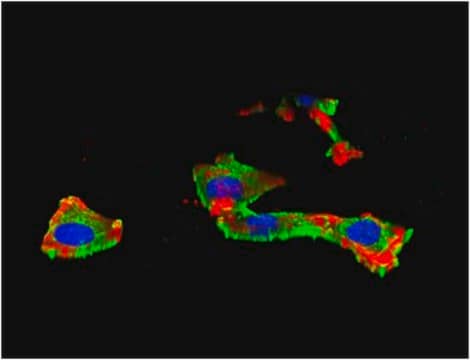
Immunoprecipitation Analysis:
Research Category
Signaling

Metabolism
Research Sub Category
Insulin/Energy Signaling

Biochem/physiol Actions

This antibody recognizes α-Insulin Receptor, β subunit.

Physical form

Affinity purified
Purified rabbit polyclonal serum in buffer containing 0.1 M Tris-glycine, pH 7.4, 150 mM NaCl and 0.05% sodium azide.

Preparation Note

Maintain refrigerated at 2-8°C for for 1 year from date of receipt.

Analysis Note

Control
Human brain tissue lysate
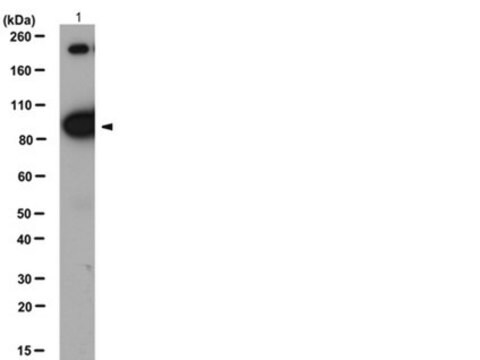
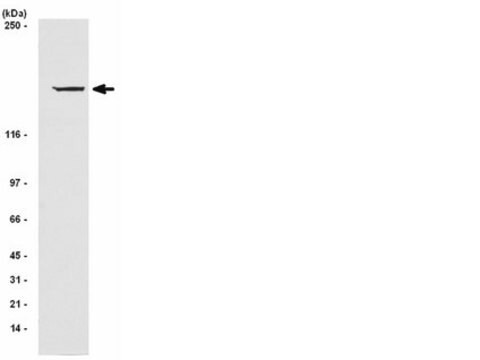
Evaluated by Western Blot in Human brain tissue lysate.
Western Blot Analysis: : 1:1,000 dilution of this antibody detected α-Insulin Receptor, β subunit in human brain tissue lysate.

Other Notes

Concentration: Please refer to the Certificate of Analysis for the lot-specific concentration.

Legal Information

UPSTATE is a registered trademark of Merck KGaA, Darmstadt, Germany

Disclaimer

Unless otherwise stated in our catalog or other company documentation accompanying the product(s), our products are intended for research use only and are not to be used for any other purpose, which includes but is not limited to, unauthorized commercial uses, in vitro diagnostic uses, ex vivo or in vivo therapeutic uses or any type of consumption or application to humans or animals.

Ähnliche Artikel vergleichen

Vollständigen Vergleich anzeigen

Unterschiede anzeigen

1 of 1

Dieser Artikel
06-429-IMABS6504-784
conjugate

unconjugated

conjugate

unconjugated

conjugate

unconjugated

conjugate

unconjugated

antibody form

affinity isolated antibody

antibody form

purified immunoglobulin

antibody form

purified antibody

antibody form

culture supernatant

species reactivity

mouse, human, rat

species reactivity

human

species reactivity

mouse, rat (demonstrated by independent lab), human

species reactivity

human, rat, mouse

biological source

rabbit

biological source

chicken

biological source

mouse

biological source

rabbit

clone

polyclonal

clone

polyclonal

clone

CT-3, monoclonal

clone

AW58, monoclonal

UniProt accession no.

P06213

UniProt accession no.

P08069

UniProt accession no.

P06213

UniProt accession no.

P35568


Still not finding the right product?

Probieren Sie unser Produkt-Auswahlhilfe, um Ihre Auswahl einzugrenzen


Lagerklasse

10 - Combustible liquids

wgk

WGK 1


Analysenzertifikate (COA)

Suchen Sie nach Analysenzertifikate (COA), indem Sie die Lot-/Chargennummer des Produkts eingeben. Lot- und Chargennummern sind auf dem Produktetikett hinter den Wörtern ‘Lot’ oder ‘Batch’ (Lot oder Charge) zu finden.

Besitzen Sie dieses Produkt bereits?

In der Dokumentenbibliothek finden Sie die Dokumentation zu den Produkten, die Sie kürzlich erworben haben.

Die Dokumentenbibliothek aufrufen


Makoto Takahashi et al.
Oncology reports, 37(5), 2929-2941 (2017-04-11)
We investigated the relationship among serum insulin level, insulin receptor (IR) expression in renal cell carcinoma (RCC), and outcomes in patients with RCC who underwent nephrectomy. We also explored the role of insulin signaling in RCC progression in a murine RCC
Thomas U Ahearn et al.
Carcinogenesis, 39(12), 1431-1437 (2018-08-31)
Circulating insulin-like growth factor-1 (IGF-1) is consistently associated with prostate cancer risk. IGF-1 binds to IGF-1 receptor (IGF1R) and insulin receptor (IR), activating cancer hallmark pathways. Experimental evidence suggests that TMPRSS2:ERG may interact with IGF/insulin signaling to influence progression. We
Insulin receptor and IRS-1 co-immunoprecipitation with SOCS-3, and IKK?/? phosphorylation are increased in obese Zucker rat skeletal muscle.
Zolotnik, IA; Figueroa, TY; Yaspelkis, BB
Life Sciences null


Global Trade Item Number

SKUGTIN
07-72404053252581694

Questions

Reviews

No rating value

Active Filters