Direkt zum Inhalt
Merck

Fortfahren mit

07-643

Anti-Scrib Antibody

Upstate®, from rabbit

Anmelden zur Ansicht der Organisations- und Vertragspreise.

Über diesen Artikel

UNSPSC Code:
12352203
NACRES:
NA.41
eCl@ss:
32160702
Conjugate:
unconjugated
Clone:
polyclonal
Application:
WB
Citations:
10


biological source

rabbit

Quality Level

conjugate

unconjugated

antibody form

purified immunoglobulin

antibody product type

primary antibodies

clone

polyclonal

species reactivity

human

manufacturer/tradename

Upstate®

technique(s)

western blot: suitable

isotype

IgG

NCBI accession no.

UniProt accession no.

shipped in

dry ice

target post-translational modification

unmodified

Gene Information

human ... UTY(7404)

General description

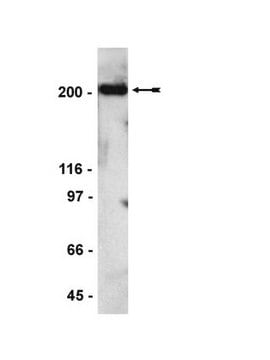
220kDa

Immunogen

fusion protein corresponding to residues 1595-1630 of human Scrib

Application

Detect Scrib using this Anti-Scrib Antibody validated for use in WB.
Research Category
Signaling
Research Sub Category
Growth Factors & Receptors

Biochem/physiol Actions

Scrib

Physical form

70% storage buffer (0.1M Tris-glycine, pH 7.4, 0.15M NaCl, 0.05% sodium azide) and 30% glycerol.
Format: Purified
Protein A purified

Preparation Note

2 years at -20°C

Analysis Note

routinely evaluated by immunoblot from HeLa cells

Legal Information

UPSTATE is a registered trademark of Merck KGaA, Darmstadt, Germany

Disclaimer

Unless otherwise stated in our catalog or other company documentation accompanying the product(s), our products are intended for research use only and are not to be used for any other purpose, which includes but is not limited to, unauthorized commercial uses, in vitro diagnostic uses, ex vivo or in vivo therapeutic uses or any type of consumption or application to humans or animals.

Ähnliche Artikel vergleichen

Vollständigen Vergleich anzeigen

Unterschiede anzeigen

1 of 1

Dieser Artikel
05-631HPA064312HPA023557
antibody form

purified immunoglobulin

antibody form

purified immunoglobulin

antibody form

affinity isolated antibody

antibody form

affinity isolated antibody

clone

polyclonal

clone

monoclonal

clone

polyclonal

clone

polyclonal

conjugate

unconjugated

conjugate

unconjugated

conjugate

unconjugated

conjugate

unconjugated

biological source

rabbit

biological source

mouse

biological source

rabbit

biological source

rabbit

species reactivity

human

species reactivity

mouse, human

species reactivity

human

species reactivity

human

shipped in

dry ice

shipped in

wet ice

shipped in

wet ice

shipped in

wet ice


Still not finding the right product?

Probieren Sie unser Produkt-Auswahlhilfe, um Ihre Auswahl einzugrenzen


Lagerklasse

10 - Combustible liquids

wgk

WGK 1


Analysenzertifikate (COA)

Suchen Sie nach Analysenzertifikate (COA), indem Sie die Lot-/Chargennummer des Produkts eingeben. Lot- und Chargennummern sind auf dem Produktetikett hinter den Wörtern ‘Lot’ oder ‘Batch’ (Lot oder Charge) zu finden.

Besitzen Sie dieses Produkt bereits?

In der Dokumentenbibliothek finden Sie die Dokumentation zu den Produkten, die Sie kürzlich erworben haben.

Die Dokumentenbibliothek aufrufen


S Nakagawa et al.
Molecular and cellular biology, 20(21), 8244-8253 (2000-10-12)
The high-risk human papillomavirus (HPV) E6 proteins stimulate the ubiquitination and degradation of p53, dependent on the E6AP ubiquitin-protein ligase. Other proteins have also been shown to be targeted for degradation by E6, including hDlg, the human homolog of the
Yiping Huang et al.
Cell cycle (Georgetown, Tex.), 7(11), 1613-1622 (2008-05-13)
Epithelial-to-mesenchymal transition (EMT) underlies cell plasticity and embryonic development and is frequently observed in advanced tumorigenesis. We demonstrated that midkine (MK), a retinoic acid-inducible heparin-binding mitogen, promotes EMT in immortalized HaCaT keratinocytes. We showed that MK binds to the Notch2
Victoria M Wu et al.
Current opinion in cell biology, 16(5), 493-499 (2004-09-15)
The size of epithelial tubes is critical for the function of organs such as the lung, kidney and vascular system. However, the molecular mechanisms regulating tube size are largely unknown. Recent work in the Drosophila tracheal system reveals that septate


Questions

Reviews

No rating value

Active Filters