Direkt zum Inhalt
Merck

Fortfahren mit

07-416

Anti-Akt1/PKBα Antibody

Upstate®, from rabbit

Synonym(e):

Protein kinase B, RAC-alpha serine/threonine-protein kinase, murine thymoma viral (v-akt) oncogene homolog-1, rac protein kinase alpha, v-akt murine thymoma viral oncogene homolog 1

Anmelden zur Ansicht der Organisations- und Vertragspreise.

Größe auswählen

Ansicht ändern
PackungsgrößeSKUVerfügbarkeitPreis

Über diesen Artikel

UNSPSC Code:
12352203
NACRES:
NA.41
eCl@ss:
32160702
Conjugate:
unconjugated
Clone:
polyclonal
Application:
IP, WB
Citations:
27
Preise und Verfügbarkeit sind derzeit nicht verfügbar.
Technischer Dienst
Benötigen Sie Hilfe? Unser Team von erfahrenen Wissenschaftlern ist für Sie da.
Unterstützung erhalten


biological source

rabbit

Quality Level

conjugate

unconjugated

antibody form

purified antibody

antibody product type

primary antibodies

clone

polyclonal

species reactivity

rat, human, mouse

packaging

antibody small pack of 25 μg

manufacturer/tradename

Upstate®

technique(s)

immunoprecipitation (IP): suitable, western blot: suitable

isotype

IgG

NCBI accession no.

UniProt accession no.

shipped in

ambient

target post-translational modification

unmodified

Gene Information

human ... AKT1(207)

General description

Akt is the major known effector of the PI3 Kinase pathway. Generation of PIP3 results in the activation of PDK1, which phosphorylates Akt on Thr308, and another kinase complex, thought to be the mTORC2 complex (or possibly an intermediate kinase linking the two) that phosphorylates Akt on Ser473. These phosphorylations additively activate Akt Ser/Thr kinase activity, and the use of phosphorylation state-specific antibodies directed against either of these sites can imply Akt activation. Activation of Akt can be measured directly by immunoprecipitation followed by phosphorylation of a known substrate with radiolabeled ATP. Akt has been shown to phosphorylate over 70 substrates including TSC1&2 in the mTOR pathway, Bad on Ser136, GSK3, which is inactivated by this phosphorylation, the FoxO family of transcription factors, PRAS40, AS160.
~60 kDa

Immunogen

15 residue synthetic peptide (C-RPHFPQFS YSASGTA) corresponding to the C-terminal (residues 466-480) of rat Akt1, with an N-terminal cysteine added for conjugation purposes. The Akt1 sequence is identical to mouse Akt1 (15/15 amino acids) and strongly conserved in bovine Akt1 (14/15 amino acids) and human Akt1 (13/15 amino acids). Human Akt2 shares 11/15 amino acids with the peptide immunogen sequence.
Epitope: C-terminus

Application

Immunoprecipitation Kinase Assay:
4 µg of a previous lot immunoprecipitated active Akt from 1 mg of HEK293 cells stimulated with IGF-1.
Research Category
Signaling
Research Sub Category
PI3K, Akt, & mTOR Signaling
This Anti-Akt1/PKBα Antibody is validated for use in IP, WB for the detection of Akt1/PKBα.

Biochem/physiol Actions

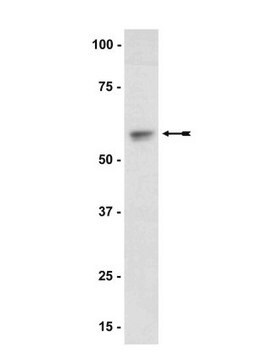
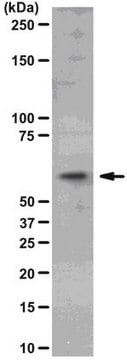
Recognizes Akt1/PKBα, MW ~60 kDa.

Physical form

Format: Purified
Protein A purified
Purified rabbit polyclonal in buffer containing 0.1 M Tris-glycine, pH 7.4, 0.15 M NaCl, 0.05% sodium azide before the addition of glycerol to 30%.

Preparation Note

Stable for 1 year at -20ºC from date of receipt.

Analysis Note

Control
Positive Antigen Control: Catalog #12-301, non-stimulated A431 cell lysate. Add 2.5µL of 2-mercaptoethanol/100µL of lysate and boil for 5 minutes to reduce the preparation. Load 20µg of reduced lysate per lane for minigels.
Evaluated by western blot in RIPA lysates from human A431 carcinoma cells.

Western Blot Analysis:
0.5-2 µg/mL of this antibody detected Akt in RIPA lysates from human A431 carcinoma cells.

Other Notes

Concentration: Please refer to the Certificate of Analysis for the lot-specific concentration.

Legal Information

UPSTATE is a registered trademark of Merck KGaA, Darmstadt, Germany

Disclaimer

Unless otherwise stated in our catalog or other company documentation accompanying the product(s), our products are intended for research use only and are not to be used for any other purpose, which includes but is not limited to, unauthorized commercial uses, in vitro diagnostic uses, ex vivo or in vivo therapeutic uses or any type of consumption or application to humans or animals.

Ähnliche Artikel vergleichen

Vollständigen Vergleich anzeigen

Unterschiede anzeigen

1 of 1

Dieser Artikel
04-77107-139805-802R
biological source

rabbit

biological source

rabbit

biological source

rabbit

biological source

rabbit

conjugate

unconjugated

conjugate

unconjugated

conjugate

-

conjugate

-

clone

polyclonal

clone

AW114, monoclonal

clone

polyclonal

clone

NL50, monoclonal

antibody form

purified antibody

antibody form

culture supernatant

antibody form

affinity isolated antibody

antibody form

purified antibody

species reactivity

rat, human, mouse

species reactivity

rat, human, mouse

species reactivity

mouse, canine

species reactivity

human, bovine, mouse, rabbit, chicken

technique(s)

immunoprecipitation (IP): suitable, western blot: suitable

technique(s)

immunoprecipitation (IP): suitable, western blot: suitable

technique(s)

immunohistochemistry: suitable (paraffin)

technique(s)

ELISA: suitable, immunocytochemistry: suitable, immunofluorescence: suitable, western blot: suitable


Still not finding the right product?

Probieren Sie unser Produkt-Auswahlhilfe, um Ihre Auswahl einzugrenzen


Lagerklasse

10 - Combustible liquids

wgk

WGK 1


Analysenzertifikate (COA)

Suchen Sie nach Analysenzertifikate (COA), indem Sie die Lot-/Chargennummer des Produkts eingeben. Lot- und Chargennummern sind auf dem Produktetikett hinter den Wörtern ‘Lot’ oder ‘Batch’ (Lot oder Charge) zu finden.

Besitzen Sie dieses Produkt bereits?

In der Dokumentenbibliothek finden Sie die Dokumentation zu den Produkten, die Sie kürzlich erworben haben.

Die Dokumentenbibliothek aufrufen


Artikel

Autophagy is a regulated process involved in cell growth, development, and recycling of cytoplasmic components in cells.


Angela M Whetzel et al.
Circulation research, 99(7), 731-739 (2006-09-09)
Monocyte recruitment and adhesion to vascular endothelium are key early events in atherosclerosis. We examined the role of sphingosine-1-phosphate (S1P) on modulating monocyte/endothelial interactions in the NOD/LtJ (NOD) mouse model of type 1 diabetes. Aortas from nondiabetic and diabetic NOD
Sumera Rizvi et al.
Oncotarget, 9(5), 5892-5905 (2018-02-22)
Deregulated Hippo pathway signaling is associated with aberrant activation of the downstream effector yes-associated protein (YAP), an emerging key oncogenic mediator in cholangiocarcinoma (CCA). In our prior work, we have demonstrated that biliary transduction of YAP along with Akt as
Laongdao Thongnak et al.
Toxicology and applied pharmacology, 396, 114997-114997 (2020-04-08)
High-fat high-fructose diet (HFF) in obesity can induce dyslipidemia and lipid accumulation both in kidney and liver which related to insulin resistance and lipotoxicity-induced cellular damage. We investigated whether dapagliflozin with or without atorvastatin could improve lipid accumulation-induced kidney and


Global Trade Item Number

SKUGTIN
07-416-25UG04054839337321

Questions

Reviews

No rating value

Active Filters