
05-659

Anti-Kaiso Antibody, clone 6F
clone 6F, Upstate®, from mouse
Größe auswählen
| Packungsgröße | SKU | Verfügbarkeit | Preis |
|---|---|---|---|
| 200 μg | Warenkorb auf Verfügbarkeit prüfen | € 438,00 |
Über diesen Artikel
Quality Level
biological source
mouse
conjugate
unconjugated
antibody form
purified antibody
antibody product type
primary antibodies
clone
6F, monoclonal
species reactivity
mouse, hamster, chicken, canine, rat, human, monkey
manufacturer/tradename
Upstate®
technique(s)
electrophoretic mobility shift assay: suitable, immunohistochemistry: suitable, immunoprecipitation (IP): suitable, western blot: suitable
isotype
IgG1
1 of 1
Dieser Artikel | |||
|---|---|---|---|
| clone 6F, monoclonal | clone 6F-H2, monoclonal | clone 6H2.1, monoclonal | clone 8E10.2, monoclonal |
| conjugate unconjugated | conjugate unconjugated | conjugate unconjugated | conjugate unconjugated |
| species reactivity mouse, hamster, chicken, canine, rat, human, monkey | species reactivity human | species reactivity rat, human, mouse | species reactivity mouse, human, rat |
| biological source mouse | biological source mouse | biological source mouse | biological source mouse |
| antibody form purified antibody | antibody form purified immunoglobulin | antibody form purified immunoglobulin | antibody form purified antibody |
| UniProt accession no. | UniProt accession no. | UniProt accession no. | UniProt accession no. |


General description
Immunogen
Application
Epigenetics & Nuclear Function
Transcription Factors
Biochem/physiol Actions
Physical form
Preparation Note
Analysis Note
Immunohistochemistry: As shown by an independent laboratory, 1μg/ml of this antibody gave positive nuclear immunostaining for Kaiso in NIH 3T3 cells fixed with 100% methanol (Daniel, 2001; Daniel, 1999).
Immunoprecipitation: As shown by an independent laboratory, 2-5μg of this antibody immunoprecipitated Kaiso from RIPA lysates from NIH 3T3 cells (Daniel, 1999; Prokhortchouk, 2001).
Supershift: As shown by an independent laboratory, this antibody will supershift a specific methyl-CpG complex (Prokhortchouk, 2001).
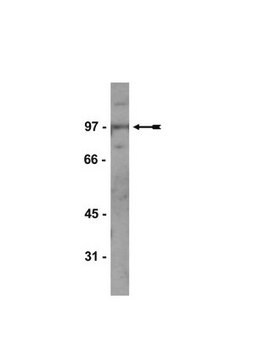
Positive Antigen Control: Catalog #12-305, 3T3/A31 lysate. Add 2.5 μL of 2-mercapto-ethanol/100 μL of lysate and boil for 5 minutes to reduce the preparation. Load 20 μg of reduced lysate per lane for minigels.
Legal Information
Disclaimer
Sie haben nicht das passende Produkt gefunden?
Probieren Sie unser Produkt-Auswahlhilfe. aus.
Lagerklasse
10 - Combustible liquids
wgk
WGK 1
Analysenzertifikate (COA)
Suchen Sie nach Analysenzertifikate (COA), indem Sie die Lot-/Chargennummer des Produkts eingeben. Lot- und Chargennummern sind auf dem Produktetikett hinter den Wörtern ‘Lot’ oder ‘Batch’ (Lot oder Charge) zu finden.
Besitzen Sie dieses Produkt bereits?
In der Dokumentenbibliothek finden Sie die Dokumentation zu den Produkten, die Sie kürzlich erworben haben.
Verwandter Inhalt
"Epigenetics describes heritable changes in gene expression caused by non-genetic mechanisms instead of by alterations in DNA sequence. These changes can be cell- or tissue-specific, and can be passed on to multiple generations. Epigenetic regulation enriches DNAbased information, allowing a cell to vary its response across diverse biological and environmental contexts. Although epigenetic mechanisms are primarily centered in the nucleus, these mechanisms can be induced by environmental signals such as hormones, nutrients, stress, and cellular damage, pointing to the involvement of cytoplasmic and extracellular factors in epigenetic regulation."
Global Trade Item Number
| SKU | GTIN |
|---|---|
| 05-659 | 04053252274398 |
Active Filters
Unser Team von Wissenschaftlern verfügt über Erfahrung in allen Forschungsbereichen einschließlich Life Science, Materialwissenschaften, chemischer Synthese, Chromatographie, Analytik und vielen mehr..
Setzen Sie sich mit dem technischen Dienst in Verbindung