Direkt zum Inhalt
Merck

Fortfahren mit

05-1076

Anti-c-Jun Antibody, clone 6E4.4

clone 6E4.4, from mouse

Synonym(e):

JNK1 alpha protein kinase, JNK1 beta protein kinase, JUN N-terminal kinase, Stress-activated protein kinase JNK1, c-Jun N-terminal kinase 1, mitogen-activated protein kinase 8, mitogen-activated protein kinase 8 isoform JNK1 alpha1, mitogen-activated pro

Anmelden zur Ansicht der Organisations- und Vertragspreise.

Größe auswählen

Ansicht ändern
PackungsgrößeSKUVerfügbarkeitPreis

Über diesen Artikel

UNSPSC Code:
12352203
NACRES:
NA.41
eCl@ss:
32160702
Conjugate:
unconjugated
Clone:
6E4.4, monoclonal
Application:
ICC, WB
Citations:
4
Preise und Verfügbarkeit sind derzeit nicht verfügbar.
Technischer Dienst
Benötigen Sie Hilfe? Unser Team von erfahrenen Wissenschaftlern ist für Sie da.
Unterstützung erhalten


biological source

mouse

Quality Level

conjugate

unconjugated

antibody form

purified immunoglobulin

antibody product type

primary antibodies

clone

6E4.4, monoclonal

species reactivity

mouse, human, rat

packaging

antibody small pack of 25 μg

technique(s)

immunocytochemistry: suitable, western blot: suitable

isotype

IgG1κ

NCBI accession no.

UniProt accession no.

shipped in

ambient

target post-translational modification

unmodified

Gene Information

human ... JUN(3725)
mouse ... Jun(16476)
rat ... Jun(24516)

General description

c-Jun is a component of the transcription factor AP-1 that binds and activates transcription at TRE/AP-1 elements and appears to be a major downstream target of the SAPK/JNK signaling pathway. The transcriptional activity of c-Jun is regulated by phosphorylation at Ser63 and Ser73. Extracellular signals including growth factors, transforming oncoproteins and UV irradiation stimulate phosphorylation of c-Jun at Ser63/73 and activate c-Jun dependent transcription. Mutation of Ser63/73 renders c-Jun nonresponsive to mitogenic and stress induced signaling pathways. The MAP kinase homologue, SAPK/JNK, binds to the N-terminal region of c-Jun and phosphorylates c-Jun at Ser63/73. In addition, the activity of SAPK/JNK is stimulated by the same signals that activate c-Jun.
~36-43 kDa
Multiple bands may be visible, indicating various phosphorylation states.

Immunogen

GST-tagged recombinant protein corresponding to c-Jun.

Application

Anti-c-Jun Antibody, clone 6E4.4 is a Mouse Monoclonal Antibody for detection of c-Jun also known as JNK1 alpha protein kinase, JNK1 beta protein kinase & has been validated in WB, ICC.
Research Category
Epigenetics & Nuclear Function
Research Sub Category
Transcription Factors
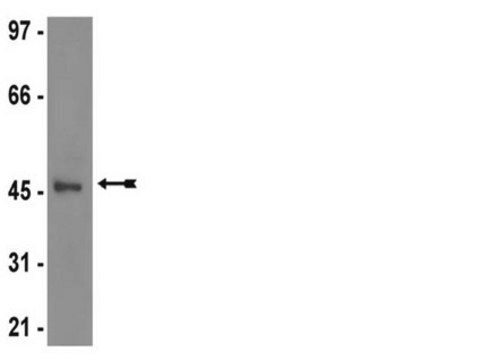
Western Blot Analysis (SNAP ID Technique): 5 µg/mL of this antibody detected c-Jun on 15 µg of NIH/3T3 cell lysate using the SNAP ID Tecnique).

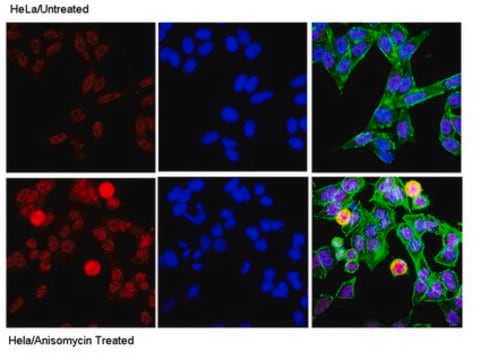
Immunocytochemistry Analysis: Confocal fluorescent analysis of HeLa, C2C12, and A431 cells using anti-c-Jun, clone 6E4.4 mouse monoclonal antibody (see page 2).

Biochem/physiol Actions

This antibody detects c-Jun, regardless of phosphorylation state.

Physical form

Format: Purified
Protein G Purified
Purified mouse monoclonal IgG1κ in buffer containing 0.1 M Tris-Glycine (pH7.4), 150 mM NaCl with 0.05% sodium azide.

Preparation Note

Stable at 2-8°C for 1 year from date of receipt.

Analysis Note

Control
NIH/3T3 cell lysate
Evaluated by Western Blot in NIH/3T3 cell lysate.

Western Blot Analysis: 0.5-2 µg/mL of this antibody detected c-Jun on 15 µg of NIH/3T3 cell lysate.

Other Notes

Concentration: Please refer to the Certificate of Analysis for the lot-specific concentration.
Replaces: 04-210

Disclaimer

Unless otherwise stated in our catalog or other company documentation accompanying the product(s), our products are intended for research use only and are not to be used for any other purpose, which includes but is not limited to, unauthorized commercial uses, in vitro diagnostic uses, ex vivo or in vivo therapeutic uses or any type of consumption or application to humans or animals.

Ähnliche Artikel vergleichen

Vollständigen Vergleich anzeigen

Unterschiede anzeigen

1 of 1

Dieser Artikel
06-65907-17504-893
antibody form

purified immunoglobulin

antibody form

affinity isolated antibody

antibody form

affinity isolated antibody

antibody form

culture supernatant

conjugate

unconjugated

conjugate

-

conjugate

-

conjugate

unconjugated

biological source

mouse

biological source

rabbit

biological source

rabbit

biological source

rabbit

clone

6E4.4, monoclonal

clone

polyclonal

clone

polyclonal

clone

C05T, monoclonal

species reactivity

mouse, human, rat

species reactivity

mouse, human

species reactivity

human, mouse, horse

species reactivity

rat, human

UniProt accession no.

P45983

UniProt accession no.

P05412

UniProt accession no.

P45983

UniProt accession no.

P49187


Still not finding the right product?

Probieren Sie unser Produkt-Auswahlhilfe, um Ihre Auswahl einzugrenzen


Lagerklasse

12 - Non Combustible Liquids

wgk

WGK 1

flash_point_f

Not applicable

flash_point_c

Not applicable


Analysenzertifikate (COA)

Suchen Sie nach Analysenzertifikate (COA), indem Sie die Lot-/Chargennummer des Produkts eingeben. Lot- und Chargennummern sind auf dem Produktetikett hinter den Wörtern ‘Lot’ oder ‘Batch’ (Lot oder Charge) zu finden.

Besitzen Sie dieses Produkt bereits?

In der Dokumentenbibliothek finden Sie die Dokumentation zu den Produkten, die Sie kürzlich erworben haben.

Die Dokumentenbibliothek aufrufen


Verwandter Inhalt

Protein Blotting Survival Handbook: Tips and Tricks


Subhadeep Chakrabarti et al.
Journal of vascular research, 50(1), 21-34 (2012-10-26)
The sex hormone estradiol (E(2)) appears to mediate both anti-atherogenic and pro-inflammatory effects in premenopausal women, suggesting a complex immunomodulatory role. Tumor necrosis factor (TNF) is a key pro-inflammatory cytokine involved in the pathogenesis of atherosclerosis and other inflammatory diseases.
Subhadeep Chakrabarti et al.
PloS one, 7(12), e52357-e52357 (2013-01-04)
Estrogen, the female sex hormone, is known to exert anti-inflammatory and anti-atherogenic effects. Traditionally, estrogen effects were believed to be largely mediated through the classical estrogen receptors (ERs). However, there is increasing evidence that G-protein coupled receptor 30 (GPR30), a
Subhadeep Chakrabarti et al.
PloS one, 10(2), e0117492-e0117492 (2015-02-26)
Milk derived tripeptides IPP (Ile-Pro-Pro) and VPP (Val-Pro-Pro) have shown promise as anti-hypertensive agents due to their inhibitory effects on angiotensin converting enzyme (ACE). Due to the key inter-related roles of hypertension, chronic inflammation and insulin resistance in the pathogenesis


Global Trade Item Number

SKUGTIN
05-1076-25UG04054839342356

Questions

Reviews

No rating value

Active Filters