Direkt zum Inhalt
Merck

Fortfahren mit

V9764

Anti-VPS34 antibody produced in rabbit

~1.0 mg/mL, affinity isolated antibody, buffered aqueous solution

Synonym(e):

Vps34 Antibody, Vps34 Antibody - Anti-VPS34 antibody produced in rabbit, Anti-PIK3C3, Anti-Phosphoinositide-3-kinase, Anti-Vacuolar protein sorting 34

Anmelden zur Ansicht der Organisations- und Vertragspreise.

Über diesen Artikel

NACRES:
NA.41
UNSPSC Code:
12352203
Conjugate:
unconjugated
Clone:
polyclonal
Application:
IF, WB
Citations:
18


biological source

rabbit

conjugate

unconjugated

antibody form

affinity isolated antibody

antibody product type

primary antibodies

clone

polyclonal

form

buffered aqueous solution

mol wt

antigen ~105 kDa

species reactivity

mouse, rat, human

concentration

~1.0 mg/mL

technique(s)

indirect immunofluorescence: suitable, western blot: 2-4 μg/mL using whole extracts of HEK-293T cells expressing human VPS34

UniProt accession no.

shipped in

dry ice

storage temp.

−20°C

target post-translational modification

unmodified

Gene Information

human ... PIK3C3(5289)
mouse ... Pik3c3(225326)
rat ... Pik3c3(65052)

General description

VPS34 is known to be involved in endocytosis and vesiculartrafficking.
Vacuolar protein sorting 34 (VPS34), also known as phosphatidylinositol 3-kinase catalytic subunit type 3 (PIK3C3), is encoded by the gene mapped to human chromosome 18q12.3. The encoded protein belongs to the phosphoinositide (PI)-3-kinase family. VPS34 is widely expressed in all tissues of mammals.

Immunogen

synthetic peptide corresponding to amino acids 22-34 of human VPS34, conjugated to KLH via an added cysteine residue. The corresponding sequence is identical in mouse and rat.

Application

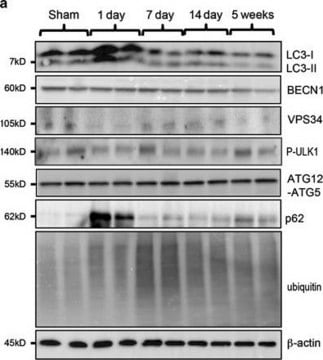
Anti-VPS34 antibody produced in rabbit has been used in immunoblotting.[1]

Biochem/physiol Actions

Vacuolar protein sorting 34 (VPS34) is a lipid kinase that phosphorylate phosphatidylinositol (PtdIns), to form phosphatidylinositol 3 phosphate (PtdIns3P). VPS34 plays a vital role in various intracellular trafficking events such as autophagy and phagosome formation. Thus, the inhibition of kinase activity of Vps34 might be considered as a potential therapeutic method for cancer treatment. VPS34 is also involved in internal vesicle formation within multivesicular endosomes, reverse transport of endosome to Golgi apparatus and membrane transport from the outer nuclear membrane towards the cell periphery. Mutation in the gene encoding VPS34 is associated with pathogenesis of schizophrenia. VPS34 plays an essential role in nutrient/amino acid induced activation of mechanistic target of rapamycin (mTOR) signaling in cultured cells and it also facilitates early embryogenesis and cell proliferation.

Physical form

Solution in 0.01 M phosphate buffered saline, pH 7.4, containing 15 mM sodium azide.

Disclaimer

Unless otherwise stated in our catalog or other company documentation accompanying the product(s), our products are intended for research use only and are not to be used for any other purpose, which includes but is not limited to, unauthorized commercial uses, in vitro diagnostic uses, ex vivo or in vivo therapeutic uses or any type of consumption or application to humans or animals.

Ähnliche Artikel vergleichen

Vollständigen Vergleich anzeigen

Unterschiede anzeigen

1 of 1

Dieser Artikel
SAB4200023SAB1305578SAB4200100
antibody form

affinity isolated antibody

antibody form

affinity isolated antibody

antibody form

affinity isolated antibody

antibody form

affinity isolated antibody

conjugate

unconjugated

conjugate

unconjugated

conjugate

-

conjugate

unconjugated

biological source

rabbit

biological source

rabbit

biological source

rabbit

biological source

rabbit

species reactivity

mouse, rat, human

species reactivity

human, mouse

species reactivity

human

species reactivity

human, rat, mouse

technique(s)

indirect immunofluorescence: suitable, western blot: 2-4 μg/mL using whole extracts of HEK-293T cells expressing human VPS34

technique(s)

immunoprecipitation (IP): 10-20 μg using lysate of mouse 3T3 cells, western blot: 2-4 μg/mL using whole extracts of G361 cells

technique(s)

-

technique(s)

western blot: 1-2 μg/mL using whole extracts of human HeLa cells and 0.5-1 μg/mL using whole extracts of mouse 3T3 or rat PC12 cells.

clone

polyclonal

clone

polyclonal

clone

polyclonal

clone

polyclonal


Still not finding the right product?

Probieren Sie unser Produkt-Auswahlhilfe, um Ihre Auswahl einzugrenzen


Lagerklasse

10 - Combustible liquids

wgk

WGK 2

flash_point_f

Not applicable

flash_point_c

Not applicable

ppe

Eyeshields, Gloves, multi-purpose combination respirator cartridge (US)


Hier finden Sie alle aktuellen Versionen:

Analysenzertifikate (COA)

Lot/Batch Number

Die passende Version wird nicht angezeigt?

Wenn Sie eine bestimmte Version benötigen, können Sie anhand der Lot- oder Chargennummer nach einem spezifischen Zertifikat suchen.

Besitzen Sie dieses Produkt bereits?

In der Dokumentenbibliothek finden Sie die Dokumentation zu den Produkten, die Sie kürzlich erworben haben.

Die Dokumentenbibliothek aufrufen


Verwandter Inhalt

Instructions


Elma Aflaki et al.
Aging cell, 15(1), 77-88 (2015-10-22)
Gaucher disease, the inherited deficiency of lysosomal glucocerebrosidase, is characterized by the presence of glucosylcer-amide macrophages, the accumulation of glucosylceramide in lysosomes and the secretion of inflammatory cytokines. However, the connection between this lysosomal storage and inflammation is not clear.
Lorenz Roggo et al.
The EMBO journal, 21(7), 1673-1683 (2002-04-03)
Here we present a detailed genetic analysis of let-512/vps34 that encodes the Caenorhabditis elegans homologue of the yeast phosphatidylinositol 3-kinase Vps34p. LET-512/VPS34 has essential functions and is ubiquitously expressed in all tissues and developmental stages. It accumulates at a perinuclear
Benoit Pasquier et al.
Journal of medicinal chemistry, 58(1), 376-400 (2014-11-18)
Vps34 (the human class III phosphoinositide 3-kinase) is a lipid kinase involved in vesicle trafficking and autophagy and therefore constitutes an interesting target for cancer treatment. Because of the lack of specific Vps34 kinase inhibitors, we aimed to identify such


Global Trade Item Number

SKUGTIN
V9764-200UL04061837481604

Questions

Reviews

No rating value

Active Filters