Direkt zum Inhalt
Merck

SAB1404792

Monoclonal Anti-RBM6, (C-terminal) antibody produced in mouse

clone 4B3, purified immunoglobulin, buffered aqueous solution

Synonym(e):

3G2, DEF-3, DEF3, DKFZp686B0877, FLJ36517, HLC-11, NY-LU-12, g16

Anmelden zur Ansicht der Organisations- und Vertragspreise.

Über diesen Artikel

NACRES:
NA.41
UNSPSC Code:
12352203
Conjugate:
unconjugated
Clone:
4B3, monoclonal
Application:
ELISA (c), ELISA (i), WB
Citations:
3

Fortfahren mit

Technischer Dienst
Benötigen Sie Hilfe? Unser Team von erfahrenen Wissenschaftlern ist für Sie da.
Unterstützung erhalten

biological source

mouse

conjugate

unconjugated

antibody form

purified immunoglobulin

antibody product type

primary antibodies

clone

4B3, monoclonal

form

buffered aqueous solution

mol wt

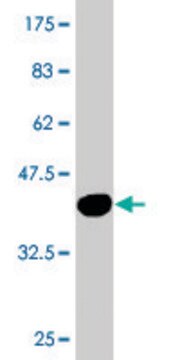
antigen ~37.11 kDa

species reactivity

human

technique(s)

capture ELISA: suitable, indirect ELISA: suitable, western blot: 1-5 μg/mL

isotype

IgG2aκ

NCBI accession no.

UniProt accession no.

shipped in

dry ice

storage temp.

−20°C

target post-translational modification

unmodified

Gene Information

human ... RBM6(10180)

Suchen Sie nach ähnlichen Produkten? Aufrufen Leitfaden zum Produktvergleich

Ähnliche Artikel vergleichen

Vollständigen Vergleich anzeigen

Unterschiede anzeigen

1 of 4

Dieser Artikel
SAB1402504SAB1400377SAB1403202
Gene Information

human ... RBM6(10180)

Gene Information

human ... RBM6(10180)

Gene Information

human ... RBM6(10180)

Gene Information

human ... RBMS3(27303)

clone

4B3, monoclonal

clone

3E9, monoclonal

clone

polyclonal

clone

3B11, monoclonal

conjugate

unconjugated

conjugate

unconjugated

conjugate

unconjugated

conjugate

unconjugated

antibody form

purified immunoglobulin

antibody form

purified immunoglobulin

antibody form

IgG fraction of antiserum

antibody form

purified immunoglobulin

biological source

mouse

biological source

mouse

biological source

mouse

biological source

mouse

species reactivity

human

species reactivity

human

species reactivity

human

species reactivity

human

General description

Mouse monoclonal antibody raised against a partial recombinant RBM6. RNA binding motif protein 6 (RBM6) is expressed in peripheral blood leukocytes, thymus and lymph nodes. The gene encoding it is localized on human chromosome 3p21.3 and has 21 exons.

Immunogen

RBM6 (NP_005768.1, 1024 a.a. ~ 1123 a.a) partial recombinant protein with GST tag. MW of the GST tag alone is 26 KDa.

Sequence
DSPERKRIKYSRETDSDRKLVDKEDIDTSSKGGCVQQATGWRKGTGLGYGHPGLASSEEAEGRMRGPSVGASGRTSKRQSNETYRDAVRRVMFARYKELD

Biochem/physiol Actions

RNA binding motif protein 6 (RBM6) associates with RNA. It has been linked to lung cancers.

Physical form

Solution in phosphate buffered saline, pH 7.4

Sie haben nicht das passende Produkt gefunden?  

Probieren Sie unser Produkt-Auswahlhilfe. aus.

Lagerklasse

10 - Combustible liquids

wgk

WGK 1

flash_point_f

Not applicable

flash_point_c

Not applicable


Hier finden Sie alle aktuellen Versionen:

Analysenzertifikate (COA)

Lot/Batch Number

Die passende Version wird nicht angezeigt?

Wenn Sie eine bestimmte Version benötigen, können Sie anhand der Lot- oder Chargennummer nach einem spezifischen Zertifikat suchen.

Besitzen Sie dieses Produkt bereits?

In der Dokumentenbibliothek finden Sie die Dokumentation zu den Produkten, die Sie kürzlich erworben haben.

Die Dokumentenbibliothek aufrufen

Elias G Bechara et al.
Molecular cell, 52(5), 720-733 (2013-12-18)
RBM5, a regulator of alternative splicing of apoptotic genes, and its highly homologous RBM6 and RBM10 are RNA-binding proteins frequently deleted or mutated in lung cancer. We report that RBM5/6 and RBM10 antagonistically regulate the proliferative capacity of cancer cells
Ting-lei Gu et al.
Blood, 110(1), 323-333 (2007-03-16)
Activated tyrosine kinases have been frequently implicated in the pathogenesis of cancer, including acute myeloid leukemia (AML), and are validated targets for therapeutic intervention with small-molecule kinase inhibitors. To identify novel activated tyrosine kinases in AML, we used a discovery
Ke Wang et al.
BMC genomics, 8, 348-348 (2007-10-03)
Transcription-induced chimerism, a mechanism involving the transcription and intergenic splicing of two consecutive genes, has recently been estimated to account for approximately 5% of the human transcriptome. Despite this prevalence, the regulation and function of these fused transcripts remains largely

Questions

Reviews

No rating value

Active Filters

Unser Team von Wissenschaftlern verfügt über Erfahrung in allen Forschungsbereichen einschließlich Life Science, Materialwissenschaften, chemischer Synthese, Chromatographie, Analytik und vielen mehr..

Setzen Sie sich mit dem technischen Dienst in Verbindung