Direkt zum Inhalt
Merck

Fortfahren mit

P1999

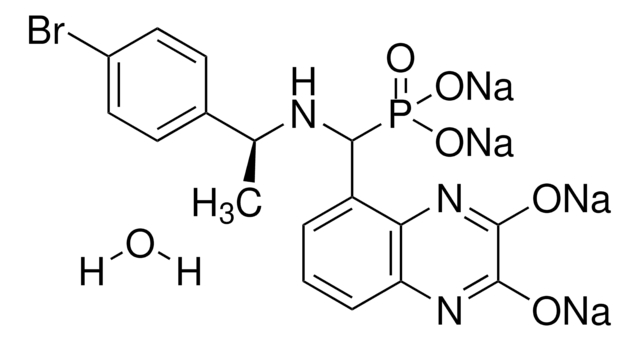
PEAQX tetrasodium hydrate

≥98% (HPLC)

Synonym(e):

NVP-AAM077 tetrasodium hydrate, [[[(1S)-1-(4-Bromophenyl)ethyl]amino](1,2,3,4-tetrahydro-2,3-dioxo-5-quinoxalinyl)methyl] phosphonic acid tetrasodium hydrate

Anmelden zur Ansicht der Organisations- und Vertragspreise.

Größe auswählen

Ansicht ändern
PackungsgrößeSKUVerfügbarkeitPreis
5 mg
Warenkorb auf Verfügbarkeit prüfen
€ 209,00
€ 177,65
25 mg
Warenkorb auf Verfügbarkeit prüfen
€ 644,00

Über diesen Artikel

Empirische Formel (Hill-System):
C17H13BrN3Na4O5P · xH2O
CAS-Nummer:
Molekulargewicht:
542.14 (anhydrous basis)
UNSPSC Code:
12352200
PubChem Substance ID:
NACRES:
NA.77
Assay:
≥98% (HPLC)
Form:
powder
Quality level:
Storage condition:
desiccated

€ 177,65

Listenpreis€ 209,00Sparen Sie 15%
Aktion nur im Web

Warenkorb auf Verfügbarkeit prüfen

Großbestellung anfragen
Technischer Dienst
Benötigen Sie Hilfe? Unser Team von erfahrenen Wissenschaftlern ist für Sie da.
Unterstützung erhalten


Quality Level

assay

≥98% (HPLC)

form

powder

storage condition

desiccated

color

white to beige

solubility

water: 10 mg/mL

storage temp.

−20°C

SMILES string

[Na+].[Na+].[Na+].[Na+].[H]O[H].C[C@H](NC(c1cccc2nc([O-])c([O-])nc12)P([O-])([O-])=O)c3ccc(Br)cc3

InChI

1S/C17H17BrN3O5P.4Na.H2O/c1-9(10-5-7-11(18)8-6-10)19-17(27(24,25)26)12-3-2-4-13-14(12)21-16(23)15(22)20-13;;;;;/h2-9,17,19H,1H3,(H,20,22)(H,21,23)(H2,24,25,26);;;;;1H2/q;4*+1;/p-4/t9-,17?;;;;;/m0...../s1

InChI key

SMGAGBKXHAHCGQ-VSYRWHDMSA-J

Application

PEAQX tetrasodium hydrate has been used N-methyl-D-aspartate (NMDA) receptor 2A (NR2A) antagonist in rats[1][2] and mice.[3]

Biochem/physiol Actions

NMDA receptor antagonist.
PEAQX is more specific for N-methyl-D-aspartate (NMDA) receptor 2A (NR2A) than N-methyl-D-aspartate (NMDA) receptor 2B (NR2B) and induces striatal apoptosis. It is less potent in activating caspase-3 than its stereomer NVP-AAM007.[4]

Features and Benefits

This compound is a featured product for Neuroscience research. Click here to discover more featured Neuroscience products. Learn more about bioactive small molecules for other areas of research at sigma.com/discover-bsm.
This compound is featured on the Glutamate Receptors (Ion Channel Family) page of the Handbook of Receptor Classification and Signal Transduction. To browse other handbook pages, click here.

Ähnliche Artikel vergleichen

Vollständigen Vergleich anzeigen

Unterschiede anzeigen

1 of 1

Dieser Artikel
N183A2979SML2774
assay

≥98% (HPLC)

assay

≥98% (HPLC)

assay

≥98% (HPLC)

assay

≥98% (HPLC)

form

powder

form

lyophilized powder

form

powder

form

powder

Quality Level

100

Quality Level

100

Quality Level

100

Quality Level

100

storage temp.

−20°C

storage temp.

2-8°C

storage temp.

-

storage temp.

−20°C

storage condition

desiccated

storage condition

desiccated

storage condition

-

storage condition

desiccated

solubility

water: 10 mg/mL

solubility

H2O: >10 mg/mL

solubility

H2O: 15 mg/mL, clear

solubility

H2O: 2 mg/mL, clear


pictograms

Exclamation mark

signalword

Warning

Hazard Classifications

Acute Tox. 4 Oral - Eye Irrit. 2 - Skin Irrit. 2 - STOT SE 3

target_organs

Respiratory system

Lagerklasse

11 - Combustible Solids

wgk

WGK 3

flash_point_f

Not applicable

flash_point_c

Not applicable

ppe

dust mask type N95 (US), Eyeshields, Gloves


Hier finden Sie alle aktuellen Versionen:

Analysenzertifikate (COA)

Lot/Batch Number

Die passende Version wird nicht angezeigt?

Wenn Sie eine bestimmte Version benötigen, können Sie anhand der Lot- oder Chargennummer nach einem spezifischen Zertifikat suchen.

Besitzen Sie dieses Produkt bereits?

In der Dokumentenbibliothek finden Sie die Dokumentation zu den Produkten, die Sie kürzlich erworben haben.

Die Dokumentenbibliothek aufrufen


Artikel

We offers many products related to ion channel family glutamate receptors for your research needs.

DISCOVER Bioactive Small Molecules for Neuroscience


Yves P Auberson et al.
Bioorganic & medicinal chemistry letters, 12(7), 1099-1102 (2002-03-23)
NMDA antagonists derived from 5-phosphonomethyl-1,4-dihydroquinoxaline-2,3-dione (3a) are potent anticonvulsant agents, and display strong protective effects in the electroshock-induced convulsion assay in mice. Their preference for the human NMDAR 1A/2A over 1A/2B subunit composition was optimized, leading to (1RS,1'S)-PEAQX (9r), which
Melissa Morales et al.
Psychopharmacology, 231(8), 1797-1807 (2013-09-18)
NMDA antagonists consistently produce social inhibition in adult animals, although effects of these manipulations on social behavior of adolescents are relatively unknown. The aim of this study was to assess potential age differences in the socially inhibitory effects of the
N C Anastasio et al.
Neuroscience, 163(4), 1181-1191 (2009-08-06)
The mechanism underlying phencyclidine (PCP)-induced apoptosis in perinatal rats and the development of schizophrenia-like behaviors is incompletely understood. We used antagonists for N-methyl-D-aspartate (NMDA) receptor subunit NR2A- and NR2B-containing NMDA receptor to test the hypothesis that the behavioral and apoptotic


Global Trade Item Number

SKUGTIN
P1999-25MG04061832083629
P1999-5MG04061832083636

Questions

Reviews

No rating value

Active Filters