Direkt zum Inhalt
Merck

P1093

Monoclonal Anti-Paxillin antibody produced in mouse

clone PXC-10, ascites fluid

Anmelden zur Ansicht der Organisations- und Vertragspreise.

Größe auswählen

0.5 ML

€ 735,00

€ 735,00


Warenkorb auf Verfügbarkeit prüfen

Großbestellung anfragen

Über diesen Artikel

UNSPSC Code:
12352203
NACRES:
NA.41
MDL number:
Conjugate:
unconjugated
Clone:
PXC-10, monoclonal
Application:
ARR, ICC, WB
Citations:
11

Fortfahren mit

Technischer Dienst
Benötigen Sie Hilfe? Unser Team von erfahrenen Wissenschaftlern ist für Sie da.
Unterstützung erhalten

biological source

mouse

Quality Level

conjugate

unconjugated

antibody form

ascites fluid

antibody product type

primary antibodies

clone

PXC-10, monoclonal

mol wt

antigen 68-40 kDa

contains

15 mM sodium azide

species reactivity

bovine, rat, human, chicken, hamster

technique(s)

immunocytochemistry: suitable, microarray: suitable, western blot: 1:500 using a cultured human cell line extract

isotype

IgG1

UniProt accession no.

shipped in

dry ice

storage temp.

−20°C

target post-translational modification

unmodified

Gene Information

human ... PXN(5829)
rat ... Pxn(360820)

Ähnliche Artikel vergleichen

Vollständigen Vergleich anzeigen

Unterschiede anzeigen

1 of 4

Dieser Artikel
C7082T3287N8523
Gene Information

human ... PXN(5829)
rat ... Pxn(360820)

Gene Information

human ... CTNNB1(1499)

Gene Information

human ... TLN1(7094), TLN2(83660)
mouse ... Tln1(21894), Tln2(70549)
rat ... Tln1(313494)

Gene Information

human ... NFKB1(4790)
mouse ... Nfkb1(18033)

species reactivity

bovine, rat, human, chicken, hamster

species reactivity

human, chicken, canine, bovine

species reactivity

chicken, frog, rat, human, mouse

species reactivity

human, mouse

antibody form

ascites fluid

antibody form

ascites fluid

antibody form

ascites fluid

antibody form

ascites fluid

biological source

mouse

biological source

mouse

biological source

mouse

biological source

mouse

conjugate

unconjugated

conjugate

unconjugated

conjugate

unconjugated

conjugate

unconjugated

clone

PXC-10, monoclonal

clone

6F9, monoclonal

clone

8d4, monoclonal

clone

NF-12, monoclonal

General description

Monoclonal Anti-Paxillin (mouse IgG1 isotype) is derived from the PXC-10 hybridoma produced by the fusion of mouse myeloma cells and splenocytes from an immunized mouse. Paxillin (68 kDa), is a cytoskeletal component. It is found in the ends of actin stress fibers of the focal adhesions, but not in adherens junctions of the cells. The paxillin molecule has a single binding site for vinculin, and at least two binding sites for focal adhesion kinase (FAK), that are separated by an intervening sequence of 100 amino acids.

Immunogen

C-terminal part of recombinant chicken paxillin (amino acids 305-559)

Application

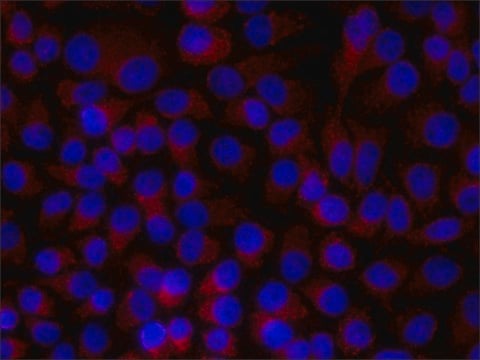
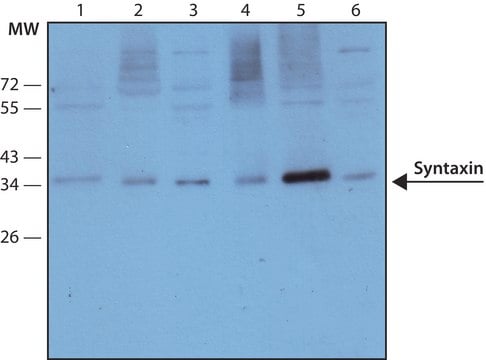
Monoclonal Anti-Paxillin antibody produced in mouse has been used in immunoblotting and immunocytochemistry.

Biochem/physiol Actions

Paxillin interacts with several proteins including members of the src family of tyrosine kinases, the transforming protein v-crk, the cytoskeletal protein vinculin, and the tyrosine kinase, focal adhesion kinase (FAK). This interaction has suggested a function for paxillin as a molecular adaptor, responsible for the recruitment of structural and signaling molecules to focal adhesions.
Recognizes an epitope located in the LIM1 domain of the paxillin molecule.

Disclaimer

Unless otherwise stated in our catalog or other company documentation accompanying the product(s), our products are intended for research use only and are not to be used for any other purpose, which includes but is not limited to, unauthorized commercial uses, in vitro diagnostic uses, ex vivo or in vivo therapeutic uses or any type of consumption or application to humans or animals.

Sie haben nicht das passende Produkt gefunden?  

Probieren Sie unser Produkt-Auswahlhilfe. aus.

Lagerklasse

10 - Combustible liquids

wgk

WGK 3

flash_point_f

Not applicable

flash_point_c

Not applicable


Hier finden Sie alle aktuellen Versionen:

Analysenzertifikate (COA)

Lot/Batch Number

Die passende Version wird nicht angezeigt?

Wenn Sie eine bestimmte Version benötigen, können Sie anhand der Lot- oder Chargennummer nach einem spezifischen Zertifikat suchen.

Besitzen Sie dieses Produkt bereits?

In der Dokumentenbibliothek finden Sie die Dokumentation zu den Produkten, die Sie kürzlich erworben haben.

Die Dokumentenbibliothek aufrufen

Paxillin: a crossroad in pathological cell migration
Lopez CAM, et al.
Journal of Hematology & Oncology, 10(1), 50-50 (2017)
Paxillin: a new vinculin-binding protein present in focal adhesions.
Turner CE, et al.
The Journal of cell biology, 111(3), 1059-1068 (1990)
Emmanuella Tsirimonaki et al.
Virus research, 115(2), 158-168 (2005-09-20)
Bovine papillomaviruses (BPVs) are oncogenic viruses. In cattle, BPV-1/2 is associated with urinary bladder cancer and BPV-4 with upper GI tract cancer. BPV E5 is a small hydrophobic protein localised in the endoplasmic reticulum (ER) and Golgi apparatus (GA). E5
Nien-Yi Chiang et al.
The Journal of biological chemistry, 286(16), 14215-14225 (2011-02-26)
Loss-of-function mutations in the gene encoding G protein-coupled receptor 56 (GPR56) lead to bilateral frontoparietal polymicrogyria (BFPP), an autosomal recessive disorder affecting brain development. The GPR56 receptor is a member of the adhesion-GPCR family characterized by the chimeric composition of
Vanessa Liévin-Le Moal et al.
Cellular microbiology, 13(7), 992-1013 (2011-04-20)
The secreted autotransporter toxin, Sat, which belongs to the subfamily of serine protease autotransporters of Enterobacteriaceae, acts as a virulence factor in extraintestinal and intestinal pathogenic strains of Escherichia coli. We observed that HeLa cells exposed to the cell-free culture

Global Trade Item Number

SKUGTIN
P1093-.5ML04061837721281

Questions

Reviews

No rating value

Active Filters

Unser Team von Wissenschaftlern verfügt über Erfahrung in allen Forschungsbereichen einschließlich Life Science, Materialwissenschaften, chemischer Synthese, Chromatographie, Analytik und vielen mehr..

Setzen Sie sich mit dem technischen Dienst in Verbindung