
Fortfahren mit
M9888

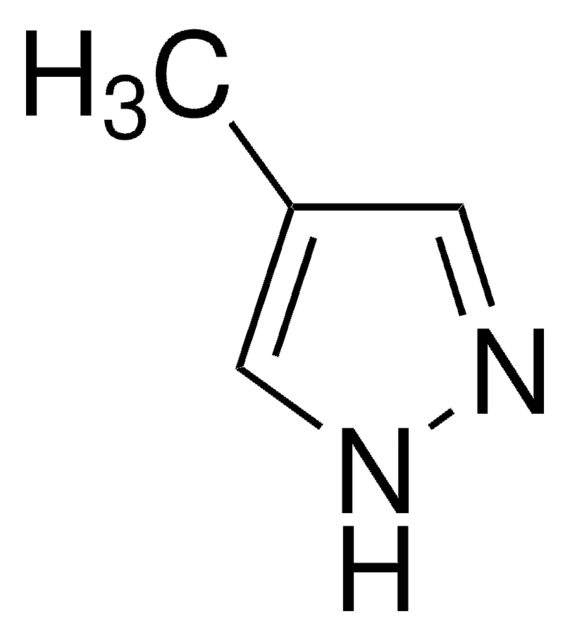
Fomepizol
Synonym(e):
4-Methyl-pyrazol
Anmelden zur Ansicht der Organisations- und Vertragspreise.
Über diesen Artikel
Empirische Formel (Hill-System):
C4H6N2
CAS-Nummer:
Molekulargewicht:
82.10
EC Number:
231-445-0
UNSPSC Code:
12352204
MDL number:
Beilstein/REAXYS Number:
105204
refractive index
n20/D 1.495 (lit.)
bp
99-100 °C/6 mmHg (lit.)
density
0.993 g/mL at 25 °C (lit.)
storage temp.
2-8°C
SMILES string
Cc1cn[nH]c1
InChI
1S/C4H6N2/c1-4-2-5-6-3-4/h2-3H,1H3,(H,5,6)
InChI key
RIKMMFOAQPJVMX-UHFFFAOYSA-N
Gene Information
human ... ADH1A(124), ADH1B(125), ADH1C(126)
Application
Gegengift bei Methanol- und Ethylenglykolvergiftungen
Biochem/physiol Actions
Alcohol dehydrogenase inhibitor

signalword
Warning
hcodes
Hazard Classifications
Acute Tox. 4 Oral - Eye Irrit. 2 - Skin Irrit. 2 - STOT SE 3
Lagerklasse
10 - Combustible liquids
wgk
WGK 3
flash_point_f
204.8 °F - closed cup
flash_point_c
96 °C - closed cup
Hier finden Sie alle aktuellen Versionen:
Besitzen Sie dieses Produkt bereits?
In der Dokumentenbibliothek finden Sie die Dokumentation zu den Produkten, die Sie kürzlich erworben haben.
Verwandter Inhalt
Zhichao Liu et al.
PLoS computational biology, 7(12), e1002310-e1002310 (2011-12-24)
Drug-induced liver injury (DILI) is a significant concern in drug development due to the poor concordance between preclinical and clinical findings of liver toxicity. We hypothesized that the DILI types (hepatotoxic side effects) seen in the clinic can be translated
Denis Fourches et al.
Chemical research in toxicology, 23(1), 171-183 (2009-12-18)
Drug-induced liver injury is one of the main causes of drug attrition. The ability to predict the liver effects of drug candidates from their chemical structures is critical to help guide experimental drug discovery projects toward safer medicines. In this