Direkt zum Inhalt
Merck

M3696

Anti-MAP2 Antibody

rabbit polyclonal

Synonym(e):

Anti-Microtubule associated protein 2

Anmelden zur Ansicht der Organisations- und Vertragspreise.

Größe auswählen

100 μG

€ 340,00

€ 340,00


Warenkorb auf Verfügbarkeit prüfen
Für Ihr Target ist ein rekombinanter, konservierungsmittelfreier Antikörper verfügbar. Probieren Sie ZMS1013


Über diesen Artikel

UNSPSC Code:
12352203
NACRES:
NA.41
MDL number:
Conjugate:
unconjugated
Clone:
polyclonal
Application:
FACS, IHC, WB
Citations:
64

Fortfahren mit

Technischer Dienst
Benötigen Sie Hilfe? Unser Team von erfahrenen Wissenschaftlern ist für Sie da.
Unterstützung erhalten

Produktname

Anti-MAP2 antibody produced in rabbit, ~1 mg/mL, affinity isolated antibody, buffered aqueous solution

biological source

rabbit

Quality Level

conjugate

unconjugated

antibody form

affinity isolated antibody

antibody product type

primary antibodies

clone

polyclonal

form

buffered aqueous solution

mol wt

antigen ~280 kDa, antigen ~72 kDa

species reactivity

rat, mouse, human

concentration

~1 mg/mL

technique(s)

flow cytometry: 1:200-1:500, immunohistochemistry: 1:100-1:200, western blot: 1:500-1:1,000

UniProt accession no.

shipped in

dry ice

storage temp.

−20°C

target post-translational modification

unmodified

Gene Information

human ... MAP2(4133)
mouse ... Mtap2(17756)
rat ... Map2(25595)

Suchen Sie nach ähnlichen Produkten? Aufrufen Leitfaden zum Produktvergleich

Ähnliche Artikel vergleichen

Vollständigen Vergleich anzeigen

Unterschiede anzeigen

1 of 4

Dieser Artikel
HPA012828HPA008273HPA029313
Quality Level

200

Quality Level

100

Quality Level

100

Quality Level

100

conjugate

unconjugated

conjugate

unconjugated

conjugate

unconjugated

conjugate

unconjugated

biological source

rabbit

biological source

rabbit

biological source

rabbit

biological source

rabbit

antibody form

affinity isolated antibody

antibody form

affinity isolated antibody

antibody form

affinity isolated antibody

antibody form

affinity isolated antibody

form

buffered aqueous solution

form

buffered aqueous glycerol solution

form

buffered aqueous glycerol solution

form

buffered aqueous glycerol solution

species reactivity

rat, mouse, human

species reactivity

human

species reactivity

human

species reactivity

human

General description

MAP2 is a microtubule-associated protein that regulates the structure and function of the cytoskeleton. The protein also modulates morphogenesis of neurons and cell proliferation. Interactions of MAP2 with F-actin have been implicated in neurite initiation and microtubular re-organization. Decreased levels of MAP2 have been associated with transmissible spongiform encephalopathies [1]. Anti-MAP2 antibody is specific for MAP2 in human, mice and rats.
Microtubule associated protein 2 (MAP2) is a neuron specific protein, which is highly expressed in the central nervous system. It is the member of cytoskeletal proteins. The gene is located on human chromosome 2q34.

Immunogen

synthetic peptide corresponding to residues 2-15 of human MAP2.

Application

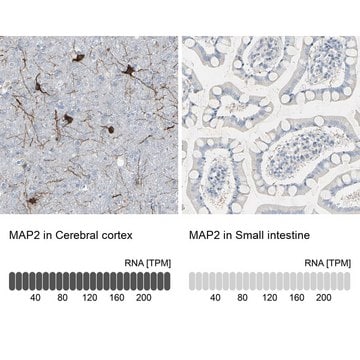
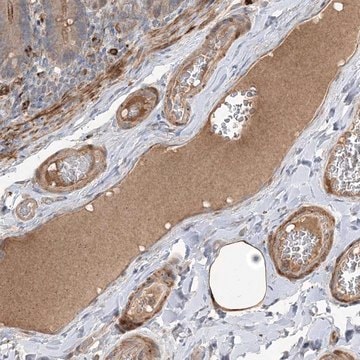
Anti-MAP2 antibody is suitable for use in immunohistochemistry (1:500 using Zamboni′s fixative-fixed, frozen mouse spinal cord and thalamus sections) , flow cytometry (1:200-1:500), immunoblotting (approx. 72 kDa and 280 kDa) and western blot (1:500-1:1,000).
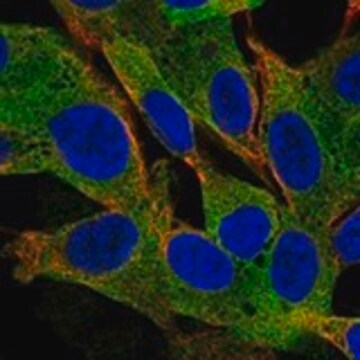
Anti-MAP2 antibody produced in rabbit has been used in immunocytochemistry.

Biochem/physiol Actions

Microtubule associated protein 2 (MAP2) plays a critical role in the formation of dendritic protrusions in astrocytes and oligodendrocytes. It maintains the homeostasis of microtubules. The protein plays an important role in neuronal plasticity.

Physical form

solution in phosphate buffered saline, containing 0.02% sodium azide.

Disclaimer

Unless otherwise stated in our catalog or other company documentation accompanying the product(s), our products are intended for research use only and are not to be used for any other purpose, which includes but is not limited to, unauthorized commercial uses, in vitro diagnostic uses, ex vivo or in vivo therapeutic uses or any type of consumption or application to humans or animals.

Sie haben nicht das passende Produkt gefunden?  

Probieren Sie unser Produkt-Auswahlhilfe. aus.

Lagerklasse

10 - Combustible liquids

flash_point_f

Not applicable

flash_point_c

Not applicable

ppe

Eyeshields, Gloves, multi-purpose combination respirator cartridge (US)


Hier finden Sie alle aktuellen Versionen:

Analysenzertifikate (COA)

Lot/Batch Number

Die passende Version wird nicht angezeigt?

Wenn Sie eine bestimmte Version benötigen, können Sie anhand der Lot- oder Chargennummer nach einem spezifischen Zertifikat suchen.

Besitzen Sie dieses Produkt bereits?

In der Dokumentenbibliothek finden Sie die Dokumentation zu den Produkten, die Sie kürzlich erworben haben.

Die Dokumentenbibliothek aufrufen

Specific binding of dehydroepiandrosterone to the N terminus of the microtubule-associated protein MAP2
Laurine E, et al.
The Journal of Biological Chemistry, 278(32), 29979-29986 (2003)
Cory C Toth et al.
Molecular pain, 6, 16-16 (2010-03-20)
Despite the frequency of diabetes mellitus and its relationship to diabetic peripheral neuropathy (DPN) and neuropathic pain (NeP), our understanding of underlying mechanisms leading to chronic pain in diabetes remains poor. Recent evidence has demonstated a prominent role of microglial
Transcriptional upregulation of microtubule-associated protein 2 is involved in the protein kinase A-induced decrease in the invasiveness of glioma cells
Zhou Y, et al.
Neuro-Oncology, 17(12), 1578-1588 (2015)
Rouhollah Habibey et al.
Scientific reports, 7(1), 8558-8558 (2017-08-19)
Due to their small dimensions, electrophysiology on thin and intricate axonal branches in support of understanding their role in normal and diseased brain function poses experimental challenges. To reduce experimental complexity, we coupled microelectrode arrays (MEAs) to bi-level microchannel devices
Qinghai Liu et al.
PloS one, 11(4), e0153376-e0153376 (2016-04-14)
This study examines the effects of nano-size particulate matter (nPM) exposure in the setting of murine reperfused stroke. Particulate matter is a potent source of inflammation and oxidative stress. These processes are known to influence stroke progression through recruitment of

Verwandter Inhalt

Instructions

Global Trade Item Number

SKUGTIN
M3696-100UG04061838256058

Questions

Reviews

No rating value

Active Filters

Unser Team von Wissenschaftlern verfügt über Erfahrung in allen Forschungsbereichen einschließlich Life Science, Materialwissenschaften, chemischer Synthese, Chromatographie, Analytik und vielen mehr..

Setzen Sie sich mit dem technischen Dienst in Verbindung