Direkt zum Inhalt
Merck

Fortfahren mit

F8521

Anti-Mouse IgG (Fab specific) F(ab′)2 fragment–FITC antibody produced in goat

affinity isolated antibody, buffered aqueous solution

Anmelden zur Ansicht der Organisations- und Vertragspreise.

Größe auswählen

Ansicht ändern
PackungsgrößeSKUVerfügbarkeitPreis
0.5 mL
Warenkorb auf Verfügbarkeit prüfen
€ 287,00

Über diesen Artikel

UNSPSC Code:
12352203
NACRES:
NA.46
MDL number:
Conjugate:
FITC conjugate
Clone:
polyclonal
Application:
IHC (p)
Citations:
18

€ 287,00


Warenkorb auf Verfügbarkeit prüfen

Großbestellung anfragen
Technischer Dienst
Benötigen Sie Hilfe? Unser Team von erfahrenen Wissenschaftlern ist für Sie da.
Unterstützung erhalten


biological source

goat

Quality Level

conjugate

FITC conjugate

antibody form

affinity isolated antibody

antibody product type

secondary antibodies

clone

polyclonal

form

buffered aqueous solution

storage condition

protect from light

technique(s)

immunohistochemistry (formalin-fixed, paraffin-embedded sections): 1:320

storage temp.

−20°C

target post-translational modification

unmodified

General description

IgG antibody subtype is the most abundant serum immunoglobulins of the immune system. It is secreted by B cells and is found in blood and extracellular fluids and provides protection from infections caused by bacteria, fungi and viruses. Maternal IgG is transferred to fetus through the placenta that is vital for immune defence of the neonate against infections.
Immunoglobulin G (IgG) is a member of the immunoglobulin family and contains gamma (γ) heavy chain in the constant (C) region. Monomeric structure of IgG contains two identical heavy chains and two identical light chains with molecular weight of 50 kDa and 25 kDa respectively. The primary structure of this antibody also contains disulfide bonds implicated in linking the two heavy chains, linking the heavy and light chains and resides inside the chains. IgG is further subdivided into four classes namely, IgG1, IgG2, IgG3 and IgG4 with different heavy chains, named γ1, γ2, γ3 and γ4, respectively.

Immunogen

Purified mouse IgG; The F(ab′)2 fragment of the antibody is obtained from pepsin digested antiserum

Application

Anti-Mouse IgG (Fab specific) F(ab′)2 fragment−FITC antibody produced in goat has been used in:
  • flow cytometry for fluorescence-activated cell sorting (FACS) analysis
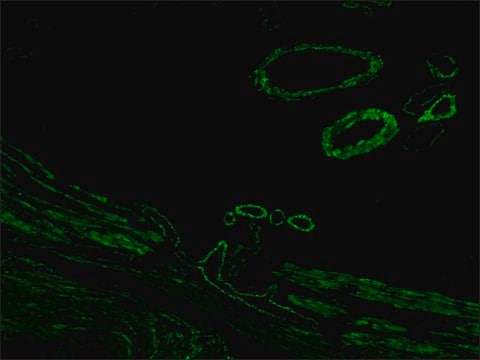
  • immunofluorescence and confocal microscopy
  • immunofluorescent HSP72 detection/immunocytochemistry experiments

Biochem/physiol Actions

Binds all mouse Igs.
Useful when trying to avoid background staining due to the presence of Fc receptors. Anti-Mouse IgG (Fab specific) F(ab′)2 fragment-FITC antibody recognizes Fab fragment of mouse IgG. No cross reaction is observed with the Fc fragment of mouse IgG. No reactivity is observed with human, horse or bovine serum. The antibody is purified by affinity isolation and conjugated with FITC in an alkaline reaction.
Immunoglobulin G (IgG) participates in hypersensitivity type II and type III reactions. IgG2a has cytotropic properties and IgG2 molecules have the ability to activate the complement system.
Maternal IgG is transferred to fetus through the placenta that is vital for immune defence of the neonate against infections.

Physical form

Solution in 0.01 M phosphate buffered saline, pH 7.4, containing 15 mM sodium azide.

Preparation Note

Adsorbed to reduce background staining with bovine, horse or human samples.

Other Notes

Antibody adsorbed with bovine, equine and human serum proteins.

Disclaimer

Unless otherwise stated in our catalog or other company documentation accompanying the product(s), our products are intended for research use only and are not to be used for any other purpose, which includes but is not limited to, unauthorized commercial uses, in vitro diagnostic uses, ex vivo or in vivo therapeutic uses or any type of consumption or application to humans or animals.

Ähnliche Artikel vergleichen

Vollständigen Vergleich anzeigen

Unterschiede anzeigen

1 of 1

Dieser Artikel
F2653F8646F4018
antibody form

affinity isolated antibody

antibody form

affinity isolated antibody

antibody form

affinity isolated antibody

antibody form

affinity isolated antibody

biological source

goat

biological source

goat

biological source

goat

biological source

goat

conjugate

FITC conjugate

conjugate

FITC conjugate

conjugate

FITC conjugate

conjugate

FITC conjugate

technique(s)

immunohistochemistry (formalin-fixed, paraffin-embedded sections): 1:320

technique(s)

flow cytometry: 1:100, immunohistochemistry (formalin-fixed, paraffin-embedded sections): 1:160

technique(s)

immunohistochemistry (formalin-fixed, paraffin-embedded sections): 1:320

technique(s)

immunohistochemistry (formalin-fixed, paraffin-embedded sections): 1:200, indirect immunofluorescence: 1:64

clone

polyclonal

clone

polyclonal

clone

polyclonal

clone

polyclonal

form

buffered aqueous solution

form

buffered aqueous solution

form

buffered aqueous solution

form

buffered aqueous solution


Still not finding the right product?

Explore all of our products under

oder

Probieren Sie unser Produkt-Auswahlhilfe, um Ihre Auswahl einzugrenzen


Lagerklasse

10 - Combustible liquids

wgk

nwg

flash_point_f

Not applicable

flash_point_c

Not applicable

ppe

Eyeshields, Gloves, multi-purpose combination respirator cartridge (US)


Hier finden Sie alle aktuellen Versionen:

Analysenzertifikate (COA)

Lot/Batch Number

Die passende Version wird nicht angezeigt?

Wenn Sie eine bestimmte Version benötigen, können Sie anhand der Lot- oder Chargennummer nach einem spezifischen Zertifikat suchen.

Besitzen Sie dieses Produkt bereits?

In der Dokumentenbibliothek finden Sie die Dokumentation zu den Produkten, die Sie kürzlich erworben haben.

Die Dokumentenbibliothek aufrufen


Verwandter Inhalt

Instructions


Choon-Taek Lee et al.
Cancer gene therapy, 10(1), 57-63 (2002-12-19)
The continuous growth of tumors depends on the altered regulation of the cell cycle, which is in turn modulated by signals from growth factors and their receptors. Blockade of insulin-like growth factor (IGF)-I and IGF-IR by antisense or dominant negative
Recombinant adenoviruses expressing dominant negative insulin-like growth factor-I receptor demonstrate antitumor effects on lung cancer
Lee CT, et al.
Cancer Gene Therapy, 10(1), 57-57 (2003)
Maroko Myohara
PloS one, 7(5), e37319-e37319 (2012-05-23)
The term 'neoblast' was originally coined for a particular type of cell that had been observed during annelid regeneration, but is now used to describe the pluripotent/totipotent stem cells that are indispensable for planarian regeneration. Despite having the same name


Global Trade Item Number

SKUGTIN
F8521-.5ML04061837517204

Questions

Reviews

No rating value

Active Filters