
Fortfahren mit
F3542

Fibronectin Fragment III1-C human
recombinant, expressed in E. coli, lyophilized powder
Synonym(e):
FF III1-C
Über diesen Artikel
biological source
human
Quality Segment
recombinant
expressed in E. coli
form
lyophilized powder
quality
essentially salt free
mol wt
8-15 kDa
packaging
pkg of 0.5 mg
technique(s)
cell culture | mammalian: suitable
surface coverage
0.45 μg/cm2
solubility
Tris-buffered saline: soluble 1.00-1.10 mg/mL, clear, colorless
UniProt accession no.
shipped in
ambient
storage temp.
−20°C
Gene Information
human ... FN1(2335)
General description
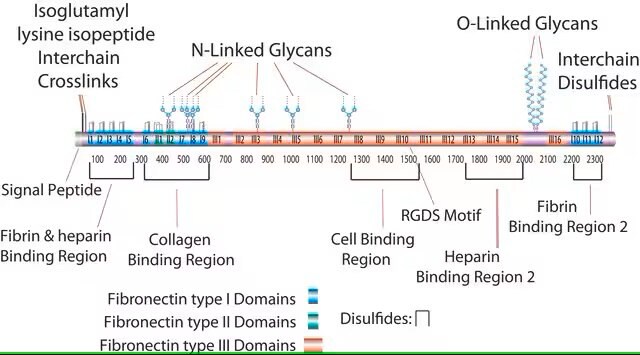
Recently a new region, type III1 repeat cloned from human placenta cDNA, was reported to participate in matrix formation. In an experiment employing antibodies for the analysisof fibronectin domains required for matrix assembly, the epitope that inhibited binding and insolubilization of labeled plasma fibronectin by fibroblasts, was identified on the type III1 and type I modules of fibronectin. This suggested a role for type III1 and type I in the mediation of fibronectin assembly. This finding was further supported by the ability of the 14 kDa fragment from the first two type III repeats of fibronectin to inhibit fibronectin matrix assembly.4 Recently recombinant fragment III1-C, modeled after the C-terminal two-thirds of the III1 repeat, was found to bind to fibronectin and induce spontaneous disulfide crosslinking of the fibronectin molecules into multimers, which resemble matrix fibrils
Application
Biochem/physiol Actions
Packaging
1 of 1
Dieser Artikel | |||
|---|---|---|---|
| recombinant expressed in E. coli | recombinant expressed in HEK 293 cells | recombinant - | recombinant - |
| technique(s) cell culture | mammalian: suitable | technique(s) cell culture | mammalian: suitable | technique(s) cell culture | mammalian: suitable | technique(s) cell culture | mammalian: suitable |
| biological source human | biological source human | biological source human plasma | biological source human fibroblasts |
| mol wt 8-15 kDa | mol wt 259.5 kDa (The protein migrates as a higher band on SDS-PAGE due to glycosylation.) | mol wt 70 kDa | mol wt 31 kDa |
| form lyophilized powder | form lyophilized powder | form lyophilized powder | form solution |
| UniProt accession no. | UniProt accession no. | UniProt accession no. | UniProt accession no. |


Lagerklasse
11 - Combustible Solids
wgk
WGK 3
flash_point_f
Not applicable
flash_point_c
Not applicable
ppe
Eyeshields, Gloves, type N95 (US)
Hier finden Sie alle aktuellen Versionen:
Besitzen Sie dieses Produkt bereits?
In der Dokumentenbibliothek finden Sie die Dokumentation zu den Produkten, die Sie kürzlich erworben haben.
Protokolle
Fibronectin auf die gewünschte Konzentration verdünnen. Die optimalen Anhaftungsbedingungen sind vom Zelltyp und der Anwendung abhängig. Die typische Beschichtungskonzentration beträgt 1–5 ug/cm2. Protokoll, Produkte und häufig gestellte Fragen zur Fibronectin-Beschichtung.
Dilute fibronectin for cell attachment, varying per cell type. Coating protocol, products, and FAQs provided.
Artikel
Fibronectin (FN) plays crucial roles in extracellular matrix fibril assembly and cellular interactions.
Cancer stem cell media, spheroid plates and cancer stem cell markers to culture and characterize CSC populations.
Verwandter Inhalt
Global Trade Item Number
| SKU | GTIN |
|---|---|
| F3542-.5MG | 04061833614129 |