Direkt zum Inhalt
Merck

D8168

Anti-Dystrophin Antibody

mouse monoclonal, MANDYS8

Synonym(e):

Dystrophin Antibody, Dystrophin Antibody - Monoclonal Anti-Dystrophin antibody produced in mouse

Anmelden zur Ansicht der Organisations- und Vertragspreise.

Größe auswählen

100 μL

€ 356,00

0.2 ML

€ 564,00

€ 356,00


Warenkorb auf Verfügbarkeit prüfen
Für Ihr Target ist ein rekombinanter, konservierungsmittelfreier Antikörper verfügbar. Probieren Sie ZMS1051

Großbestellung anfragen

Über diesen Artikel

UNSPSC Code:
12352203
NACRES:
NA.41
MDL number:
Conjugate:
unconjugated
Clone:
MANDYS8, monoclonal
Application:
ARR, ELISA (i), IF, WB
Citations:
71

Fortfahren mit

Technischer Dienst
Benötigen Sie Hilfe? Unser Team von erfahrenen Wissenschaftlern ist für Sie da.
Unterstützung erhalten

Produktname

Monoclonal Anti-Dystrophin antibody produced in mouse, clone MANDYS8, ascites fluid

biological source

mouse

conjugate

unconjugated

antibody form

ascites fluid

antibody product type

primary antibodies

clone

MANDYS8, monoclonal

species reactivity

chicken, rat, human, pig, rabbit, mouse

technique(s)

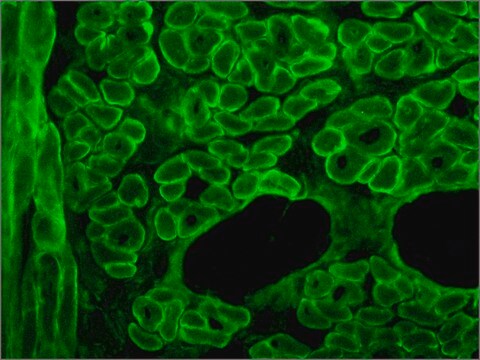
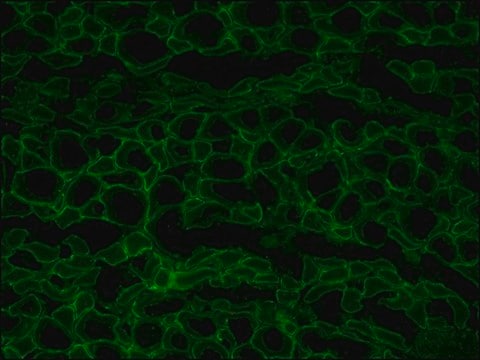
indirect ELISA: suitable, indirect immunofluorescence: 1:400 using frozen human or animal muscle tissue sections., microarray: suitable, western blot: suitable

isotype

IgG2b

UniProt accession no.

shipped in

dry ice

storage temp.

−20°C

target post-translational modification

unmodified

Quality Level

Gene Information

human ... DMD(1756)
mouse ... Dmd(13405)
rat ... Dmd(24907)

Suchen Sie nach ähnlichen Produkten? Aufrufen Leitfaden zum Produktvergleich

Ähnliche Artikel vergleichen

Vollständigen Vergleich anzeigen

Unterschiede anzeigen

1 of 4

Dieser Artikel
D8043SAB4200764O1136
Gene Information

human ... DMD(1756)
mouse ... Dmd(13405)
rat ... Dmd(24907)

Gene Information

human ... DMD(1756)
mouse ... Dmd(13405)
rat ... Dmd(24907)

Gene Information

human ... DMD(1756)

Gene Information

human ... ODC1(4953)
mouse ... Odc1(18263)

species reactivity

chicken, rat, human, pig, rabbit, mouse

species reactivity

rat, human, mouse, fish

species reactivity

porcine, rabbit, mouse, rat, human

species reactivity

human, mouse

conjugate

unconjugated

conjugate

unconjugated

conjugate

-

conjugate

unconjugated

antibody form

ascites fluid

antibody form

ascites fluid

antibody form

purified from hybridoma cell culture

antibody form

ascites fluid

biological source

mouse

biological source

mouse

biological source

mouse

biological source

mouse

clone

MANDYS8, monoclonal

clone

MANDRA1, monoclonal

clone

MANDYS8, monoclonal

clone

ODC-29, monoclonal

General description

Monoclonal Anti-Dystrophin (mouse IgG2b isotype) is derived from the MANDYS8 hybridoma produced by the fusion of mouse myeloma cells and splenocytes from an immunized mouse. Dystrophin is a structural protein on the inner face of the membrane, consisting of a 25-repeat, rod-like, triple-helical domain separating an N-terminal actin binding domain from two C-terminal domains, one of which is rich in cysteine.
The rod domain of the human dystrophin molecule is present in normal muscle tissue and in nearly all Becker muscular dystrophies. It is absent in the cases of Duchenne muscular dystrophies and in the dystrophic mouse (mdx).

Immunogen

recombinant human dystrophin fragment.

Application

Monoclonal Anti-Dystrophin antibody produced in mouse has been used in
  • immunohistochemistry
  • immunofluorescence[1]
  • double immunofluorescence terminal dUTP nick-end labeling (TUNEL)[1]
  • immunoblotting

Monoclonal anti-dystrophin antibody can be used for localization of dystrophin using immunochemical assays like ELISA and immunohistochemistry. The antibody can also be used in immunoblotting for brain dystrophin. Further, it can be used in western blotting and double immunofluorescent labelling (diluted 1: 500) of dystrophin.

Biochem/physiol Actions

Dystrophin deficiency is associated with severe Duchenne muscular dystrophy (DMD). Becker muscular dystrophy (BMD) show less pronounced abnormalities of dystrophin protein expression. Since abnormalities in the protein expression occur specifically in patients with these types of muscular dystrophy, dystrophin analysis may be used to distinguish these conditions from other neuromuscular diseases.

Other Notes

This product can be found as purified product that was produced using cell culture hybridoma product.
SAB4200764 Anti-Dystrophin antibody, Mouse monoclonal
clone MANDYS8, purified from hybridoma cell culture

Disclaimer

Unless otherwise stated in our catalog or other company documentation accompanying the product(s), our products are intended for research use only and are not to be used for any other purpose, which includes but is not limited to, unauthorized commercial uses, in vitro diagnostic uses, ex vivo or in vivo therapeutic uses or any type of consumption or application to humans or animals.

Sie haben nicht das passende Produkt gefunden?  

Probieren Sie unser Produkt-Auswahlhilfe. aus.

Lagerklasse

10 - Combustible liquids

wgk

WGK 3

flash_point_f

Not applicable

flash_point_c

Not applicable


Hier finden Sie alle aktuellen Versionen:

Analysenzertifikate (COA)

Lot/Batch Number

Die passende Version wird nicht angezeigt?

Wenn Sie eine bestimmte Version benötigen, können Sie anhand der Lot- oder Chargennummer nach einem spezifischen Zertifikat suchen.

Besitzen Sie dieses Produkt bereits?

In der Dokumentenbibliothek finden Sie die Dokumentation zu den Produkten, die Sie kürzlich erworben haben.

Die Dokumentenbibliothek aufrufen

The dystrophin complex: structure, function, and implications for therapy
Gao QQ and McNally EM
Comprehensive Physiology, 5(3), 1223-1239 (2011)
Effects of long-term resveratrol-induced SIRT1 activation on insulin and apoptotic signalling in aged skeletal muscle
Sin TK, et al.
Acta Diabetologica, 52(6), 1063-1075 (2015)
Myospryn is a calcineurin-interacting protein that negatively modulates slow-fiber-type transformation and skeletal muscle regeneration
Kielbasa OM, et al.
Faseb Journal, 25(7), 2276-2286 (2011)
Rachel Blitzblau et al.
Brain research, 1218, 21-34 (2008-06-06)
Muscular dystrophy patients often show cognitive impairment, in addition to muscle degeneration caused by dystrophin gene defects. The cognitive impairments lead to speculation that the dystrophin protein family may play a key role at neuronal synapses. Dystrophin regulates the stability
Michela Morano et al.
Scientific reports, 8(1), 5047-5047 (2018-03-24)
Neuregulin 1 (NRG1) is a growth factor produced by both peripheral nerves and skeletal muscle. In muscle, it regulates neuromuscular junction gene expression, acetylcholine receptor number, muscle homeostasis and satellite cell survival. NRG1 signalling is mediated by the tyrosine kinase

Verwandter Inhalt

Questions

Reviews

No rating value

Active Filters

Unser Team von Wissenschaftlern verfügt über Erfahrung in allen Forschungsbereichen einschließlich Life Science, Materialwissenschaften, chemischer Synthese, Chromatographie, Analytik und vielen mehr..

Setzen Sie sich mit dem technischen Dienst in Verbindung