Direkt zum Inhalt
Merck

D2016

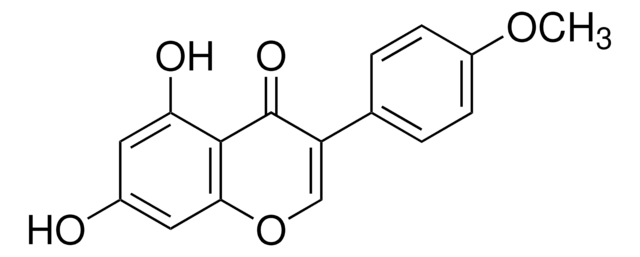
Biochanin A

Synonym(e):

4′-Methylgenistein, 5,7-Dihydroxy-4′-methoxy-isoflavon, Genistein 4′-Methyl- Ether, Olmelin

Anmelden zur Ansicht der Organisations- und Vertragspreise.

Größe auswählen

Preise und Verfügbarkeit sind derzeit nicht verfügbar.

Über diesen Artikel

Empirische Formel (Hill-System):
C16H12O5
CAS-Nummer:
Molekulargewicht:
284.26
UNSPSC Code:
41116107
NACRES:
NA.25
PubChem Substance ID:
EC Number:
207-744-7
Beilstein/REAXYS Number:
278107
MDL number:
Form:
powder
Quality level:

Fortfahren mit

Technischer Dienst
Benötigen Sie Hilfe? Unser Team von erfahrenen Wissenschaftlern ist für Sie da.
Unterstützung erhalten

InChI key

WUADCCWRTIWANL-UHFFFAOYSA-N

InChI

1S/C16H12O5/c1-20-11-4-2-9(3-5-11)12-8-21-14-7-10(17)6-13(18)15(14)16(12)19/h2-8,17-18H,1H3

SMILES string

COc1ccc(cc1)C2=COc3cc(O)cc(O)c3C2=O

form

powder

mp

210-213 °C (lit.)

Quality Level

Gene Information

Suchen Sie nach ähnlichen Produkten? Aufrufen Leitfaden zum Produktvergleich

Ähnliche Artikel vergleichen

Vollständigen Vergleich anzeigen

Unterschiede anzeigen

1 of 4

Dieser Artikel
92142PHL800121071381
Biochanin A phyproof® Reference Substance

PHL80012

Biochanin A

Biochanin A United States Pharmacopeia (USP) Reference Standard

USP

1071381

Biochanin A

form

powder

form

-

form

powder

form

-

Quality Level

100

Quality Level

100

Quality Level

-

Quality Level

-

mp

210-213 °C (lit.)

mp

210-213 °C (lit.)

mp

210-213 °C (lit.)

mp

210-213 °C (lit.)

Gene Information

human ... CYP19A1(1588)
mouse ... Aldh1a2(19378), Maoa(17161)

Gene Information

-

Gene Information

-

Gene Information

-

General description

Biochanin A (BCA) is synthesized in vitro from phloroglucinol. A series of steps involving Friedel−Crafts reaction results in an intermediate product 1-(2,4,6-trihydroxyphenyl)-2-(4 methoxyphenyl) ethanone, which post cyclization leads to BCA. It is catabolized to isoflavone genistein post ingestion.[1]

Application

Biochanin A has been used to evaluate its effect on the ergotamine (ERT)-induced contractility in bovine mesenteric vasculature.[2] It may be used to test its anticancer potential in human glioblastoma cell lines.[3] It has been used as a reference standard in high-performance liquid chromatography−tandem mass spectrometry.[4]

Biochem/physiol Actions

Biochanin A is an isoflavone phytoestrogen found in red clover (Trifolium pratense) that is a selective agonist at ER-β estrogen receptors, and may have chemopreventive efficacy against breast cancer. In line with its low activity at ER-α estrogen receptors, it is essentially devoid of uterotrophic activity. Biochanin A is also a ligand for the aryl hydrocarbon receptor (AhR). It reduces arterial resistance and enhances microcirculation perhaps via effects on potassium and/or calcium ion channels. Induction of sulfotransferases for xenobiotic detoxification has been proposed as a mechanism of its cancer preventive effects.
Biochanin A is an isoflavone phytoestrogen found in red clover (Trifolium pratense) that is a selective agonist at ER-β estrogen receptors, and may have chemopreventive efficacy against breast cancer. In line with its low activity at ER-α estrogen receptors, it is essentially devoid of uterotrophic activity. Biochanin A is also a ligand for the aryl hydrocarbon receptor (AhR). It reduces arterial resistance and enhances microcirculation perhaps via effects on potassium and/or calcium ion channels.
Biochanin A is an isoflavone phytoestrogen found in red clover (Trifolium pratense) that is a selective agonist at ER-β estrogen receptors, and may have chemopreventive efficacy against breast cancer. In line with its low activity at ER-α estrogen receptors, it is essentially devoid of uterotrophic activity. Biochanin A is also a ligand for the aryl hydrocarbon receptor (AhR). It reduces arterial resistance and enhances microcirculation perhaps via effects on potassium and/or calcium ion channels. Induction of sulfotransferases for xenobiotic detoxification has been proposed as a mechanism of its cancer preventive effects.

Lagerklasse

11 - Combustible Solids

wgk

WGK 3

flash_point_f

Not applicable

flash_point_c

Not applicable

ppe

Eyeshields, Gloves, type N95 (US)


Hier finden Sie alle aktuellen Versionen:

Analysenzertifikate (COA)

Lot/Batch Number

Die passende Version wird nicht angezeigt?

Wenn Sie eine bestimmte Version benötigen, können Sie anhand der Lot- oder Chargennummer nach einem spezifischen Zertifikat suchen.

Besitzen Sie dieses Produkt bereits?

In der Dokumentenbibliothek finden Sie die Dokumentation zu den Produkten, die Sie kürzlich erworben haben.

Die Dokumentenbibliothek aufrufen

Estrogenic effect of the phytoestrogen biochanin A in zebrafish, Danio rerio, and brown trout, Salmo trutta
Holbech H, et al.
Aquatic Toxicology (Amsterdam, Netherlands), 144, 19-25 (2013)
Combination of Biochanin A and Temozolomide Impairs Tumor Growth by Modulating Cell Metabolism in Glioblastoma Multiforme
Desai V, et al.
Anticancer research, 39(1), 57-66 (2019)
Interaction of isoflavones and endophyte-infected tall fescue seed extract on vasoactivity of bovine mesenteric vasculature
Jia Y, et al.
Frontiers in nutrition, 2(9), 32-32 (2015)
Sunil Kumar Manna
Biochemical pharmacology, 83(10), 1383-1392 (2012-03-06)
Several protein tyrosine kinase (PTK) inhibitors predominantly isoflavones, such as genistein, erbstatin, quercetin, daidzein, present in red clover, cabbage and alfalfa, show apoptotic effect against cancer cells. In this study I found that biochanin, a methoxy form of genistein, inhibits
Zhongliu Zhou et al.
Molecules (Basel, Switzerland), 17(11), 12636-12641 (2012-10-27)
Two novel compounds, 1α-methoxy-3β-hydroxy-4α-(3′,4′-dihydroxyphenyl)-1, 2,3,4-tetrahydronaphthalin (1) and 1α,3β-dihydroxy-4α-(3′,4′-dihydroxyphenyl)-1,2,3,4-tetrahydronaphthalin (2), were isolated along with six known compounds 3-8 from the rhizomes of Cyperus rotundus. This paper reports the isolation and full spectroscopic characterization of these new compounds by NMR, UV, IR

Artikel

Antioxidants protect biological systems from oxidative damage produced by oxygen-containing free radicals and from redoxactive transition metal ions such as iron, copper, and cadmium.

Questions

Reviews

No rating value

Active Filters

Unser Team von Wissenschaftlern verfügt über Erfahrung in allen Forschungsbereichen einschließlich Life Science, Materialwissenschaften, chemischer Synthese, Chromatographie, Analytik und vielen mehr..

Setzen Sie sich mit dem technischen Dienst in Verbindung