Direkt zum Inhalt
Merck

C8104

Monoclonal Anti-Ceramide antibody produced in mouse

clone MID 15B4, purified immunoglobulin, buffered aqueous solution

Synonym(e):

Ceramide Antibody, Ceramide Antibody - Monoclonal Anti-Ceramide antibody produced in mouse

Anmelden zur Ansicht der Organisations- und Vertragspreise.

Größe auswählen

50 TEST

€ 658,00

€ 658,00


Warenkorb auf Verfügbarkeit prüfen


Über diesen Artikel

UNSPSC Code:
12352203
NACRES:
NA.41
MDL number:
Conjugate:
unconjugated
Clone:
MID 15B4, monoclonal
Application:
ELISA (i), IHC (f)
Citations:
25

Fortfahren mit

Technischer Dienst
Benötigen Sie Hilfe? Unser Team von erfahrenen Wissenschaftlern ist für Sie da.
Unterstützung erhalten

biological source

mouse

conjugate

unconjugated

antibody form

purified immunoglobulin

antibody product type

primary antibodies

clone

MID 15B4, monoclonal

form

buffered aqueous solution

technique(s)

immunohistochemistry (frozen sections): suitable, indirect ELISA: 1:10

isotype

IgM

shipped in

wet ice

storage temp.

2-8°C

target post-translational modification

unmodified

Quality Level

Ähnliche Artikel vergleichen

Vollständigen Vergleich anzeigen

Unterschiede anzeigen

1 of 4

Dieser Artikel
C2456D8168B2531
biological source

mouse

biological source

mouse

biological source

mouse

biological source

mouse

antibody form

purified immunoglobulin

antibody form

ascites fluid

antibody form

ascites fluid

antibody form

ascites fluid

conjugate

unconjugated

conjugate

unconjugated

conjugate

unconjugated

conjugate

unconjugated

clone

MID 15B4, monoclonal

clone

COL-1, monoclonal

clone

MANDYS8, monoclonal

clone

BU-33, monoclonal

form

buffered aqueous solution

form

-

form

-

form

-

storage temp.

2-8°C

storage temp.

−20°C

storage temp.

−20°C

storage temp.

−20°C

General description

Ceramide is an endogenous lipid component of a novel biochemical pathway termed the sphingomyelin pathway. Ceramide is produced in response to cellular stimulation by hormones, cytokines and antigens. Ceramide synthesis is mediated either by the salvage pathway by the acylation of sphingosine or sphingolipids hydrolysis or by de novo pathway via dihydroceramide formation. Structurally, ceramides have a sphingoid base, a long-chain amino alcohol linked to fatty acid by an amide bond. Ceramide is generated by hydrolysis of sphingomyelin by sphingomyelinase.

Immunogen

ceramide conjugated to bovine serum albumin.

Application

Monoclonal Anti-Ceramide antibody produced in mouse has been used in:
  • immunohistochemistry
  • immunolabeling in electron microscopy
  • enzyme-linked immunosorbent assay (ELISA)
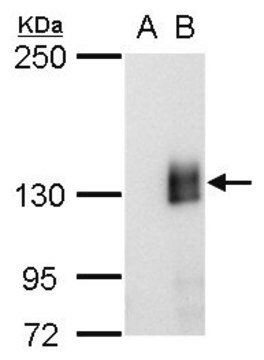
  • immunoblotting
  • immunoprecipitation
  • as a probe to determine the presence and roles of ceramide in sphingomyelin pathway signaling and the regulation of protein phosphorylation.

Biochem/physiol Actions

Ceramide appears to have a role in mediating biological responses in a wide variety of cell types. Ceramide metabolites such as sphingosine and sphingosine-1-phosphate have potent biological activities of their own. They are directly involved in the proliferation and differentiation of skin cells and regulate skin barrier functionality. Ceramide based analogs are potential anti-tumor agents and are regarded as tumor suppressor lipid. Mechanisms for ceramide action involve regulation of protein phosphorylation via stimulation of a serine/threonine protein phosphatase, a proline-directed kinase and possibly other direct and/or indirect targets. Ceramide is emerging as an intracellular messenger than mediates effects on terminal differentiation and cell proliferation as well as apoptosis or cell death and cell-cycle arrest. The interrelationship of ceramide actions with other bioactive lipids and systems represents an area of active research.
Mouse monoclonal clone MID 15B4 anti-Ceramide antibody recognizes free and bound ceramides.

Physical form

Solution in phosphate buffered saline containing 0.5 M NaCl, 0.1% bovine serum albumin, and 0.09% sodium azide.

Preparation Note

Purified from ascites fluid by gel filtration using sephacryl S-300 resin.

Analysis Note

The antibody was characterized on ceramide covalently bound to myoglobin.

Disclaimer

Unless otherwise stated in our catalog or other company documentation accompanying the product(s), our products are intended for research use only and are not to be used for any other purpose, which includes but is not limited to, unauthorized commercial uses, in vitro diagnostic uses, ex vivo or in vivo therapeutic uses or any type of consumption or application to humans or animals.

Sie haben nicht das passende Produkt gefunden?  

Probieren Sie unser Produkt-Auswahlhilfe. aus.

Lagerklasse

10 - Combustible liquids

flash_point_f

Not applicable

flash_point_c

Not applicable


Hier finden Sie alle aktuellen Versionen:

Analysenzertifikate (COA)

Lot/Batch Number

Die passende Version wird nicht angezeigt?

Wenn Sie eine bestimmte Version benötigen, können Sie anhand der Lot- oder Chargennummer nach einem spezifischen Zertifikat suchen.

Besitzen Sie dieses Produkt bereits?

In der Dokumentenbibliothek finden Sie die Dokumentation zu den Produkten, die Sie kürzlich erworben haben.

Die Dokumentenbibliothek aufrufen

Ignazio Restivo et al.
International journal of molecular sciences, 24(2) (2023-01-22)
Cell death program of red blood cells (RBCs), called eryptosis, is characterized by activation of caspases and scrambling of membrane phospholipids with externalization of phosphatidylserine (PS). Excessive eryptosis confers a procoagulant phenotype and is implicated in impairment of microcirculation and
ELOVL4-mediated production of very long-chain ceramides stabilizes tight junctions and prevents diabetes-induced retinal vascular permeability
Kady NM, et al.
Diabetes, 67(4), 769-781 (2018)
Zi-Jun Sun et al.
JCI insight, 7(24) (2022-12-23)
Accumulating evidence suggests the pathogenic role of immunity and metabolism in diabetic kidney disease (DKD). Herein, we aimed to investigate the effect of complement factor B (CFB) on lipid metabolism in the development of DKD. We found that in patients
Jormay Lim et al.
Communications biology, 3(1), 45-45 (2020-01-29)
Intraflagellar transport (IFT) proteins are essential for cilia assembly and function. IFT protein mutations lead to ciliopathies, which manifest as variable skeletal abnormalities. However, how IFT proteins regulate cell alignment during bone development is unknown. Here, we show that the
The sphingolipid salvage pathway in ceramide metabolism and signaling
Kitatani K, et al.
Cellular Signalling, 20(6), 1010-1018 (2008)

Verwandter Inhalt

Questions

Reviews

No rating value

Active Filters

Unser Team von Wissenschaftlern verfügt über Erfahrung in allen Forschungsbereichen einschließlich Life Science, Materialwissenschaften, chemischer Synthese, Chromatographie, Analytik und vielen mehr..

Setzen Sie sich mit dem technischen Dienst in Verbindung