Direkt zum Inhalt
Merck

Fortfahren mit

C6987

Anti-Cortactin (GK-18) antibody produced in rabbit

IgG fraction of antiserum, buffered aqueous solution

Synonym(e):

Anti-EMS1, Anti-p80/85

Anmelden zur Ansicht der Organisations- und Vertragspreise.

Über diesen Artikel

UNSPSC Code:
12352203
NACRES:
NA.41
MDL number:
Conjugate:
unconjugated
Clone:
polyclonal
Application:
ARR, IF, WB
Citations:
8


biological source

rabbit

Quality Level

conjugate

unconjugated

antibody form

IgG fraction of antiserum

antibody product type

primary antibodies

clone

polyclonal

form

buffered aqueous solution

species reactivity

human, mouse, rat, chicken

technique(s)

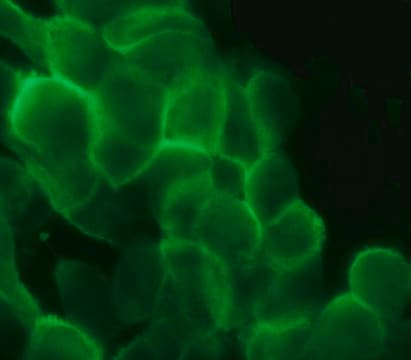
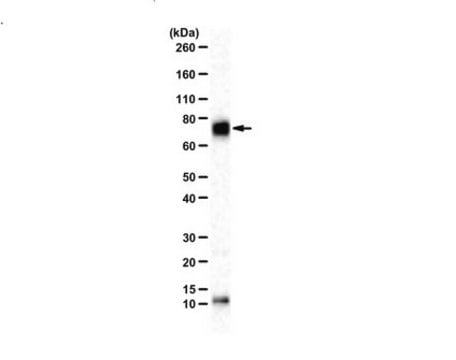
indirect immunofluorescence: 1:500 using mouse fibroblasts NIH3T3 cell line, microarray: suitable, western blot: 1:1,000 using cytosol extract of rat brain, whole extract of chicken embryo fibroblasts, or whole cell extract of human epidermoid carcinoma A431 cell line

UniProt accession no.

shipped in

dry ice

storage temp.

−20°C

target post-translational modification

unmodified

Gene Information

human ... CTTN(2017)
mouse ... Cttn(13043)
rat ... Cttn(60465)

General description

Cortactin gene is located on human chromosome 11q13. Cortactin exists as multiple isoforms (75-85 kDa), formed by alternative splicing. It contains an unique multidomain structure consisting of 6.5 tandem repeats of a 37-amino acid sequence required for direct binding to F-actin, followed by an α-helix region, a proline-rich region, and three tyrosine residues targeted by sarcoma (Src) related kinases. It represents a highly conserved family of perimembrane signaling proteins, including the hematopoietic lineage cell specific proteins hematopoietic cell-specific Lyn substrate 1 (HS1/LCKBP1) and hematopoietic progenitor kinase 1 [HPK1]-interacting protein of 55 kDa (HIP-55).

Immunogen

synthetic peptide corresponding to the N-terminal region of human cortactin (amino acids 18-35) conjugated to KLH.

Application

Anti-Cortactin (GK-18) antibody produced in rabbit is suitable for the following applications:
  • Indirect immunofluorescence at a dilution of 1:500 using mouse fibroblasts NIH3T3 cell line
  • Microarray
  • Western blotting at a dilution of 1:1,000 using cytosol extract of rat brain, whole extract of chicken embryo fibroblasts or whole cell extract of human epidermoid carcinoma A431 cell line

Biochem/physiol Actions

Cortactin (EMS1) is an important branched actin regulator involved in invasion and migration of tumor cells and hepatocellular carcinoma (HCC). Overexpression of this protein is closely associated with poor human HCCs prognosis caused by cancer embolus and metastasis. The overexpressed protein promotes vesicular trafficking at a variety of cellular sites including endosomes and the trans-Golgi network. Trafficking is highly sensitive to cortactin-regulated branched actin assembly.
Cortactin is overexpressed in human breast cancer and in head and neck tumors. Overexpression and redistribution of cortactin into podosome-like structures has been observed in human carcinoma cell lines suggesting that cortactin is involved in tumor cell invasion and metastasis. The C-terminal region contains a Src-homology 3 (SH3) domain that interacts with several postsynaptic density (PSD), PDZ-family (post-synaptic density protein 95 (PSD-95), Drosophila disc large tumor suppressor (Dlg1) and zona occludens 1 (ZO-1)) proteins) including cortactin-binding protein 1 (CortBP1), SH3 and multiple ankyrin repeat domains 3 (SHANK3), Zonula occludens-1 (ZO-1) and Cortactin-binding protein 90 (CBP90) (CBP-90). Cortactin is enriched within lamellipodia of motile cells and in neuronal growth cones. Cortactin is normally phosphorylated on serine and threonine residues. Cortactin becomes heavily phosphorylated on tyrosine in pp60src transfected oncogenic fibroblasts and accumulates with F-actin in podosomes. Cortactin co-localizes with the actin-related protein Arp2/3 complex at sites of actin polymerization within the lamellipodia It binds directly to the Arp2/3 complex and activates it to promote assembly of branched actin filaments networks.

Physical form

Supplied as a solution in 0.01 M phosphate buffered saline, pH 7.4, containing 15 mM sodium azide.

Disclaimer

Unless otherwise stated in our catalog or other company documentation accompanying the product(s), our products are intended for research use only and are not to be used for any other purpose, which includes but is not limited to, unauthorized commercial uses, in vitro diagnostic uses, ex vivo or in vivo therapeutic uses or any type of consumption or application to humans or animals.

Ähnliche Artikel vergleichen

Vollständigen Vergleich anzeigen

Unterschiede anzeigen

1 of 1

Dieser Artikel
SAB4504373SAB4504372ABT1378
antibody form

IgG fraction of antiserum

antibody form

affinity isolated antibody

antibody form

affinity isolated antibody

antibody form

affinity isolated antibody

Quality Level

200

Quality Level

100

Quality Level

100

Quality Level

100

conjugate

unconjugated

conjugate

unconjugated

conjugate

unconjugated

conjugate

-

biological source

rabbit

biological source

rabbit

biological source

rabbit

biological source

rabbit

shipped in

dry ice

shipped in

wet ice

shipped in

wet ice

shipped in

ambient

UniProt accession no.

Q14247

UniProt accession no.

Q14247

UniProt accession no.

Q14247

UniProt accession no.

Q14247


Still not finding the right product?

Probieren Sie unser Produkt-Auswahlhilfe, um Ihre Auswahl einzugrenzen


Lagerklasse

12 - Non Combustible Liquids

flash_point_f

Not applicable

flash_point_c

Not applicable


Hier finden Sie alle aktuellen Versionen:

Analysenzertifikate (COA)

Lot/Batch Number

Die passende Version wird nicht angezeigt?

Wenn Sie eine bestimmte Version benötigen, können Sie anhand der Lot- oder Chargennummer nach einem spezifischen Zertifikat suchen.

Besitzen Sie dieses Produkt bereits?

In der Dokumentenbibliothek finden Sie die Dokumentation zu den Produkten, die Sie kürzlich erworben haben.

Die Dokumentenbibliothek aufrufen


Verwandter Inhalt


Amplification and overexpression of CTTN (EMS1) contribute to the metastasis of esophageal squamous cell carcinoma by promoting cell migration and anoikis resistance
Luo ML, et al.
Cancer research, 66(24), 11690-11699 (2006)
Cortactin in cell migration and cancer at a glance
MacGrath SM and Koleske AJ
Journal of Cell Science, 125(7), 1621-1626 (2012)
Cortactin: cell functions of a multifaceted actin-binding protein
Schnoor M, et al.
Trends in Cell Biology, 28(2), 79-98 (2018)


Global Trade Item Number

SKUGTIN
C6987-200UL04061837719998

Questions

Reviews

No rating value

Active Filters