Direkt zum Inhalt
Merck

Fortfahren mit

C6870

Anti-COMT antibody produced in rabbit

IgG fraction of antiserum, buffered aqueous solution

Synonym(e):

Anti-Catechol-O-methyltransferase

Anmelden zur Ansicht der Organisations- und Vertragspreise.

Über diesen Artikel

UNSPSC Code:
12352203
NACRES:
NA.41
MDL number:
Conjugate:
unconjugated
Clone:
polyclonal
Application:
IP, WB
Citations:
8


biological source

rabbit

Quality Level

conjugate

unconjugated

antibody form

IgG fraction of antiserum

antibody product type

primary antibodies

clone

polyclonal

form

buffered aqueous solution

mol wt

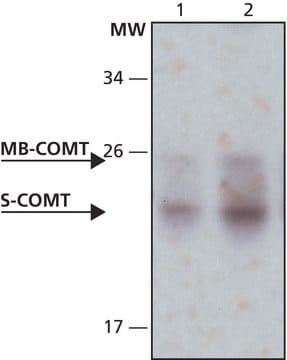
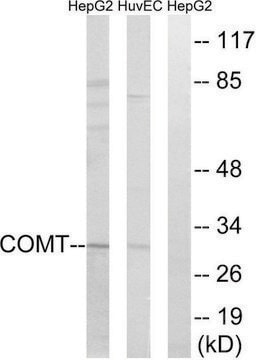
antigen ~24 kDa (and ~28 kDa)

species reactivity

human, mouse, rat

technique(s)

immunoprecipitation (IP): 5-10 μL using human HepG2 cell lysates, western blot: 1:250-1:500 using whole extracts of mouse and rat liver

UniProt accession no.

shipped in

dry ice

storage temp.

−20°C

target post-translational modification

unmodified

Gene Information

human ... COMT(1312)
mouse ... Comt1(12846)
rat ... Comt(24267)

General description

COMT (Catechol-O-methyltransferase) catalyzes the transfer of a methyl group from S-adenosylmethionine to catecholamines, including the neurotransmitters dopamine, epinephrine, and norepinephrine. This O-methylation results in one of the major degradative
Catechol-O-methyltransferase (COMT) is encoded by the gene mapped to human chromosome 22q11.21. It is widely expressed in neuronal and non-neuronal tissues. In mammals, two isoforms of COMT have been identified a cytosolic soluble form (S-COMT) and a membrane-bound form (MB-COMT), whose relative levels differ in various tissues and species.

Application

Anti-COMT antibody produced in rabbit has been used in enzyme linked immunoassay (ELISA).
Anti-COMT antibody produced in rabbit is suitable for immunoprecipitation at a concentration of 5-10μL using human HepG2 cell lysates and western blotting at a dilution of 1:250-1:500 using whole extracts of mouse and rat liver.

Biochem/physiol Actions

Catechol-O-methyltransferase (COMT) catalyzes the transfer of a methyl group from S-adenosylmethionine to catecholamine neurotransmitters including dopamine, noradrenaline, and adrenaline, their metabolites, and L-DOPA. Its major physiological role is to inactivate biologically active or toxic catechols. Variations in enzymatic activity of COMT result in the pathogenesis of different psychiatric and neurological diseases. COMT inhibitors are important therapeutic agents used in the treatment of Parkinson′s disease.
Catechol-O-methyltransferase (COMT) is referred as HEL-S-98n. The COMT Met/Met genotype individuals can acquire skill in executive function tasks (as multi-UV supervisory control to a higher level and faster than other genotype groups). The genetic variants of COMT alter neurobehavioral functions that are affected by mercury in adults and might modify the adverse neurobehavioral effects of mercury exposure in children.
The antibody recognizes MB-COMT and S-COMT.

Physical form

Solution in 0.01 M phos­phate buffered saline, pH 7.4, containing 15 mM sodium azide.

Disclaimer

Unless otherwise stated in our catalog or other company documentation accompanying the product(s), our products are intended for research use only and are not to be used for any other purpose, which includes but is not limited to, unauthorized commercial uses, in vitro diagnostic uses, ex vivo or in vivo therapeutic uses or any type of consumption or application to humans or animals.

Ähnliche Artikel vergleichen

Vollständigen Vergleich anzeigen

Unterschiede anzeigen

1 of 1

Dieser Artikel
SAB4500401SAB4300735SAB4500410
Quality Level

200

Quality Level

100

Quality Level

100

Quality Level

-

antibody form

IgG fraction of antiserum

antibody form

affinity isolated antibody

antibody form

affinity isolated antibody

antibody form

affinity isolated antibody

biological source

rabbit

biological source

rabbit

biological source

rabbit

biological source

rabbit

conjugate

unconjugated

conjugate

unconjugated

conjugate

unconjugated

conjugate

unconjugated

mol wt

antigen ~24 kDa (and ~28 kDa)

mol wt

antigen 30 kDa

mol wt

82 kDa

mol wt

antigen 52 kDa

UniProt accession no.

P21964

UniProt accession no.

P21964

UniProt accession no.

P49747

UniProt accession no.

P41279


Still not finding the right product?

Explore all of our products under

oder

Probieren Sie unser Produkt-Auswahlhilfe, um Ihre Auswahl einzugrenzen


Lagerklasse

10 - Combustible liquids

wgk

WGK 2

flash_point_f

Not applicable

flash_point_c

Not applicable

ppe

Eyeshields, Gloves, multi-purpose combination respirator cartridge (US)


Hier finden Sie alle aktuellen Versionen:

Analysenzertifikate (COA)

Lot/Batch Number

Die passende Version wird nicht angezeigt?

Wenn Sie eine bestimmte Version benötigen, können Sie anhand der Lot- oder Chargennummer nach einem spezifischen Zertifikat suchen.

Besitzen Sie dieses Produkt bereits?

In der Dokumentenbibliothek finden Sie die Dokumentation zu den Produkten, die Sie kürzlich erworben haben.

Die Dokumentenbibliothek aufrufen


Verwandter Inhalt

Instructions


Distribution of catechol-O-methyltransferase (COMT) proteins and enzymatic activities in wild-type and soluble COMT deficient mice
Myohanen T, et al.
Journal of Neurochemistry, 113(6), 1632-1643 (2010)
Weimin Kong et al.
British journal of pharmacology, 180(13), 1690-1709 (2023-01-25)
Liver failure is associated with psychiatric alterations, partly resulting from the increased brain dopamine levels. We investigated the relationship between increased dopamine levels and mental abnormalities using bile duct ligation (BDL) rats and the mechanism by which liver failure increased
The chemistry of catechol-O-methyltransferase inhibitors
International Review of Neurobiology, 95(4), 119-162 (2010)


Global Trade Item Number

SKUGTIN
C6870-200UL04061837719981

Questions

Reviews

No rating value

Active Filters