
Fortfahren mit
C3275

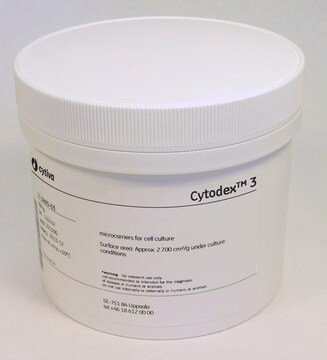
Cytodex® 3 microcarrier beads
>175 μm particle size (spherical), in 0.9% NaCl solution
Anmelden zur Ansicht der Organisations- und Vertragspreise.
Über diesen Artikel
material
dextran beads
sterility
non-sterile
particle size
>175 μm (spherical)
density
1.04 g/cm3 at 25 °C
General description
Dextran beads coated with denatured porcine-skin collagen bound to surface.
The microcarrier of choice for cells that may be difficult to culture in vitro.
Microcarrier culture is a technique which makes possible the practical high yield culture of anchorage-dependent cells. Cytodex has been specifically developed for the culture of a wide range of animal cells in culture volumes ranging from a few ml to more than 6000 L. Using Cytodex in simple suspension culture systems provides yields of several million cells per mL.
Formed by chemically coupling a thin layer of denatured collagen to the cross-linked dextran matrix, this is the microcarrier of choice for cells that may be difficult to culture in vitro, and particularly for cells with an epithelial like morphology.
Microcarrier culture is a technique which makes possible the practical high yield culture of anchorage-dependent cells. Cytodex has been specifically developed for the culture of a wide range of animal cells in culture volumes ranging from a few ml to more than 6000 L. Using Cytodex in simple suspension culture systems provides yields of several million cells per mL.
Formed by chemically coupling a thin layer of denatured collagen to the cross-linked dextran matrix, this is the microcarrier of choice for cells that may be difficult to culture in vitro, and particularly for cells with an epithelial like morphology.
Application
Cytodex™3 microcarrier beads are suitable for:
- the isolation, transportation, and storage of cells
- cells that might be challenging to culture in vitro, especially cells with an epithelial morphology, sensitive, differentiated, or low in plating efficiency (e.g., endocrine cells, hepatocytes)
- large-scale production of viruses, cells, and recombinant cell products (e.g. hormones, nucleic acids, enzymes, interferon)
For cells (particularly those of epithelial origin) which are normally difficult to grow in culture.
Features and Benefits
- Designed for culture of primary cells or those with an epithelioid morphology, especially cells with low plating-efficiency or differentiated or sensitive cell-types which are normally difficult to grow, e.g. hepatocytes, endocrine cells.
- Contains a layer of acid-denatured porcine collagen (gelatin) on the surface of the microporous matrix.
- Designed to yield harvested cells of the highest viability.
- Transparent for easy microscopic examination of attached cells.
Preparation Note
Prior to use, swell beads in PBS (50 mL/g) and autoclave at 120°C.
Legal Information
Cytodex is a registered trademark of Cytiva
Lagerklasse
13 - Non Combustible Solids
wgk
WGK 3
flash_point_f
Not applicable
flash_point_c
Not applicable
ppe
Eyeshields, Gloves, type N95 (US)
Hier finden Sie alle aktuellen Versionen:
Besitzen Sie dieses Produkt bereits?
In der Dokumentenbibliothek finden Sie die Dokumentation zu den Produkten, die Sie kürzlich erworben haben.
David K Giles et al.
Microbes and infection, 10(14-15), 1494-1503 (2008-10-04)
Confinement of the obligate intracellular bacterium Chlamydia trachomatis to a membrane-bound vacuole, termed an inclusion, within infected epithelial cells neither prevents secretion of chlamydial antigens into the host cytosol nor protects chlamydiae from innate immune detection. However, the details leading
Kun Ding et al.
mAbs, 9(2), 269-284 (2016-12-09)
Exudative age-related macular degeneration (AMD) is the most common cause of moderate and severe vision loss in developed countries. Intraocular injections of vascular endothelial growth factor (VEGF or VEGF-A)-neutralizing proteins provide substantial benefit, but frequent, long-term injections are needed. In
George Haddad et al.
Journal of the American Society of Nephrology : JASN, 32(2), 323-341 (2021-01-23)
Renal ischemia-reperfusion (I/R) injury is a major cause of AKI. Noncoding RNAs are intricately involved in the pathophysiology of this form of AKI. Transcription of hypoxia-induced, long noncoding RNA H19, which shows high embryonic expression and is silenced in adults
Global Trade Item Number
| SKU | GTIN |
|---|---|
| C3275-10G | 04061832659633 |