
Fortfahren mit
C0715

Monoclonal Anti-Cathepsin D antibody produced in mouse
clone CTD-19, ascites fluid
Synonym(e):
Anti-CLN10, Anti-CPSD, Anti-HEL-S-130P
Größe auswählen
| Ihnen/SKU | Verfügbarkeit | Preis |
|---|---|---|
0.5 mL | Warenkorb auf Verfügbarkeit prüfen | € 665,00 € 565,25 |
Über diesen Artikel
€ 565,25
Listenpreis€ 665,00Sparen Sie 15%biological source
mouse
Quality Segment
conjugate
unconjugated
antibody form
ascites fluid
antibody product type
primary antibodies
clone
CTD-19, monoclonal
mol wt
antigen 34 kDa, antigen 52 kDa (weaker band)
species reactivity
human
technique(s)
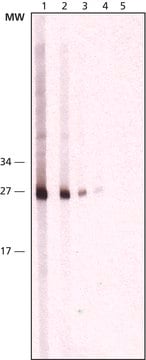
immunohistochemistry (formalin-fixed, paraffin-embedded sections): 1:200 using human breast carcinoma tissue, indirect ELISA: suitable, microarray: suitable, western blot: 1:1,000 using human breast carcinoma cell line extract
isotype
IgG2a
UniProt accession no.
shipped in
dry ice
storage temp.
−20°C
target post-translational modification
unmodified
Gene Information
human ... CTSD(1509)
General description
Cathepsin D (CD, EC 3.4.23.5), an aspartyl endopeptidase, is induced by estrogen in certain estrogen receptor (ER)-positive breast cancer cell lines, but is produced constitutively by ER-negative cell lines. Cathepsin D is synthesized as a 52 kDa inactive precursor (pro-cathepsin D). Proteolytic removal of the amino-terminal 43 amino acid fragment and cleavage at an internal site results in an enzymatically active 48 kDa heterodimer consisting of two chains of 14 and 34 kDa.
The level of CD synthesized by cells is increased in response to mitogenic signals from estrogen, EGF, FGF, and IGF- I. The ability of tumor cells to invade the extracellular matrix has been attributed to cathepsins released by tumor cells or associated with the plasma membrane of tumor cells. CD is capable of digesting extracellular matrix proteins in in vivo models. Transfection of the CD gene into rat cells increases their tumorigenicity when injected into nude mice. Indeed, the concentrations of CD are significantly higher in breast carcinomas than in either normal breast tissues or benign breast tumors.
Immunogen
Application
Immunohistochemistry (1 paper)
Western Blotting (1 paper)
Biochem/physiol Actions
Disclaimer
1 of 1
Dieser Artikel | |||
|---|---|---|---|
| species reactivity human | species reactivity human | species reactivity rat, human | species reactivity rat, mouse, human, monkey |
| antibody form ascites fluid | antibody form purified immunoglobulin | antibody form purified immunoglobulin | antibody form ascites fluid |
| conjugate unconjugated | conjugate unconjugated | conjugate unconjugated | conjugate unconjugated |
| biological source mouse | biological source mouse | biological source mouse | biological source mouse |
| Gene Information human ... CTSD(1509) | Gene Information human ... CTSK(1513) | Gene Information human ... CTSB(1508) | Gene Information human ... CCND1(595) |
| clone CTD-19, monoclonal | clone CL124-1H6, monoclonal | clone CB59-4B11, monoclonal | clone DCS-6, monoclonal |



Still not finding the right product?
Probieren Sie unser Produkt-Auswahlhilfe, um Ihre Auswahl einzugrenzen
Lagerklasse
10 - Combustible liquids
wgk
WGK 3
Hier finden Sie alle aktuellen Versionen:
Besitzen Sie dieses Produkt bereits?
In der Dokumentenbibliothek finden Sie die Dokumentation zu den Produkten, die Sie kürzlich erworben haben.