Direkt zum Inhalt
Merck

B9277

Monoclonal Anti-Band 3 antibody produced in mouse

clone BIII-136, ascites fluid

Anmelden zur Ansicht der Organisations- und Vertragspreise.

Größe auswählen

100 μL

€ 493,00

0.2 ML

€ 555,90

€ 493,00


Warenkorb auf Verfügbarkeit prüfen

Großbestellung anfragen

Über diesen Artikel

UNSPSC Code:
12352203
NACRES:
NA.46
MDL number:
Conjugate:
unconjugated
Clone:
BIII-136, monoclonal
Application:
IF, IP, WB
Citations:
25

Fortfahren mit

Technischer Dienst
Benötigen Sie Hilfe? Unser Team von erfahrenen Wissenschaftlern ist für Sie da.
Unterstützung erhalten

biological source

mouse

Quality Level

conjugate

unconjugated

antibody form

ascites fluid

antibody product type

primary antibodies

clone

BIII-136, monoclonal

contains

15 mM sodium azide

species reactivity

human

technique(s)

immunoprecipitation (IP): suitable using human erythrocytes, indirect immunofluorescence: suitable using methanol-fixed human erythrocytes, western blot: 1:5,000 using human erythrocytes

isotype

IgG2a

shipped in

dry ice

storage temp.

−20°C

target post-translational modification

unmodified

Gene Information

human ... SLC4A1(6521)

Ähnliche Artikel vergleichen

Vollständigen Vergleich anzeigen

Unterschiede anzeigen

1 of 4

Dieser Artikel
SAB4200722U0508C7805
conjugate

unconjugated

conjugate

-

conjugate

unconjugated

conjugate

unconjugated

antibody form

ascites fluid

antibody form

purified from hybridoma cell culture

antibody form

ascites fluid

antibody form

ascites fluid

species reactivity

human

species reactivity

human

species reactivity

human, rat, mouse, bovine

species reactivity

human, rat

biological source

mouse

biological source

mouse

biological source

mouse

biological source

mouse

clone

BIII-136, monoclonal

clone

BIII-136, monoclonal

clone

6C1, monoclonal

clone

FH-7A, monoclonal

Gene Information

human ... SLC4A1(6521)

Gene Information

human ... SLC4A1(6521)

Gene Information

human ... UBB(7314), UBC(7316)
mouse ... Ubb(22187), Ubc(22190)
rat ... Ubb(192255), Ubc(50522)

Gene Information

human ... COL3A1(1281)
rat ... Col3a1(84032)

General description

Band 3 is a hydrophobic protein, it exists in erythrocytes as a dimer and tetramer and has a strong tendency to aggregate because of oxidative stress.
Band 3 is an anion exchanger that is abundantly found in erythrocyte membranes. This integral membrane anion exchanger protein regulates mechanical stability and ion homeostasis across the red blood cell membrane. Genetic alterations in Band 3 have been associated with familial distal renal tubular acidosis
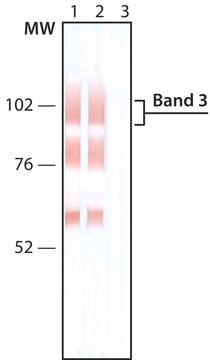
Monoclonal Anti-Band 3 antibody detects Band 3 protein (90-100 kD) and several lower molecular mass peptides migrating in SDS-PAGE gels in the regions of 60, 40 and 20 kD. The product specifically binds to the cytoplasmic amino-terminal protein of band 3 (the epitope is approx. 20 kD from the N-terminal end). As the epitope is not located at the erythrocyte surface, the antibody product does not agglutinate red blood cells. Furthermore, its cell surface binding cannot be detected by an indirect agglutination assay. The antibody does not localize Band 3 from horse, bovine, pig, guinea pig, dog or mouse erythrocytes, nor does it localize Band 3 from nonerythroid human fibroblast extract.

Immunogen

Glycophorin B from human erythrocytes.

Application

Monoclonal Anti-Band 3 antibody can be used for western blot[1], immunoprecipitation and indirect immunofluorescence using human erythrocytes.
Monoclonal Anti-Human Band 3 has been used in immunoblotting. It may also be used in the study of red cell structures and functions and to study the fragmentation of the cytoplasmic domain of band 3 protein in vivo and in vitro.
Monoclonal anti-Band 3 antibodies can be used in ELISA and immunoprecipitation. It may also be used for immunofluorescent staining.

Biochem/physiol Actions

Band 3, a 90-100kD protein is the major integral protein of human erythrocytes responsible for anion exchange. It also regulates the intracellular pH. Monoclonal anti-Band 3 antibody is useful in in vivo and in vitro study of fragmentation of cytoplasmic domain of band 3 protein. It may also be used for immunoblot analysis. Monoclonal Anti-Human Band 3 antibody reacts specifically with cytoplasmic N-terminal band 3 proteins (90-100kD).
The antibody recognizes an epitope located in the cytoplasmic N-terminus of the band 3 molecule/proteins (90-100kDa).

Disclaimer

Unless otherwise stated in our catalog or other company documentation accompanying the product(s), our products are intended for research use only and are not to be used for any other purpose, which includes but is not limited to, unauthorized commercial uses, in vitro diagnostic uses, ex vivo or in vivo therapeutic uses or any type of consumption or application to humans or animals.

Sie haben nicht das passende Produkt gefunden?  

Probieren Sie unser Produkt-Auswahlhilfe. aus.

Lagerklasse

10 - Combustible liquids

wgk

nwg

flash_point_f

Not applicable

flash_point_c

Not applicable


Hier finden Sie alle aktuellen Versionen:

Analysenzertifikate (COA)

Lot/Batch Number

Die passende Version wird nicht angezeigt?

Wenn Sie eine bestimmte Version benötigen, können Sie anhand der Lot- oder Chargennummer nach einem spezifischen Zertifikat suchen.

Besitzen Sie dieses Produkt bereits?

In der Dokumentenbibliothek finden Sie die Dokumentation zu den Produkten, die Sie kürzlich erworben haben.

Die Dokumentenbibliothek aufrufen

E Lecarpentier et al.
PloS one, 11(1), e0147262-e0147262 (2016-01-28)
In the human placenta the maternal blood circulates in the intervillous space (IVS). The syncytiotrophoblast (STB) is in direct contact with maternal blood. The wall shear stress (WSS) exerted by the maternal blood flow on the STB has not been
Reduced PKC α Activity Induces Senescent Phenotype in Erythrocytes.
Govekar, R., B., et al.
Anemia, doi:10-doi:10 (2012)
Antonella Pantaleo et al.
Oxidative medicine and cellular longevity, 2016, 6051093-6051093 (2016-04-02)
In erythrocytes, the regulation of the redox sensitive Tyr phosphorylation of band 3 and its functions are still partially defined. A role of band 3 oxidation in regulating its own phosphorylation has been previously suggested. The current study provides evidences
Mohammad Al-Ansari et al.
BMC hematology, 15, 17-17 (2015-12-22)
Glucose-6-phosphate dehydrogenase (G6PD) deficiency is associated with erythrocyte sensitivity to oxidative damage and hemolytic crises. In β-thalassemia major, where hemoglobin instability imposes oxidative stress, erythrocytes show reduced hENT1 nucleoside transporter expression and decreased nucleoside uptake. This study investigated hENT1 expression
M Czerwiński et al.
European journal of biochemistry, 174(4), 647-654 (1988-07-01)
The mouse hybridoma monoclonal antibody BIII.136 of the IgG2a class is specific for human erythrocyte band-3 protein. It was shown by means of immunoblotting and immunoprecipitation assays that the antibody recognized an epitope located in the cytoplasmic pole of the

Global Trade Item Number

SKUGTIN
B9277-.2ML04061837856389
B9277-100UL04061837856396

Questions

Reviews

No rating value

Active Filters

Unser Team von Wissenschaftlern verfügt über Erfahrung in allen Forschungsbereichen einschließlich Life Science, Materialwissenschaften, chemischer Synthese, Chromatographie, Analytik und vielen mehr..

Setzen Sie sich mit dem technischen Dienst in Verbindung