


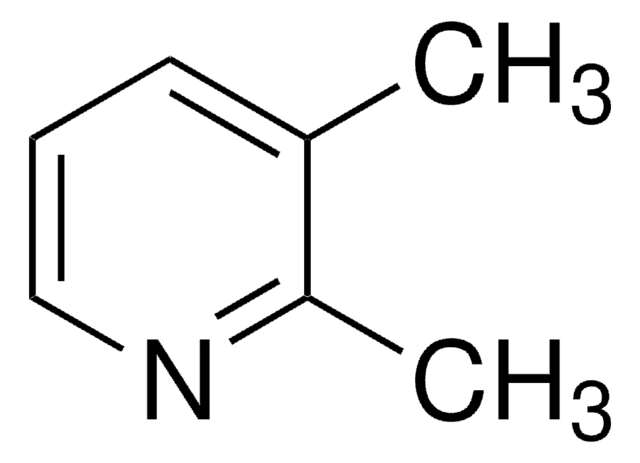


The test methods for this 2,6-Lutidine product is considered proprietary.
Fortfahren mit
L3900

2,6-Lutidin
ReagentPlus®, 98%
Synonym(e):
2,6-Dimethylpyridin
Anmelden zur Ansicht der Organisations- und Vertragspreise.
Größe auswählen
Ansicht ändern
| Packungsgröße | SKU | Verfügbarkeit | Preis |
|---|
Über diesen Artikel
Empirische Formel (Hill-System):
C7H9N
CAS-Nummer:
Molekulargewicht:
107.15
UNSPSC Code:
12352005
PubChem Substance ID:
NACRES:
NA.22
EC Number:
203-587-3
MDL number:
Beilstein/REAXYS Number:
105690
Assay:
98%
Form:
liquid
Preise und Verfügbarkeit sind derzeit nicht verfügbar.
Technischer Dienst
Benötigen Sie Hilfe? Unser Team von erfahrenen Wissenschaftlern ist für Sie da.
Unterstützung erhaltenQuality Segment
product line
ReagentPlus®
assay
98%
form
liquid
refractive index
n20/D 1.497 (lit.)
bp
143-145 °C ((lit.)), 143-145 °C (lit.)
mp
-6 °C, −6 °C (lit.)
density
0.92 g/mL at 25 °C ((lit.)), 0.92 g/mL at 25 °C (lit.)
SMILES string
CCCCCCCCCCCC(=O)ON1C(=O)CCC1=O, Cc1cccc(C)n1
InChI
1S/C16H27NO4/c1-2-3-4-5-6-7-8-9-10-11-16(20)21-17-14(18)12-13-15(17)19/h2-13H2,1H3, 1S/C7H9N/c1-6-4-3-5-7(2)8-6/h3-5H,1-2H3
InChI key
LRKGVVJOUNKTGG-UHFFFAOYSA-N
, OISVCGZHLKNMSJ-UHFFFAOYSA-N
Application
2,6-Lutidin kann bei der Oxidation von α-CF3-Alkoholen zu den entsprechenden Carbonylverbindungen in Gegenwart von 4-Acetamido-2,2,6,6-tetramethylpiperidin-1-oxoammonium-tetrafluorborat (Bobbitt-Salz) als Oxidationsreagenz als Base verwendet werden.
Es hat folgende Anwendungen:
Es hat folgende Anwendungen:
- Als Promoter der katalytischen asymmetrischen Fluorierung von α-Cyanophosphonaten in Gegenwart von chiralen Pd(II)-Bisphosphin-Komplexen.
- In Kombination mit tert-Butyldimethylsilyltriflat für den Schutz von tertiären Alkoholen und unreaktiven sekundären Alkoholen.
- In Kombination mit Triethylsilyl-trifluormethansulfonat für die Umwandlung von Acetalen in die entsprechenden Aldehyde in Dichlormethan, gefolgt von einer weiteren Verarbeitung in Wasser.
Legal Information
ReagentPlus is a registered trademark of Merck KGaA, Darmstadt, Germany
1 of 1
Dieser Artikel | |||
|---|---|---|---|
| assay 98% | assay 99% | assay 99% | assay ≥98% |
| Quality Level 200 | Quality Level 100 | Quality Level 100 | Quality Level 200 |
| form liquid | form liquid | form - | form liquid |
| refractive index n20/D 1.497 (lit.) | refractive index n20/D 1.499 (lit.) | refractive index n20/D 1.508 (lit.) | refractive index n20/D 1.504 (lit.) |
| density 0.92 g/mL at 25 °C ((lit.)), 0.92 g/mL at 25 °C (lit.) | density 0.927 g/mL at 25 °C (lit.) | density 0.945 g/mL at 25 °C (lit.) | density 0.939 g/mL at 25 °C (lit.) |
| bp 143-145 °C ((lit.)), 143-145 °C (lit.) | bp 159 °C (lit.) | bp 162-163 °C (lit.) | bp 169-170 °C (lit.) |
Still not finding the right product?
Explore all of our products under 2,6-Lutidin
signalword
Warning
hcodes
Hazard Classifications
Acute Tox. 4 Oral - Eye Irrit. 2 - Flam. Liq. 3 - Skin Irrit. 2
Lagerklasse
3 - Flammable liquids
wgk
WGK 3
ppe
Eyeshields, Faceshields, Gloves, type ABEK (EN14387) respirator filter
flash_point_f
89.6 °F
flash_point_c
32 °C
Hier finden Sie alle aktuellen Versionen:
Besitzen Sie dieses Produkt bereits?
In der Dokumentenbibliothek finden Sie die Dokumentation zu den Produkten, die Sie kürzlich erworben haben.
Verwandter Inhalt
Studies with trialkylsilyltriflates: new syntheses and applications.
Corey E J, et al.
Tetrahedron Letters, 22(36), 3455-3458 (1981)
Unexpected Highly Chemoselective Deprotection of the Acetals from Aldehydes and Not Ketones: TESOTf? 2, 6-Lutidine Combination.
Fujioka H, et al.
Journal of the American Chemical Society, 126(38), 11800-11801 (2004)
Pd (II)-Catalyzed Asymmetric Fluorination of ?-Aryl-?-cyanophosphonates with the Aid of 2, 6-Lutidine.
Moriya K I, et al.
Synlett, 2007(07), 1139-1142 (2007)
Global Trade Item Number
| SKU | GTIN |
|---|---|
| L3900-2L-A | 04061837676291 |
| L3900-100ML-A | 04061833957134 |
| L3900-500ML-A | 04061833957141 |
-
What is the appearance test standard used for product L3900 (2,6-Lutidine). Color chart or EP color standard?
1 answer-
Helpful?
-
-
How can I determine the shelf life / expiration / retest date of this product?
1 answer-
If this product has an expiration or retest date, it will be shown on the Certificate of Analysis (COA, CofA). If there is no retest or expiration date listed on the product's COA, we do not have suitable stability data to determine a shelf life. For these products, the only date on the COA will be the release date; a retest, expiration, or use-by-date will not be displayed.
For all products, we recommend handling per defined conditions as printed in our product literature and website product descriptions. We recommend that products should be routinely inspected by customers to ensure they perform as expected.
For products without retest or expiration dates, our standard warranty of 1 year from the date of shipment is applicable.
For more information, please refer to the Product Dating Information document: https://www.sigmaaldrich.com/deepweb/assets/sigmaaldrich/marketing/global/documents/418/501/product-dating-information-06-25-mk.pdfHelpful?
-
-
How is shipping temperature determined? And how is it related to the product storage temperature?
1 answer-
Products may be shipped at a different temperature than the recommended long-term storage temperature. If the product quality is sensitive to short-term exposure to conditions other than the recommended long-term storage, it will be shipped on wet or dry-ice. If the product quality is NOT affected by short-term exposure to conditions other than the recommended long-term storage, it will be shipped at ambient temperature. As shipping routes are configured for minimum transit times, shipping at ambient temperature helps control shipping costs for our customers. For more information, please refer to the Storage and Transport Conditions document: https://www.sigmaaldrich.com/deepweb/assets/sigmaaldrich/marketing/global/documents/316/622/storage-transport-conditions-mk.pdf
Helpful?
-