



Autoclaving affects the pH of the dissolved medium, hence it is preferable to check the pH after autoclaving. pH should be checked at a temperature between 20-25°C. Adjustments can be made with HCl/NaOH if needed, while stirring.
Fortfahren mit
22091

Trypton-Soja-Agar – Dehydrierte Kulturmedien
NutriSelect® Plus, powder, suitable for microbiology
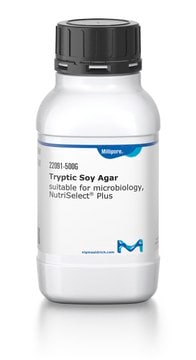
Tryptic Soy Agar - Dehydrated Culture Media
Synonym(e):
CASO-Agar, Soja-Casein-Agar, verdaut; TSA, Trypton-Soja-Agar, CASO-Agar, Sojabohnen-Caseinaufschluss-Agar, TSA, Trypton-Soja-Agar
Anmelden zur Ansicht der Organisations- und Vertragspreise.
Größe auswählen
Ansicht ändern
| Packungsgröße | SKU | Verfügbarkeit | Preis |
|---|---|---|---|
| 500 g | Warenkorb auf Verfügbarkeit prüfen | € 162,00 | |
| 2.5 kg | Warenkorb auf Verfügbarkeit prüfen | € 493,00 |
Über diesen Artikel
NACRES:
NA.74
UNSPSC Code:
41171605
Manufacturer/tradename:
NutriSelect® Plus
Agency:
according to GB 4789.40-2016, according to ISO 11731:2017, according to ISO 22964:2017
Form:
powder
Suitability:
Enterococcus spp., Haemophilus spp., Pneumococcus spp., nonselective for Bacillus spp., nonselective for Bacteroides spp., nonselective for Campylobacter spp., nonselective for Candida spp., nonselective for Cronobacter spp., nonselective for Escherichia coli, nonselective for Neisseria spp., nonselective for Staphylococcus spp., nonselective for Streptococcus spp., nonselective for bacteria (General Media), nonselective for coliforms
Application(s):
agriculture
bioburden testing
cleaning products
clinical testing
cosmetics
environmental
food and beverages
personal care
surface monitoring
veterinary, microbiology
bioburden testing
cleaning products
clinical testing
cosmetics
environmental
food and beverages
personal care
surface monitoring
veterinary, microbiology
Technischer Dienst
Benötigen Sie Hilfe? Unser Team von erfahrenen Wissenschaftlern ist für Sie da.
Unterstützung erhaltenQuality Segment
agency
according to GB 4789.40-2016, according to ISO 11731:2017, according to ISO 22964:2017
sterility
non-sterile
product line
BioChemika
form
powder
shelf life
limited shelf life, expiry date on the label
composition
agar, 15 g/L , casein peptone (pancreatic), 15 g/L , sodium chloride, 5 g/L , soya peptone (papainic), 5 g/L
packaging
bottle of 2.5 kg, bottle of 500 g
manufacturer/tradename
NutriSelect® Plus
technique(s)
microbe id | specific enzyme detection: suitable, microbiological culture: suitable
color
light yellow
final pH
7.3±0.2 (25 °C)
application(s)
agriculture
bioburden testing
cleaning products
clinical testing
cosmetics
environmental
food and beverages
personal care
surface monitoring
veterinary, microbiology
suitability
Enterococcus spp., Haemophilus spp., Pneumococcus spp., nonselective for Bacillus spp., nonselective for Bacteroides spp., nonselective for Campylobacter spp., nonselective for Candida spp., nonselective for Cronobacter spp., nonselective for Escherichia coli, nonselective for Neisseria spp., nonselective for Staphylococcus spp., nonselective for Streptococcus spp., nonselective for bacteria (General Media), nonselective for coliforms
General description
Trypton-Soja-Agar ist ein Allzweck-Nährmedium für die Isolierung und Kultivierung von anspruchsvollen und anspruchslosen Mikroorganismen oder die Pflege von Stammkulturen. Es ist ein komplexes Medium zur Kultivierung und Isolierung vieler Bakterien, Hefen und Schimmelpilze. Die Formulierung des TSA-Mediums enthält eine Kombination von Casein- und Soja-Peptonen und liefert organischen Stickstoff, insbesondere Aminosäuren und längerkettige Peptide. Natriumchlorid hält das osmotische Gleichgewicht im Medium aufrecht und die natürlichen Zucker von den Sojapeptonen dienen als Energiequelle.
Application
Trypton-Soja-Agar wird für die Vorkultivierung und Keimzahlbestimmung (E. coli) mittels Membranfiltrationstechnik eingesetzt. Das Nährmedium eignet sich gleichermaßen für die Kultivierung von aeroben und anaeroben Bakterien. Da es keine X- und V-Faktoren enthält, eignet es sich für die Identifizierung von Haemophilus sp. durch Zusatz von Streifen mit X-Faktor (Hämin) und V-Faktor (DPN = NAD).
Features and Benefits
NutriSelect® Plus sind Nährmedien in Pulverform, die Folgendes bieten:
- Qualitätskontrolle mit Test auf Wachstumsförderung gemäß Branchenstandards
- Qualitätssicherung gemäß ISO 9001
- Kostengünstige Medien in Pulverform
Preparation Note
40 g dehydrierte Medien, suspendiert in 1 Liter aufgereinigtem, filtriertem Wasser. Bei 121 °C 15 Minuten lang sterilisieren. Auf 45–50 °C abkühlen. Vorsichtig mischen und in sterile Petrischalen oder sterile Kulturröhrchen verteilen.
Legal Information
GRANUCULT is a registered trademark of Merck KGaA, Darmstadt, Germany
NutriSelect is a registered trademark of Merck KGaA, Darmstadt, Germany
Disclaimer
Wir haben je nach Bedarf zwei Arten von Kulturmedien im Angebot: das ausgezeichnete Granulat GranuCult® und das kostengünstige Pulver NutriSelect®. Die Bezeichnungen Basic, Plus oder Prime werden angehängt, um das Maß der Qualitätssicherung anzugeben – von einer grundlegenden Qualitätssicherung über die gängige QC-Plus bis hin zu Prime für eine vollständige Einhaltung behördlicher Auflagen.
1 of 1
Dieser Artikel | |||
|---|---|---|---|
| manufacturer/tradename NutriSelect® Plus | manufacturer/tradename NutriSelect® Plus | manufacturer/tradename NutriSelect® Plus | manufacturer/tradename NutriSelect® Plus |
| suitability Enterococcus spp., Pneumococcus spp., nonselective for Bacteroides spp., nonselective for Candida spp., nonselective for Escherichia coli, nonselective for Staphylococcus spp., nonselective for bacteria (General Media), Haemophilus spp., nonselective for Campylobacter spp., nonselective for Neisseria spp., nonselective for coliforms, nonselective for Bacillus spp., nonselective for Streptococcus spp., nonselective for Cronobacter spp. | suitability Enterococcus spp., Haemophilus spp., Pneumococcus spp., nonselective for Bacillus spp., nonselective for Bacteroides spp., nonselective for Campylobacter spp., nonselective for Candida spp., nonselective for Escherichia coli, nonselective for Neisseria spp., nonselective for Staphylococcus spp., nonselective for Streptococcus spp., nonselective for bacteria (General Media), nonselective for coliforms | suitability Enterococcus spp., Haemophilus spp., Pneumococcus spp., nonselective for Bacillus spp., nonselective for Bacteroides spp., nonselective for Campylobacter spp., nonselective for Candida spp., nonselective for Escherichia coli, nonselective for Neisseria spp., nonselective for Staphylococcus spp., nonselective for Streptococcus spp., nonselective for bacteria (Fastidious organisms), nonselective for coliforms | suitability Micrococcus spp., nonselective for Aspergillus spp., nonselective for Bacillus spp., nonselective for Candida spp., nonselective for Enterococcus spp., nonselective for Escherichia coli, nonselective for Pseudomonas spp., nonselective for Salmonella spp., nonselective for Serratia spp., nonselective for Staphylococcus spp., nonselective for Streptococcus spp., nonselective for bacteria (General Media), nonselective for coliforms |
| agency according to GB 4789.40-2016, according to ISO 22964:2017, according to ISO 11731:2017 | agency - | agency according to GB 4789.40-2016, according to ISO 11731:2017, according to ISO 22964:2017 | agency - |
| form powder | form powder | form powder | form powder |
| application(s) agriculture | application(s) agriculture | application(s) bioburden testing | application(s) cleaning products |
| technique(s) microbe id | specific enzyme detection: suitable, microbiological culture: suitable | technique(s) microbe id | specific enzyme detection: suitable, microbiological culture: suitable | technique(s) microbe id | specific enzyme detection: suitable, microbiological culture: suitable | technique(s) - |
Still not finding the right product?
Explore all of our products under Trypton-Soja-Agar – Dehydrierte Kulturmedien
Lagerklasse
11 - Combustible Solids
wgk
WGK 3
flash_point_f
Not applicable
flash_point_c
Not applicable
ppe
Eyeshields, Gloves, type N95 (US)
Hier finden Sie alle aktuellen Versionen:
Besitzen Sie dieses Produkt bereits?
In der Dokumentenbibliothek finden Sie die Dokumentation zu den Produkten, die Sie kürzlich erworben haben.
Artikel
Some Bacillus species are crucial for advancing our understanding of bacteria, while others can be harmful, acting as spoilage organisms or pathogens. Nevertheless, all these species are significant in biotechnological research.
Campylobacter spp. are regarded as the leading cause of bacterial gastroenteritis in humans worldwide.
Cronobacter spp. are frequently found on vegetables, meat, fermented bread, dairy and in baby food. Consumption of contaminated powdered infant formula milk can result in sepsis, infant meningitis and necrotizing enterocolitis.
Verwandter Inhalt
Binbin Deng et al.
iScience, 23(2), 100827-100827 (2020-02-15)
Pseudomonas aeruginosa biofilms represent a major threat to health care. Rugose small colony variants (RSCV) of P. aeruginosa, isolated from chronic infections, display hyperbiofilm phenotype. RSCV biofilms are highly resistant to antibiotics and host defenses. This work shows that RSCV
Byron Brook et al.
Science translational medicine, 12(542) (2020-05-08)
Death from sepsis in the neonatal period remains a serious threat for millions. Within 3 days of administration, bacille Calmette-Guérin (BCG) vaccination can reduce mortality from neonatal sepsis in human newborns, but the underlying mechanism for this rapid protection is
Mariana Lanzarini-Lopes et al.
Water research, 184, 116191-116191 (2020-07-30)
This paper investigates using UV-C side-emitting optical fibers (SEOFs) to prevent growth of pathogenic bacteria (Pseudomonas aeruginosa and Escherichia coli) on nutrient-rich surfaces. Attaching a SEOF to a single 265 nm light emitting diode (LED) increases irradiation area by >1000x
Global Trade Item Number
| SKU | GTIN |
|---|---|
| 22091-500G | 04061838776761 |
| 22091-2.5KG | 04061838776754 |
-
Hi everyone and good afternoon My question is about checking of PH of Media, in which conditions we should check PH of the medium before autoclaving or after autoclaving
1 answer-
Helpful?
-