
Fortfahren mit
18224

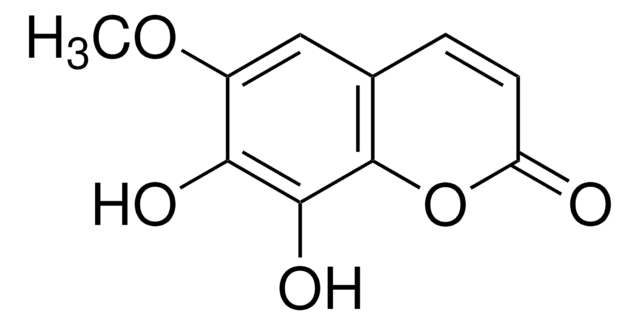
Fraxetin
analytical standard
Synonym(e):
7,8-Dihydroxy-6-methoxycumarin, Fraxetin
Anmelden zur Ansicht der Organisations- und Vertragspreise.
Über diesen Artikel
Empirische Formel (Hill-System):
C10H8O5
CAS-Nummer:
Molekulargewicht:
208.17
NACRES:
NA.24
PubChem Substance ID:
UNSPSC Code:
85151701
EC Number:
209-376-2
MDL number:
grade
analytical standard
Quality Segment
assay
≥98.0% (HPLC)
shelf life
limited shelf life, expiry date on the label
technique(s)
HPLC: suitable, gas chromatography (GC): suitable
impurities
≤2.5% water (calc. from elemental analysis)
mp
230-231 °C (lit.)
application(s)
food and beverages
format
neat
SMILES string
COc1cc2C=CC(=O)Oc2c(O)c1O
InChI
1S/C10H8O5/c1-14-6-4-5-2-3-7(11)15-10(5)9(13)8(6)12/h2-4,12-13H,1H3
InChI key
HAVWRBANWNTOJX-UHFFFAOYSA-N
Application
Refer to the product′s Certificate of Analysis for more information on a suitable instrument technique. Contact Technical Service for further support.
Still not finding the right product?
Explore all of our products under Fraxetin

signalword
Warning
hcodes
Hazard Classifications
Acute Tox. 4 Oral
Lagerklasse
11 - Combustible Solids
wgk
WGK 3
flash_point_f
Not applicable
flash_point_c
Not applicable
Hier finden Sie alle aktuellen Versionen:
Besitzen Sie dieses Produkt bereits?
In der Dokumentenbibliothek finden Sie die Dokumentation zu den Produkten, die Sie kürzlich erworben haben.
Miguel Nemesio-Gorriz et al.
Journal of experimental botany, 71(19), 6074-6083 (2020-07-01)
Ash dieback, a forest epidemic caused by the invasive fungus Hymenoscyphus fraxineus, threatens ash trees throughout Europe. Within Fraxinus excelsior populations, a small proportion of genotypes show a low susceptibility to the pathogen. We compared the metabolomes from a cohort
Jisoo Song et al.
Pharmaceutics, 13(1) (2021-01-23)
Fraxetin is a coumarin scaffold compound extracted from Fraxinus rhynchophylla. It has antioxidant, anti-inflammatory, hepatoprotective, and antifibrotic effects. Furthermore, fraxetin has anticancer effects in breast and lung cancer. We aimed to evaluate whether fraxetin has anticancer activity in hepatocellular carcinoma
Christopher J Harbort et al.
Cell host & microbe, 28(6), 825-837 (2020-10-08)
Plants benefit from associations with a diverse community of root-colonizing microbes. Deciphering the mechanisms underpinning these beneficial services are of interest for improving plant productivity. We report a plant-beneficial interaction between Arabidopsis thaliana and the root microbiota under iron deprivation
Global Trade Item Number
| SKU | GTIN |
|---|---|
| 18224-50MG | 04061838755698 |
| 18224-100MG | 04061838755681 |