
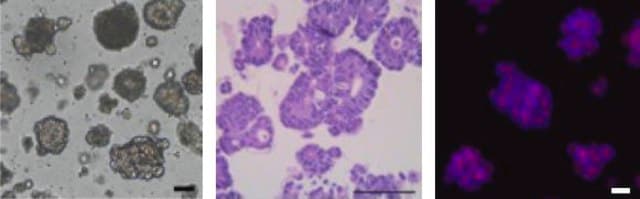
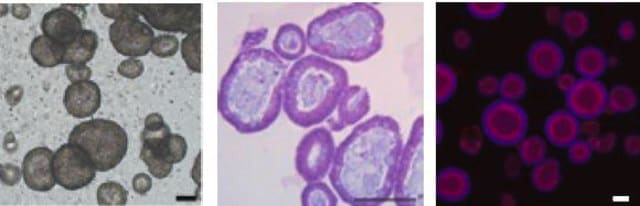
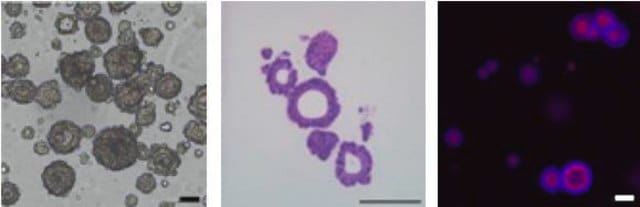

Once isolated, organoids are cultured in specialized media embedded in a rich extracellular matrix (ECM) basement membrane extract hydrogel such as Growth Factor Reduced Matrigel. Media is replenished every other day and cells are passaged once per week (7-12 days) before cells become too large or necrotic. Cells can be passaged in either small clump fragments or as single cells using mechanical dissociation/enzyme-free passaging reagents. Depending on organoid type and confluency, split ratios of roughly 1:3-1:4 can be used when passaging organoids. For sensitive organoid types, ROCKi (Y27632) (SCM075) can be added during passaging to help in promoting cell viability.
SCC506

3dGRO® Human CRC Organoids (ISO68)
Human
Anmelden zur Ansicht der Organisations- und Vertragspreise.
Größe auswählen
Ansicht ändern
| Packungsgröße | SKU | Verfügbarkeit | Preis |
|---|
Über diesen Artikel
UNSPSC Code:
41106509
NACRES:
NA.81
Preise und Verfügbarkeit sind derzeit nicht verfügbar.
Technischer Dienst
Benötigen Sie Hilfe? Unser Team von erfahrenen Wissenschaftlern ist für Sie da.
Unterstützung erhaltenProduktname
3dGRO® Human CRC Organoids (ISO68), Colorectal Cancer, Sigmoid Colon, Age: 63, Male, Mutation: APC, TP53, KRAS, SMAD4
biological source
human colon (sigmoid)
packaging
pkg of >100,000 organoids vials
manufacturer/tradename
Sigma-Aldrich
gender
male
growth mode
N/A
technique(s)
cell culture: suitable
application(s)
3D cell culture
control
colon (sigmoid)
relevant disease(s)
cancer (colorectal)
shipped in
ambient
storage temp.
−70°C
General description
Colorectal cancer accounts for roughly 10% of all cancer cases worldwide with more than half of all patients with CRC developing metastatic disease leading to death. Recently tissue derived organoids have emerged as a more predictive 3 dimensional cell culture model of disease. 3D organoid cultures conserve the original genetic and phenotypic characteristics of the primary tissue allowing for their application in many research fields included drug development, personalized medicine and potential therapeutics. In vitro cultured tumor organoids have also been shown to predict patient response to chemotherapeutics. PDOs derived from colorectal cancer (CRC organoids) have been used for cell modeling and to investigate the function of cancer related driver gene mutations including APC, TP53, KRAS, BRAF, PIK3CA etc.
3dGRO® Human CRC Organoids are offered in a ready-to-assay format intended to simplify the organoid cell culture workflow. A single vial of organoids is enough to directly thaw and seed into a 96-well plate without cell expansion for drug screening applications. The organoids are manufactured using Cellesce’s patented technology which enables the robust growth and expansion of patient-derived organoids (PDOs). Cellesce’s technology minimizes manual handling time to maximize reproducibility in order to position organoid cell models as a cost effective and accurate tool in early-stage drug discovery. The organoid biobank includes tumor derived colorectal cancer PDOs from a range of genetic backgrounds, driver gene mutations, tumor sites and cancer stages. These organoid cell lines have been well characterized and are all validated for response against a number of known CRC-targeting agents.
3dGRO® Human CRC Organoids are offered in a ready-to-assay format intended to simplify the organoid cell culture workflow. A single vial of organoids is enough to directly thaw and seed into a 96-well plate without cell expansion for drug screening applications. The organoids are manufactured using Cellesce’s patented technology which enables the robust growth and expansion of patient-derived organoids (PDOs). Cellesce’s technology minimizes manual handling time to maximize reproducibility in order to position organoid cell models as a cost effective and accurate tool in early-stage drug discovery. The organoid biobank includes tumor derived colorectal cancer PDOs from a range of genetic backgrounds, driver gene mutations, tumor sites and cancer stages. These organoid cell lines have been well characterized and are all validated for response against a number of known CRC-targeting agents.
Application
Cell Growth: Organoid expansion after 7 daysMycoplasma: NegativeViral Testing: Negative (HIV-1, HIV-2, HBV, CMV, EBV, HPV)Sterility (Bacteria, Yeast, Fungi): NegativeMutational Profile: APC ∆Q1096*E1408*, TP53 ∆R248W, KRAS ∆G13D, SMAD4 ∆Q534*
Features and Benefits
Ready-to-Assay human colorectal cancer organoids for 3D cell culture applications.
Preparation Note
Store 3dGRO® Human CRC Organoids at -80°C. For long term storage the cells should be stored in liquid nitrogen.
Legal Information
3dGRO® is a trademark of Merck KGaA, Darmstadt, Germany.
3dGRO® organoids were derived utilizing HUB Organoid Technology.
Subject to local law, this product is intended to be sold for internal in vitro research use only subject to terms and conditions found here: www.sigmaaldrich.com/pdouse. This product may not be re-engineered or copied; used to make derivatives or modifications; used to develop, test, or manufacture a commercial product; used as a component in a commercial product; resold or licensed; used in any clinical applications or trials; or used in humans. A license or limited commercial use agreement is required for use by any for-profit entity, use in services, and use in sponsored academic research. For information regarding any such use, please contact [email protected].
3dGRO® organoids were derived utilizing HUB Organoid Technology.
Subject to local law, this product is intended to be sold for internal in vitro research use only subject to terms and conditions found here: www.sigmaaldrich.com/pdouse. This product may not be re-engineered or copied; used to make derivatives or modifications; used to develop, test, or manufacture a commercial product; used as a component in a commercial product; resold or licensed; used in any clinical applications or trials; or used in humans. A license or limited commercial use agreement is required for use by any for-profit entity, use in services, and use in sponsored academic research. For information regarding any such use, please contact [email protected].
3dGRO is a registered trademark of Merck KGaA, Darmstadt, Germany
Disclaimer
RESEARCH USE ONLY. This product is regulated in France when intended to be used for scientific purposes, including for import and export activities (Article L 1211-1 paragraph 2 of the Public Health Code). The purchaser (i.e. enduser) is required to obtain an import authorization from the France Ministry of Research referred in the Article L1245-5-1 II. of Public Health Code. By ordering this product, you are confirming that you have obtained the proper import authorization.
Unless otherwise stated in our catalog or other company documentation accompanying the product(s), our products are intended for research use only and are not to be used for any other purpose, which includes but is not limited to, unauthorized commercial uses, in vitro diagnostic uses, ex vivo or in vivo therapeutic uses or any type of consumption or application to humans or animals.
Unless otherwise stated in our catalog or other company documentation accompanying the product(s), our products are intended for research use only and are not to be used for any other purpose, which includes but is not limited to, unauthorized commercial uses, in vitro diagnostic uses, ex vivo or in vivo therapeutic uses or any type of consumption or application to humans or animals.
1 of 1
Dieser Artikel | |||
|---|---|---|---|
| biological source human | biological source human | biological source human | biological source human |
| technique(s) cell culture | mammalian: suitable, cell culture | stem cell: suitable | technique(s) cell culture | mammalian: suitable, cell culture | stem cell: suitable | technique(s) cell culture | mammalian: suitable, cell culture | stem cell: suitable | technique(s) cell culture | mammalian: suitable, cell culture | stem cell: suitable |
| storage temp. −70°C | storage temp. −70°C | storage temp. −70°C | storage temp. −70°C |
| packaging pkg of >100,000 organoids vials | packaging pkg of >100,000 organoids vials | packaging pkg of >100,000 organoids vials | packaging pkg of >100,000 organoids vials |
| shipped in ambient | shipped in ambient | shipped in ambient | shipped in ambient |
| manufacturer/tradename Sigma-Aldrich | manufacturer/tradename Sigma-Aldrich | manufacturer/tradename Sigma-Aldrich | manufacturer/tradename Sigma-Aldrich |
Lagerklasse
12 - Non Combustible Liquids
wgk
WGK 3
flash_point_f
Not applicable
flash_point_c
Not applicable
Analysenzertifikate (COA)
Suchen Sie nach Analysenzertifikate (COA), indem Sie die Lot-/Chargennummer des Produkts eingeben. Lot- und Chargennummern sind auf dem Produktetikett hinter den Wörtern ‘Lot’ oder ‘Batch’ (Lot oder Charge) zu finden.
Besitzen Sie dieses Produkt bereits?
In der Dokumentenbibliothek finden Sie die Dokumentation zu den Produkten, die Sie kürzlich erworben haben.
Artikel
Organoid culture FAQs. Learn how to culture and analyze organoids following established 3D cell culture protocols. Tips and tricks.
Verwandter Inhalt
Luned M Badder et al.
PloS one, 15(8), e0235319-e0235319 (2020-08-19)
Aberrant activation of the Wnt signalling pathway is required for tumour initiation and survival in the majority of colorectal cancers. The development of inhibitors of Wnt signalling has been the focus of multiple drug discovery programs targeting colorectal cancer and
Global Trade Item Number
| SKU | GTIN |
|---|---|
| SCC506 | 04065266299106 |
-
How are organoids cultured?
1 answer-
Helpful?
-
-
How do you stain organoids with antibodies?
1 answer-
Organoids can be stained with antibodies for immunocytochemical (ICC)/Immunohistochemical (IHC) analysis using either whole-mount or paraffin embedding/sectioning techniques. It is critical to use antibodies prequalified for organoid analysis.
Helpful?
-
-
How Do you Extract RNA/DNA from Organoids in Cultured in Matrigel?
1 answer-
Traditional DNA/RNA isolation kits can be used to prepare genomic material for sequencing (RNA-seq, scRNA-seq, WGS, CHIP-seq etc). For some applications with large organoids, tissue specific DNA/RNA extraction kits are recommended. TRI Reagent (T9424) can be added to the dissociated organoids before RNA extraction and can be stored at -80 °C until future use.
Helpful?
-