

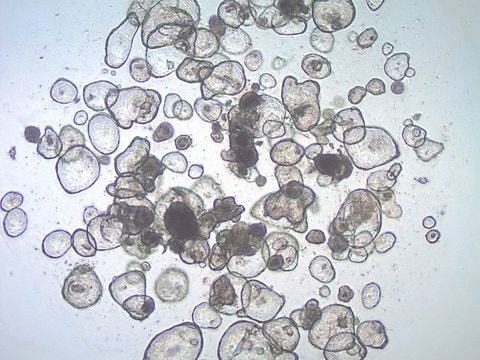
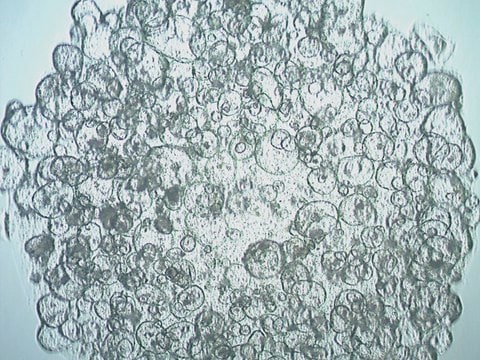
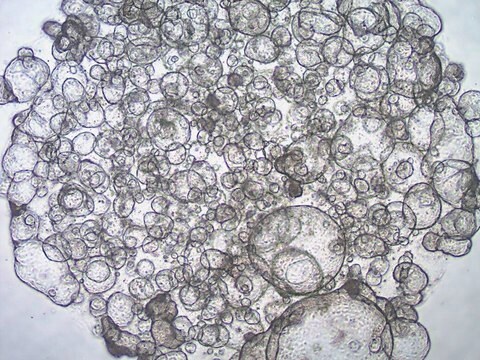
Traditional DNA/RNA isolation kits can be used to prepare genomic material for sequencing (RNA-seq, scRNA-seq, WGS, CHIP-seq etc). For some applications with large organoids, tissue specific DNA/RNA extraction kits are recommended. TRI Reagent (T9424) can be added to the dissociated organoids before RNA extraction and can be stored at -80 °C until future use.
SCC310

3dGRO® Colon Intestinal Organoids, Age 46 (14-881-CR)
Adenocarcinoma, Colon (Rectum), Age: 46, Male, Mutation: TP53, KRAS, APC
Synonym(e):
colon organoids
Anmelden zur Ansicht der Organisations- und Vertragspreise.
Größe auswählen
Ansicht ändern
| Packungsgröße | SKU | Verfügbarkeit | Preis |
|---|---|---|---|
| 1 vial | Warenkorb auf Verfügbarkeit prüfen | € 2.590,00 |
Über diesen Artikel
NACRES:
NA.81
UNSPSC Code:
41106509
€ 2.590,00
Warenkorb auf Verfügbarkeit prüfen
Technischer Dienst
Benötigen Sie Hilfe? Unser Team von erfahrenen Wissenschaftlern ist für Sie da.
Unterstützung erhaltenbiological source
human colon (rectum)
description
Cryopreserved patient derived gastrointestinal organoids (PDOs)
packaging
vial of >1500 viable organoids cells
manufacturer/tradename
Millipore
gender
male
technique(s)
cell culture: suitable
application(s)
3D cell culture
control
colon (rectum)
relevant disease(s)
adenocardinoma
shipped in
liquid nitrogen
storage temp.
−196°C
General description
Patient derived organoids (PDOs) are novel in vitro 3D cell models that preserve original tissue physiology and molecular pathology, thus representing a clinically-relevant alternative to traditional 2D cell lines and an effective tool to refine and reduce animal models. PDOs can be derived from adult patient biopsies or resected tissues containing native LGR5+ stem cell populations and cultured within an ECM-rich substrate using specialized organoid media such as L-WRN conditioned media. Adult tissue derived organoids are phenotypically and genetically stable in long term culture, presenting more mature phenotypes compared to iPSC-derived organoids. Importantly, PDOs have shown to be able to predict patient clinical responses to chemotherapeutics.
We are now offering a comprehensive biobank of highly characterized tissue-derived human gastrointestinal organoids from normal and diseased patients. The intestinal organoid biobank contains over 50 highly characterized intestinal organoids from both normal and diseased patients derived from multiple regions of the digestive systems including small intestine (duodenum, ileum), stomach, rectum and colon.
Cell Line Characteristics
We are now offering a comprehensive biobank of highly characterized tissue-derived human gastrointestinal organoids from normal and diseased patients. The intestinal organoid biobank contains over 50 highly characterized intestinal organoids from both normal and diseased patients derived from multiple regions of the digestive systems including small intestine (duodenum, ileum), stomach, rectum and colon.
Cell Line Characteristics
- Sex: Male
- Age: 46 Years
- Organ: Colon (Rectum)
- Disease: Adenocarcinoma (TP53 Pro151Ser, KRAS Gly12Asp, APC Pro1443fs)
Biochem/physiol Actions
Human, Organoid
Packaging
≥1500 viable organoids/vial
Preparation Note
Store in liquid nitrogen. The organoids can be cultured for at least 10 passages after initial thawing without significantly affecting the cell marker expression and functionality.
Legal Information
3dGRO® is a trademark of Merck KGaA, Darmstadt, Germany.
3dGRO® organoids were derived utilizing HUB Organoid Technology.
Subject to local law, this product is intended to be sold for internal in vitro research use only subject to terms and conditions found here: www.sigmaaldrich.com/pdouse. This product may not be re-engineered or copied; used to make derivatives or modifications; used to develop, test, or manufacture a commercial product; used as a component in a commercial product; resold or licensed; used in any clinical applications or trials; or used in humans. A license or limited commercial use agreement is required for use by any for-profit entity, use in services, and use in sponsored academic research. For information regarding any such use, please contact [email protected].
3dGRO® organoids were derived utilizing HUB Organoid Technology.
Subject to local law, this product is intended to be sold for internal in vitro research use only subject to terms and conditions found here: www.sigmaaldrich.com/pdouse. This product may not be re-engineered or copied; used to make derivatives or modifications; used to develop, test, or manufacture a commercial product; used as a component in a commercial product; resold or licensed; used in any clinical applications or trials; or used in humans. A license or limited commercial use agreement is required for use by any for-profit entity, use in services, and use in sponsored academic research. For information regarding any such use, please contact [email protected].
3dGRO is a registered trademark of Merck KGaA, Darmstadt, Germany
Disclaimer
RESEARCH USE ONLY. This product is regulated in France when intended to be used for scientific purposes, including for import and export activities (Article L 1211-1 paragraph 2 of the Public Health Code). The purchaser (i.e. enduser) is required to obtain an import authorization from the France Ministry of Research referred in the Article L1245-5-1 II. of Public Health Code. By ordering this product, you are confirming that you have obtained the proper import authorization.
1 of 1
Dieser Artikel | |||
|---|---|---|---|
| technique(s) cell culture | stem cell: suitable | technique(s) cell culture | stem cell: suitable | technique(s) cell culture | stem cell: suitable | technique(s) cell culture | stem cell: suitable |
| packaging vial of >1500 viable organoids cells | packaging - | packaging - | packaging - |
| manufacturer/tradename Millipore | manufacturer/tradename - | manufacturer/tradename - | manufacturer/tradename - |
| shipped in liquid nitrogen | shipped in - | shipped in - | shipped in - |
Lagerklasse
10 - Combustible liquids
wgk
WGK 3
flash_point_f
Not applicable
flash_point_c
Not applicable
Analysenzertifikate (COA)
Suchen Sie nach Analysenzertifikate (COA), indem Sie die Lot-/Chargennummer des Produkts eingeben. Lot- und Chargennummern sind auf dem Produktetikett hinter den Wörtern ‘Lot’ oder ‘Batch’ (Lot oder Charge) zu finden.
Besitzen Sie dieses Produkt bereits?
In der Dokumentenbibliothek finden Sie die Dokumentation zu den Produkten, die Sie kürzlich erworben haben.
Protokolle
Learn how to cultivate similar-sized iPSC-derived colon organoids using Millicell® Microwell plates and perform a forskolin-induced swelling assay.
Artikel
Organoid culture products to generate tissue and stem cell derived 3D brain, intestinal, gut, lung and cancer tumor organoid models.
Organoid culture FAQs. Learn how to culture and analyze organoids following established 3D cell culture protocols. Tips and tricks.
Verwandter Inhalt
Explore our portfolio of 3D cell culture tools and technologies for any 3D cell line or application and discover organoids, hydrogels, ULA, microwell, or hydrogel plates, and more.
Global Trade Item Number
| SKU | GTIN |
|---|---|
| SCC310 | 04061842199105 |
-
How Do you Extract RNA/DNA from Organoids in Cultured in Matrigel?
1 answer-
Helpful?
-
-
How are organoids cultured?
1 answer-
Once isolated, organoids are cultured in specialized media embedded in a rich extracellular matrix (ECM) basement membrane extract hydrogel such as Growth Factor Reduced Matrigel. Media is replenished every other day and cells are passaged once per week (7-12 days) before cells become too large or necrotic. Cells can be passaged in either small clump fragments or as single cells using mechanical dissociation/enzyme-free passaging reagents. Depending on organoid type and confluency, split ratios of roughly 1:3-1:4 can be used when passaging organoids. For sensitive organoid types, ROCKi (Y27632) (SCM075) can be added during passaging to help in promoting cell viability.
Helpful?
-
-
How do you stain organoids with antibodies?
1 answer-
Organoids can be stained with antibodies for immunocytochemical (ICC)/Immunohistochemical (IHC) analysis using either whole-mount or paraffin embedding/sectioning techniques. It is critical to use antibodies prequalified for organoid analysis.
Helpful?
-