Direkt zum Inhalt
Merck

Fortfahren mit

OP10L

Anti-c-Myc (Ab-1) Mouse mAb (9E10)

lyophilized, clone 9E10, Calbiochem®

Anmelden zur Ansicht der Organisations- und Vertragspreise.

Größe auswählen

Ansicht ändern
PackungsgrößeSKUVerfügbarkeitPreis
200 μg
Warenkorb auf Verfügbarkeit prüfen
€ 467,00

Über diesen Artikel

NACRES:
NA.41
UNSPSC Code:
12352203
Clone:
9E10, monoclonal
Species reactivity:
rat (weakly), human, mouse (weakly)
Application:
Citations:
26

€ 467,00


Warenkorb auf Verfügbarkeit prüfen

Großbestellung anfragen
Technischer Dienst
Benötigen Sie Hilfe? Unser Team von erfahrenen Wissenschaftlern ist für Sie da.
Unterstützung erhalten


biological source

mouse

Quality Level

antibody form

purified antibody

antibody product type

primary antibodies

clone

9E10, monoclonal

form

lyophilized

does not contain

preservative

species reactivity

rat (weakly), human, mouse (weakly)

manufacturer/tradename

Calbiochem®

storage condition

OK to freeze

dilution

(Flow Cytometry (20 µg/mL)
Frozen Sections (2-10 µg/mL)
Immunoblotting (1-5 µg/mL,
Immunofluorescence (1-5 µg/mL)
Immunoprecipitation (1 µg/sample)
Chromatin Immunoprecipitation (5 µg/mL,
Paraffin Sections (not recommended))

isotype

IgG1

shipped in

ambient

storage temp.

2-8°C

target post-translational modification

unmodified

Gene Information

human ... MYC(4609)
mouse ... Myc(17869)
rat ... Myc(24577)

General description

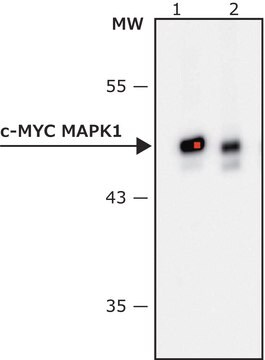
Purified mouse monoclonal antibody generated by immunizing BALB/c mice with the specified immunogen and fusing splenocytes with SP2/0 mouse myeloma cells. Recognizes the ~64-67 kDa (apparent MW) c-Myc protein.
Recognizes a ~60-67 kDa c-Myc protein in HL60 cells and lung carcinoma tissue.
This Anti-c-Myc (Ab-1) Mouse mAb (9E10) is validated for use in FC, Frozen Sections, Immunoblotting, IF, IP, Chromatin IP, Paraffin Sections for the detection of c-Myc (Ab-1).

Immunogen

Epitope: within amino acids 410-419
Human
a synthetic peptide (AEEQKLISEEDLLRKRREQLKHKLEQLRNSCA) corresponding to amino acids 408-439 of human c-Myc

Application

Flow Cytometry (20 µg/ml or use Cat. No. OP10F)

Frozen Sections (2-10 µg/ml)

Immunoblotting (1-5 µg/ml, see application references)

Immunofluorescence (1-5 µg/ml or use Cat. No. OP10F)

Immunoprecipitation (1 µg/sample)

Chromatin Immunoprecipitation (5 µg/ml, see application references)

Paraffin Sections (not recommended)

Physical form

Lyophilized from a volatile buffer, 100 µg BSA.

Preparation Note

Reconstitute the lyophilized antibody with sterile PBS, pH 7.4, or sterile 20 mM Tris-saline (20 mM Tris containing 0.15 M NaCl), pH 7.4, to yield a final concentration of 100 µg/ml. Lyophilized antibodies should be resuspended at 4°C with occasional gentle mixing for at least 2 h.

Analysis Note

Negative Control
HT1080 cells
Positive Control
HL-60 cells or lung carcinoma

Other Notes

LeGouy, E., et al. 1987. In Nuclear Oncogenes, Cold Spring Harbor Laboratory, 144.
Cole, M.D. 1986. Ann. Rev. Gen.20, 361.
Nisen, P.D., et al. 1986. Cancer Res.46, 6217.
Nau, M.M., et al. 1985. Nature318, 69.
Persson, H., et al. 1984. Science225, 687.
Alitalo, K., et al. 1983. Proc. Natl. Acad. Sci. USA80, 1707.
The c-Myc protein is extremely labile. c-Myc degradation can be as a result of freeze/thaw cycles, thus, we recommend using fresh lysates with a cocktail of protease inhibitors. c-Myc is often destroyed during the processing of paraffin sections and can therefore be difficult to detect in this application. This antibody recognizes the c-Myc protein and its cleavage products. The sequence of c-Myc predicts a ~45 kDa protein, but c-Myc migrates under reducing conditions as a ~64-67 kDa band. This antibody will not detect v-Myc but may react weakly to rodent c-Myc when used at high concentrations (10 µg/ml). An extra ~34-40 kDa band may be detected in a immunoblot. May also be used in immunofluorescence as well as the detection and purification of recombinant proteins tagged with the Myc epitope sequence EQKLISEEDL (see application references). The immunogen, c-Myc (Peptide-1) is also available for competition studies (Cat. No. PP06). Antibody should be titrated for optimal results in individual systems.

Legal Information

CALBIOCHEM is a registered trademark of Merck KGaA, Darmstadt, Germany

Disclaimer

Toxicity: Standard Handling (A)

Ähnliche Artikel vergleichen

Vollständigen Vergleich anzeigen

Unterschiede anzeigen

1 of 1

Dieser Artikel
OP10SAB4200742C6594
antibody form

purified antibody

antibody form

purified antibody

antibody form

purified from hybridoma cell culture

antibody form

purified immunoglobulin

biological source

mouse

biological source

mouse

biological source

mouse

biological source

mouse

clone

9E10, monoclonal

clone

9E10, monoclonal

clone

9E10, monoclonal

clone

9E10, monoclonal

species reactivity

rat (weakly), human, mouse (weakly)

species reactivity

rat (weakly), human, mouse (weakly)

species reactivity

human

species reactivity

human

Gene Information

human ... MYC(4609)
mouse ... Myc(17869)
rat ... Myc(24577)

Gene Information

human ... MYC(4609)
mouse ... Myc(17869)
rat ... Myc(24577)

Gene Information

human ... MYC(4609)

Gene Information

human ... MYC(4609)

form

lyophilized

form

liquid

form

lyophilized powder

form

buffered aqueous solution


Still not finding the right product?

Explore all of our products under

oder

Probieren Sie unser Produkt-Auswahlhilfe, um Ihre Auswahl einzugrenzen


Lagerklasse

11 - Combustible Solids

wgk

WGK 1


Analysenzertifikate (COA)

Suchen Sie nach Analysenzertifikate (COA), indem Sie die Lot-/Chargennummer des Produkts eingeben. Lot- und Chargennummern sind auf dem Produktetikett hinter den Wörtern ‘Lot’ oder ‘Batch’ (Lot oder Charge) zu finden.

Besitzen Sie dieses Produkt bereits?

In der Dokumentenbibliothek finden Sie die Dokumentation zu den Produkten, die Sie kürzlich erworben haben.

Die Dokumentenbibliothek aufrufen


Kazutaka Iijima et al.
Oncology letters, 22(1), 546-546 (2021-08-03)
Six-transmembrane epithelial antigen of the prostate 1 (STEAP1) has emerged as an ideal target in cancer therapeutics. However, the functions of STEAP1 in liver cancer remain unexplored. The current study aimed to characterize the biological roles of STEAP1 in liver
Yusuke Kamihara et al.
Oncotarget, 7(39), 64330-64341 (2016-09-08)
Deregulated iron metabolism underlies the pathogenesis of many human cancers. Recently, low expression of ferroportin, which is the only identified non-heme iron exporter, has been associated with significantly reduced overall survival in multiple myeloma (MM); however, the altered iron metabolism
P Loflin et al.
FEBS letters, 509(2), 267-271 (2001-12-14)
Differentiation-dependent expression of the Na(+)/glucose cotransporter (SGLT1) is accompanied by a large, cAMP-dependent increase in stability of its mRNA. Stabilization is mediated by protein binding to a critical uridine-rich element (URE) in its 3' untranslated region. In the present study


Global Trade Item Number

SKUGTIN
OP10L-200UG04055977225044

Questions

Reviews

No rating value

Active Filters