Direkt zum Inhalt
Merck

Fortfahren mit

MAC112

Anti-S•Tag fusion protein Antibody

clone 26A4.1.2, from mouse

Anmelden zur Ansicht der Organisations- und Vertragspreise.

Größe auswählen

Ansicht ändern
PackungsgrößeSKUVerfügbarkeitPreis
50 μg
Warenkorb auf Verfügbarkeit prüfen
€ 406,00

Über diesen Artikel

UNSPSC Code:
12352203
NACRES:
NA.41
eCl@ss:
32160702
Clone:
26A4.1.2, monoclonal
Technique(s):
immunocytochemistry: suitable, immunoprecipitation (IP): suitable, western blot: suitable
Application:
ICC, IP, WB
Citations:
7

€ 406,00


Warenkorb auf Verfügbarkeit prüfen

Großbestellung anfragen
Technischer Dienst
Benötigen Sie Hilfe? Unser Team von erfahrenen Wissenschaftlern ist für Sie da.
Unterstützung erhalten


biological source

mouse

Quality Level

antibody form

purified immunoglobulin

antibody product type

primary antibodies

clone

26A4.1.2, monoclonal

species reactivity (predicted by homology)

all

technique(s)

immunocytochemistry: suitable, immunoprecipitation (IP): suitable, western blot: suitable

isotype

IgG1κ

shipped in

wet ice

target post-translational modification

unmodified

General description

The S•Tag fusion protein is one of many polypeptide tags used to facilitate the identification and purification of many targets of interest. The gene encoding the S•Tag peptide can be added into a vector with another gene that encodes a target of interest. Such vectors, which are available through the Novagen product line, are subsequently transfected into various mammalian, bacterial, or insect cell cultures. Because the target of interest and the S•Tag peptide are expressed as one protein, identification of the target is facilitated with the use of antibodies that are specific for the respective fusion tag. Optional purification of the target may be performed using chromatography techniques that allow for the binding and removal of the respective fusion tag, if desired.
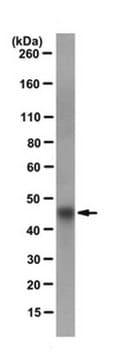
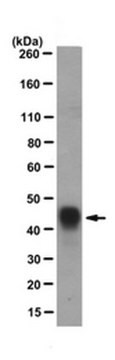
~45 kDa observed. The molecular weight of S•Tag fusion protein is not 45 kDa The Posi-Tag Epitope Tag Control, which contains an S•Tag fusion protein, is observed at ~45 kDa

Immunogen

Linear peptide corresponding to S•Tag fusion proteins.

Application

Detect S•Tag fusion protein using this Anti-S•Tag fusion protein Antibody validated for use in Western Blotting, ICC, Immunoprecipitation.
Immunocytochemistry Analysis: A representative lot detected S•Tag fusion proteins in transfected COS-7 cells.

Immunoprecipitation Analysis: A representative lot immunoprecipitate S•Tag fusion proteins in IP.
Research Category
Epitope Tags & General Use
Research Sub Category
Epitope Tags

Physical form

Format: Purified
Protein G Purified
Purified mouse monoclonal IgG1κ cultured supernatant in buffer containing 0.1 M Tris-Glycine (pH 7.4), 150 mM NaCl with 0.05% sodium azide.

Preparation Note

Stable for 1 year at 2-8°C from date of receipt.

Analysis Note

Control
Posi-Tag Epitope Tag Control
Evaluated by Western Blot in Posi-Tag Epitope Tag Control.

Western Blot Analysis: 0.05 µg/mL of this antibody detected S•Tag fusion proteins in 5 µL of Posi-Tag Epitope Tag Control.

Other Notes

Concentration: Please refer to the Certificate of Analysis for the lot-specific concentration.

Disclaimer

Unless otherwise stated in our catalog or other company documentation accompanying the product(s), our products are intended for research use only and are not to be used for any other purpose, which includes but is not limited to, unauthorized commercial uses, in vitro diagnostic uses, ex vivo or in vivo therapeutic uses or any type of consumption or application to humans or animals.

Ähnliche Artikel vergleichen

Vollständigen Vergleich anzeigen

Unterschiede anzeigen

1 of 1

Dieser Artikel
P9109MAB10764MAC111
antibody form

purified immunoglobulin

antibody form

purified immunoglobulin

antibody form

purified immunoglobulin

antibody form

purified immunoglobulin

clone

26A4.1.2, monoclonal

clone

AG25, monoclonal

clone

20, monoclonal

clone

8-326.6.1, monoclonal

biological source

mouse

biological source

mouse

biological source

mouse

biological source

mouse

shipped in

wet ice

shipped in

dry ice

shipped in

wet ice

shipped in

wet ice

isotype

IgG1κ

isotype

IgG1

isotype

IgG1κ

isotype

IgG1κ

technique(s)

immunocytochemistry: suitable, western blot: suitable, immunoprecipitation (IP): suitable

technique(s)

immunoprecipitation (IP): suitable, western blot: suitable

technique(s)

immunocytochemistry: suitable, western blot: suitable

technique(s)

ELISA: suitable, immunocytochemistry: suitable, immunoprecipitation (IP): suitable, western blot: suitable


Still not finding the right product?

Probieren Sie unser Produkt-Auswahlhilfe, um Ihre Auswahl einzugrenzen


Lagerklasse

12 - Non Combustible Liquids

wgk

WGK 1

flash_point_f

Not applicable

flash_point_c

Not applicable


Analysenzertifikate (COA)

Suchen Sie nach Analysenzertifikate (COA), indem Sie die Lot-/Chargennummer des Produkts eingeben. Lot- und Chargennummern sind auf dem Produktetikett hinter den Wörtern ‘Lot’ oder ‘Batch’ (Lot oder Charge) zu finden.

Besitzen Sie dieses Produkt bereits?

In der Dokumentenbibliothek finden Sie die Dokumentation zu den Produkten, die Sie kürzlich erworben haben.

Die Dokumentenbibliothek aufrufen


Minh Bui et al.
Epigenetics & chromatin, 17(1), 19-19 (2024-06-03)
Over the past several decades, the use of biochemical and fluorescent tags has elucidated mechanistic and cytological processes that would otherwise be impossible. The challenging nature of certain nuclear proteins includes low abundancy, poor antibody recognition, and transient dynamics. One
Jana Neuhold et al.
BMC biotechnology, 20(1), 26-26 (2020-05-14)
Recombinant protein production and purification of large protein complexes in eukaryotes requires efficient methods to generate multi-gene expression constructs, where each individual gene is under the control of its own promoter and terminator. Current methods are based either on serial
Vivek Reddy Palicharla et al.
Molecular biology of the cell, 34(3), ar18-ar18 (2023-01-19)
The primary cilium is a nexus for cell signaling and relies on specific protein trafficking for function. The tubby family protein TULP3 transports integral membrane proteins into cilia through interactions with the intraflagellar transport complex-A (IFT-A) and phosphoinositides. It was


Global Trade Item Number

SKUGTIN
MAC11204053252597800

Questions

Reviews

No rating value

Active Filters