Direkt zum Inhalt
Merck

Fortfahren mit

MABS1918

Anti-Ubiquitin Lys6 specific Affimer reagent GFP/His tag

Anmelden zur Ansicht der Organisations- und Vertragspreise.

Größe auswählen

Ansicht ändern
Ihnen/SKUVerfügbarkeitPreis
25 μg
Warenkorb auf Verfügbarkeit prüfen
€ 159,00
100 μg
Warenkorb auf Verfügbarkeit prüfen
€ 399,00

Über diesen Artikel

NACRES:
NA.41
UNSPSC Code:
12352203
Conjugate:
unconjugated
Clone:
K6_29, recombinant monoclonal
Application:
WB
Citations:
-

€ 159,00


Warenkorb auf Verfügbarkeit prüfen

Großbestellung anfragen
Technischer Dienst
Benötigen Sie Hilfe? Unser Team von erfahrenen Wissenschaftlern ist für Sie da.
Unterstützung erhalten


biological source

bacterial

Quality Segment

conjugate

unconjugated

antibody form

purified antibody

antibody product type

primary antibodies

clone

K6_29, recombinant monoclonal

mol wt

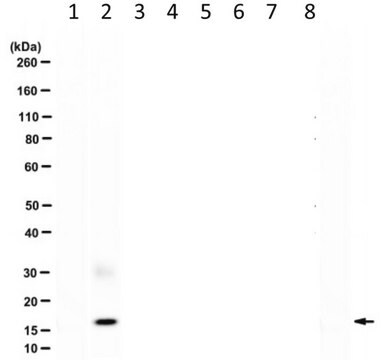
calculated mol wt 8.60 kDa, observed mol wt ~16 kDa

species reactivity

human

packaging

antibody small pack of 100 μg

technique(s)

western blot: suitable

isotype

IgG

shipped in

dry ice

storage temp.

2-8°C

target post-translational modification

unmodified

General description

Ubiquitin (Ub), a highly conserved 76-amino acid (8.6 kDa) protein that escorts proteins for rapid degradation to the multi-component enzymatic complex known as the 26S proteasome. Ubiquitin is initially produced as polyubiquitin-B or polyubiquitin-C precursor protein and its posttranslational cleavage yield multiple copies of identical 76-amino acid ubiquitin. Ubiquitin is involved in one of the most common post-translational modifications of cellular proteins, where it is linked covalently via its carboxyl terminus (Gly76) to lysine residues in target proteins. A given target lysine residue can be linked to one single ubiquitin molecule (monoubiquitylated) or to a chain of ubiquitins (polyubiquitylated). In a polyubiquitin chain, ubiquitin molecules can be linked through one of the seven lysine residues (K6, K11, K27, K29, K33, K48, and K63) or through the ubiquitin N-terminus methionine 1 residue (which generates linear chains). Polyubiquitin chains, when attached to a target protein, have different functions depending on the Lys residue of the ubiquitin that is linked: Lysine 6-linked may be involved in DNA repair; Lysine 11-linked is involved in endoplasmic reticulum-associated degradation, lysine 29-linked is involved in lysosomal degradation, and Lysine 48-linked is involved in protein degradation via the proteasome. Affimer molecules are small proteins (~ 12 kDa) that bind to target molecules with similar specificity and affinity to that of antibodies. These engineered non-antibody binding proteins are designed to mimic the molecular recognition characteristics of monoclonal antibodies in different applications. It has been shown that each affimer molecule ca bind one ubiquitin molecule and the Affimer dimerizes to bind the two ubiquitin moieties of a diubiquitin in a linkage-specific manner. The K6 Affimer is reported to tightly bind to K6 diubiquitin in a highly specific manner. It can be used to detect K6 chains and with polyubiquitin enrichment it can detect even the endogenous levels of K6 chains. (Ref.: Michel, MA., et al. (2017). Mol. Cell. 68(1); 233-246).

Immunogen

Ubiquitin Lys6 specific Affimer reagent, Anti-Ubiquitin Lys6 specific Affimer reagent, Ubiquitin Lys6 specific Affimer Reagent GFP/His tag

Application

Quality Control Testing

Evaluated by Western Blotting with Various K-linked di-ubiquitin chains.

Western Blotting Analysis (WB): A 1:1,000 dilution of this Affimer reagent detected di-ubiquitin K6-linkages.

Tested Applications

Western Blotting Analysis: A representative lot of this Affimer detected di-Ubiquitin Lys6. in Western Blotting applications (Michel, M.A., et. al. (2017). Mol Cell. 68(1):233-246).

Note: Actual optimal working dilutions must be determined by end user as specimens, and experimental conditions may vary with the end user
Anti-Ubiquitin Lys6 specific GFP/His-tag Affimer reagent, Cat. No. MABS1918, detects diubiquitin K6-linkage and is tested for use in Western Blotting.

Biochem/physiol Actions

Anti-diUbiquitin K6 GFP/His-tag Affimer reagent detects K6 linked poly-ubiquitin chains with a KD of approximately 20 pM. Binding to other di-ubiquitin linkages is negligible.

Physical form

Purified GFP/His-tag Affimer reagent in buffer containing 100 mM Sodium Phosphate, 150 mM Sodium Chloride, 0.02% Sodium Azide, pH 7.4.

Preparation Note

Recommend storage at +2°C to +8°C. For long term storage antibodies can be kept at -20°C. Avoid repeated freeze-thaws.

Other Notes

Concentration: Please refer to the Certificate of Analysis for the lot-specific concentration.

Disclaimer

Unless otherwise stated in our catalog or other company documentation accompanying the product(s), our products are intended for research use only and are not to be used for any other purpose, which includes but is not limited to, unauthorized commercial uses, in vitro diagnostic uses, ex vivo or in vivo therapeutic uses or any type of consumption or application to humans or animals.

Ähnliche Artikel vergleichen

Vollständigen Vergleich anzeigen

Unterschiede anzeigen

1 of 1

Dieser Artikel
ABS2206ZRB2150U0508
conjugate

unconjugated

conjugate

unconjugated

conjugate

unconjugated

conjugate

unconjugated

biological source

bacterial

biological source

rabbit

biological source

rabbit

biological source

mouse

clone

K6_29, recombinant monoclonal

clone

polyclonal

clone

Apu2, recombinant monoclonal

clone

6C1, monoclonal

antibody form

purified antibody

antibody form

purified antibody

antibody form

purified antibody

antibody form

ascites fluid

species reactivity

human

species reactivity

human

species reactivity

mouse, human

species reactivity

human, rat, mouse, bovine

storage temp.

2-8°C

storage temp.

-

storage temp.

2-8°C

storage temp.

−20°C


Still not finding the right product?

Probieren Sie unser Produkt-Auswahlhilfe, um Ihre Auswahl einzugrenzen


Lagerklasse

12 - Non Combustible Liquids

wgk

WGK 2

flash_point_f

Not applicable

flash_point_c

Not applicable


Analysenzertifikate (COA)

Suchen Sie nach Analysenzertifikate (COA), indem Sie die Lot-/Chargennummer des Produkts eingeben. Lot- und Chargennummern sind auf dem Produktetikett hinter den Wörtern ‘Lot’ oder ‘Batch’ (Lot oder Charge) zu finden.

Besitzen Sie dieses Produkt bereits?

In der Dokumentenbibliothek finden Sie die Dokumentation zu den Produkten, die Sie kürzlich erworben haben.

Die Dokumentenbibliothek aufrufen


Questions

Reviews

No rating value

Active Filters