Direkt zum Inhalt
Merck

Fortfahren mit

MABN804

Anti-Ribeye Antibody, clone 3D12.1

clone 3D12.1, from mouse

Synonym(e):

C-terminal-binding protein 2, CtBP2, Ribeye

Anmelden zur Ansicht der Organisations- und Vertragspreise.

Größe auswählen

Ansicht ändern
PackungsgrößeSKUVerfügbarkeitPreis

Über diesen Artikel

UNSPSC Code:
12352203
NACRES:
NA.43
eCl@ss:
32160702
Conjugate:
unconjugated
Clone:
3D12.1, monoclonal
Application:
IHC, WB
Citations:
-
Preise und Verfügbarkeit sind derzeit nicht verfügbar.
Technischer Dienst
Benötigen Sie Hilfe? Unser Team von erfahrenen Wissenschaftlern ist für Sie da.
Unterstützung erhalten


biological source

mouse

Quality Segment

conjugate

unconjugated

antibody form

purified immunoglobulin

antibody product type

primary antibodies

clone

3D12.1, monoclonal

species reactivity

human

technique(s)

immunohistochemistry: suitable (paraffin), western blot: suitable

isotype

IgG1κ

NCBI accession no.

UniProt accession no.

shipped in

dry ice

target post-translational modification

unmodified

Gene Information

human ... CTBP2(1488)

General description

Human C-terminal-binding protein 2 (CtBP2) and Ribeye (UniProt P56545-1 and P56545-2, respectively) are two proteins encoded by the CTBP2 gene (Gene ID 1488) in human, they are produced as a result of alternative splicing. The C-terminal 425-amino acid sequence of Ribeye (aa 561-985) is identical to that of CtBP2 (aa 21-445), however the first 20 amino acids at the CtBP2 N-terminal end is replaced with a 560-amino acid sequence in the case of Ribeye. Ribeye is a protein specific to synaptic ribbons. Ribbon synapses are high-performance synapses built by certain nonspiking sensory neurons, such as photoreceptors, retinal bipolar cells, and inner ear hair cells. The main site of exocytosis of these neurons is characterized by unique presynaptic structures called the synaptic ribbons that associate with large numbers of synaptic vesicles primed for exocytosis and has a direct impact on synaptic signaling. Ribeye is composed of an N-terminal A domain and a C-terminal B domain that is largely identical to CtBP2. The A domain unique to Ribeye has a structural role at the synaptic ribbon, while the B domain of Ribeye possesses lysophosphatidic acid (LPA) acyltransferase (LPAAT) activity that catalyzes the generation of the highly active signaling phospholipid phosphatidic acid (PA) from LPA. LPAAT-deficient Ribeye mutant does not recruit PA-binding proteins to synaptic ribbons, whereas wild-type RIBEYE supports PA-dependent binding, The B domain also contains an NADH-binding subdomain (NBD), which is reported to compete against Arf1 for Arf-GTPase activating protein-3 (ArfGAP3) binding. Ribeye therefore functions as an Arf1 positive regulator at the synaptic ribbon by preventing the inactivation of Arf1 by ArfGAP3.
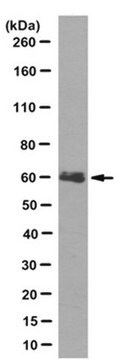
~106 kDa observed (109.2 kDa calculated).

Immunogen

Epitope: N-terminal region
GST-tagged recombinant protein corresponding to the N-terminal region of human Ribeye.

Application

Anti-Ribeye Antibody, clone 3D12.1, Cat. No. MABN804, is a highly specific mouse monoclonal antibody, that targets Ribeye and has been tested in Western Blotting and Immunohistochemistry (Paraffin).
Research Category
Neuroscience
Research Sub Category
Developmental Neuroscience
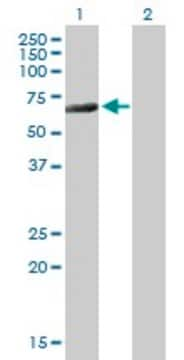
Western Blotting Analysis: 0.5 µg/mL from a representative lot detected Ribeye in 10 µg of SH-SY5Y cell lysate.
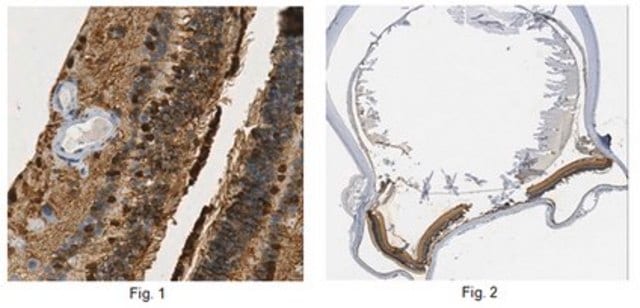
Immunohistochemistry Analysis: A 1:50-250 dilution from a representative lot detected Ribeye in human cardiac myocytes and human cerebellum tissues.

Biochem/physiol Actions

Specific for CTBP2 spliced variant Ribeye. Does not react with the canonical CtBP2 isoform.

Physical form

Format: Purified
Protein G Purified
Purified mouse monoclonal IgG1κ antibody in buffer containing 0.1 M Tris-Glycine (pH 7.4), 150 mM NaCl with 0.05% sodium azide.

Preparation Note

Stable for 1 year at 2-8°C from date of receipt.

Analysis Note

Evaluated by Western Blotting in HeLa cell lysate.

Western Blotting Analysis: 0.5 µg/mL of this antibody detected Ribeye in 10 µg of HeLa cell lysate.

Other Notes

Concentration: Please refer to lot specific datasheet.

Disclaimer

Unless otherwise stated in our catalog or other company documentation accompanying the product(s), our products are intended for research use only and are not to be used for any other purpose, which includes but is not limited to, unauthorized commercial uses, in vitro diagnostic uses, ex vivo or in vivo therapeutic uses or any type of consumption or application to humans or animals.

Ähnliche Artikel vergleichen

Vollständigen Vergleich anzeigen

Unterschiede anzeigen

1 of 1

Dieser Artikel
SAB1405672MABN296MABC582
species reactivity

human

species reactivity

human

species reactivity

human, rat

species reactivity

human

biological source

mouse

biological source

mouse

biological source

mouse

biological source

mouse

Gene Information

human ... CTBP2(1488)

Gene Information

human ... CTBP2(1488)

Gene Information

human ... RLBP1(6017)

Gene Information

human ... BIRC3(330)

clone

3D12.1, monoclonal

clone

polyclonal

clone

3C1.1, monoclonal

clone

11D12.1, monoclonal

antibody form

purified immunoglobulin

antibody form

purified immunoglobulin

antibody form

purified immunoglobulin

antibody form

purified immunoglobulin

conjugate

unconjugated

conjugate

unconjugated

conjugate

unconjugated

conjugate

unconjugated


Still not finding the right product?

Probieren Sie unser Produkt-Auswahlhilfe, um Ihre Auswahl einzugrenzen


Lagerklasse

12 - Non Combustible Liquids

wgk

WGK 1

flash_point_f

Not applicable

flash_point_c

Not applicable


Analysenzertifikate (COA)

Suchen Sie nach Analysenzertifikate (COA), indem Sie die Lot-/Chargennummer des Produkts eingeben. Lot- und Chargennummern sind auf dem Produktetikett hinter den Wörtern ‘Lot’ oder ‘Batch’ (Lot oder Charge) zu finden.

Besitzen Sie dieses Produkt bereits?

In der Dokumentenbibliothek finden Sie die Dokumentation zu den Produkten, die Sie kürzlich erworben haben.

Die Dokumentenbibliothek aufrufen


Verwandter Inhalt

A major focus of breast cancer research is to understand the mechanisms responsible for disease progression and drug resistance. Toward that end, it has been found that approximately two thirds of all human breast carcinomas overexpress the Estrogen Receptor α (ERα) protein and it remains the primary pharmacological target for endocrine therapy1,2. The normal cellular function of ERα is as a transcription factor that mediates a wide variety of physiological processes, many of which are dependent upon phosphorylation of the receptor at specific amino acid residues3,4. Indeed, ERα is known to be phosphorylated at a multitude of different sites, yet how these all correlate to disease remains unclear5. Here, we interrogated multiple sites of ERα for phosphorylation status by screening an extensive panel of different breast cancer patient samples and other non-breast cancer tissue microarray (TMA) slide samples to determine their relevance to disease.


Global Trade Item Number

SKUGTIN
MABN80404055977176988

Questions

Reviews

No rating value

Active Filters