
MABN641

Anti-TMEM16B Antibody, clone 7H10
clone 7H10, from mouse
Synonym(e):
Anoctamin-2, Transmembrane protein 16B
Größe auswählen
| Packungsgröße | SKU | Verfügbarkeit | Preis |
|---|---|---|---|
| 100 μg | Warenkorb auf Verfügbarkeit prüfen | € 361,00 |
Über diesen Artikel
biological source
mouse
Quality Segment
conjugate
unconjugated
antibody form
purified antibody
antibody product type
primary antibodies
clone
7H10, monoclonal
species reactivity
mouse, human
technique(s)
immunocytochemistry: suitable, immunohistochemistry: suitable, western blot: suitable
isotype
IgG1κ
NCBI accession no.
UniProt accession no.
shipped in
wet ice
target post-translational modification
unmodified
Gene Information
human ... ANO2(57101)
General description
Immunogen
Application
Neuroscience
Developmental Signaling
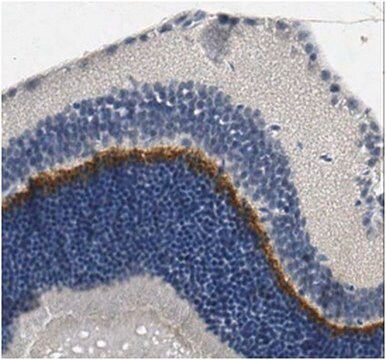
Immunocytochemistry Analysis: A representative lot detected TMEM16B in mouse retina cells (Stohr, H., et al. (2009). The Journal of Neuro. 29(21):6809-6818).
Physical form
Preparation Note
Analysis Note
Imunnohistochemistry Analysis: A 1:50 dilution of this antibody detected TMEM16B in mouse retina tissue.
Other Notes
Disclaimer
1 of 1
Dieser Artikel | |||
|---|---|---|---|
| Gene Information human ... ANO2(57101) | Gene Information human ... ANO2(57101) | Gene Information human ... ANO2(57101) | Gene Information human ... ANO1(55107) |
| biological source mouse | biological source rabbit | biological source rabbit | biological source rabbit |
| species reactivity mouse, human | species reactivity human, rat | species reactivity mouse, rat, human | species reactivity human, mouse |
| conjugate unconjugated | conjugate unconjugated | conjugate unconjugated | conjugate unconjugated |
| antibody form purified antibody | antibody form affinity isolated antibody | antibody form affinity isolated antibody | antibody form affinity isolated antibody |
| clone 7H10, monoclonal | clone polyclonal | clone polyclonal | clone polyclonal |
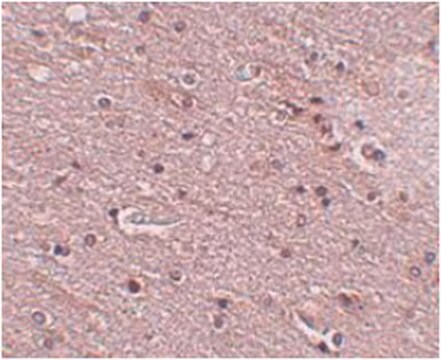
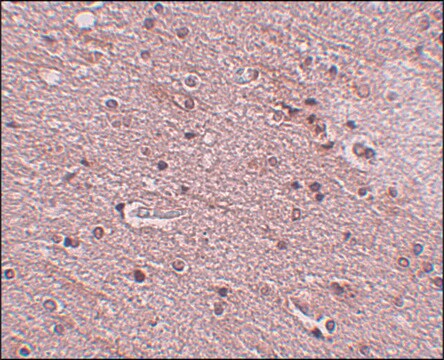

Still not finding the right product?
Probieren Sie unser Produkt-Auswahlhilfe, um Ihre Auswahl einzugrenzen
Lagerklasse
12 - Non Combustible Liquids
wgk
WGK 1
flash_point_f
Not applicable
flash_point_c
Not applicable
Analysenzertifikate (COA)
Suchen Sie nach Analysenzertifikate (COA), indem Sie die Lot-/Chargennummer des Produkts eingeben. Lot- und Chargennummern sind auf dem Produktetikett hinter den Wörtern ‘Lot’ oder ‘Batch’ (Lot oder Charge) zu finden.
Besitzen Sie dieses Produkt bereits?
In der Dokumentenbibliothek finden Sie die Dokumentation zu den Produkten, die Sie kürzlich erworben haben.
Verwandter Inhalt
"Apoptosis & Autophagy in Cancer: Cell Survival by Eluding Cell Death The ability of tumor cells to elude programmed cell death, also known as apoptosis, is a hallmark of most types of cancer. Similary, autophagy is a highly regulated, homeostatic degradative process where cells destroy their own components via the lysosomal machinery and recycle them for prolonged cell survival. Via extensive crosstalk with pro-apoptotic signaling pathways, autophagy can also contribute to cell death and greatly influence general cell health. Elucidating the correlation between autophagy and apoptotic cell death has become the focus of a great deal of research, particularly in tumor biology. On one hand, autophagy may induce cell death by degrading essential components; on the other hand, it may facilitate survival of cancer cells under unfavorable metabolic conditions."
Global Trade Item Number
| SKU | GTIN |
|---|---|
| MABN641 | 04053252934964 |