Direkt zum Inhalt
Merck

Fortfahren mit

MABE867

Anti-Mad1-Antikörper, Klon BB3-8

clone BB3-8, from mouse

Synonym(e):

Mitotic spindle assembly checkpoint protein MAD1, Mitotic arrest deficient 1-like protein 1, MAD1-like protein 1, Mitotic checkpoint MAD1 protein homolog, HsMAD1, hMAD1, Tax-binding protein 181

Anmelden zur Ansicht der Organisations- und Vertragspreise.

Größe auswählen

Ansicht ändern
PackungsgrößeSKUVerfügbarkeitPreis
100 μg
Warenkorb auf Verfügbarkeit prüfen
€ 402,00

Über diesen Artikel

UNSPSC Code:
12352203
NACRES:
NA.41
eCl@ss:
32160702
Conjugate:
unconjugated
Clone:
BB3-8, monoclonal
Application:
IF, WB
Citations:
16

€ 402,00


Warenkorb auf Verfügbarkeit prüfen

Großbestellung anfragen
Technischer Dienst
Benötigen Sie Hilfe? Unser Team von erfahrenen Wissenschaftlern ist für Sie da.
Unterstützung erhalten


biological source

mouse

Quality Level

conjugate

unconjugated

antibody form

purified immunoglobulin

antibody product type

primary antibodies

clone

BB3-8, monoclonal

species reactivity

human

technique(s)

immunofluorescence: suitable, western blot: suitable

isotype

IgG1κ

NCBI accession no.

UniProt accession no.

shipped in

wet ice

target post-translational modification

unmodified

Gene Information

human ... MAD1L1(8379)

General description

Mitotic arrest deficient-like 1 (Hefe) ist auch als MAD1 und MAD1L1 bekannt. Es ist Teil der MAD1-Familie, die wesentlich für die Entwicklung ist. MAD1 dient als Checkpoint bei der mitotischen Bildung des Spindelapparats. Während der Anaphase und Telophase ist MAD1 in der Spindelmittelzone der Zelle lokalisiert, wo es die Anaphase verhindert, bis das Chromosom an der Metaphasenplatte angeordnet ist. Während der Metaphase ist MAD1 am Zentrosom lokalisiert. MAD1 ist an der Zellzyklussteuerung und Tumorsuppression beteiligt. MAD1 dient als Homodimer und interagiert mit MAD2L1. Es wird angenommen, dass MAD1 an MAD2 rekrutiert, das anschließend die Bindung von MAD2 an CDC20 fördert.
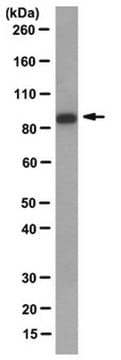
~83 kDa gemessen

Immunogen

His-markiertes rekombinantes Protein, das humanem Mad1 entspricht.

Application

Anti-Mad1-Antikörper, Klon BB3-8 ist ein hochspezifischer monoklonaler Maus-Antikörper, der auf MAD1 abzielt und in Western Blot und Immunfluoreszenz geprüft wurde.
Forschungskategorie
Epigenetik & Zellkernfunktion
Forschungsunterkategorie
Zellzyklus, DNA-Replikation & -Reparatur
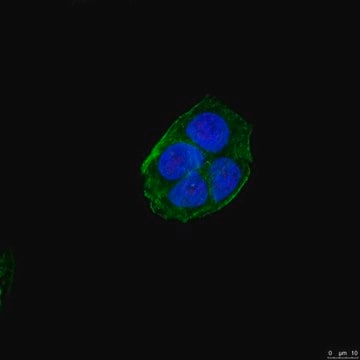
Immunfluoreszenz-Analyse: Eine repräsentative Charge aus einem unabhängigen Labor wies Mad1 in HeLa-Zellen nach (Santaguida, S., et al. (2011). EMBO J. 30(8):1508-1519.).

Immunfluoreszenz-Analyse: Eine repräsentative Charge aus einem unabhängigen Labor wies Mad1 in HeLa-Zellen nach (Screpanti, E., et al. (2011). Curr Biol. 21(5):391-398.).

Western-Blot-Analyse: Eine repräsentative Charge aus einem unabhängigen Labor wies Mad1 in HeLa-Zelllysat nach (Screpanti, E., et al. (2011). Curr Biol. 21(5):391-398.).

Physical form

Aufgereinigtes monoklonales Maus-IgG1κ in Puffer mit 0,1 mol/l Tris-Glycin (pH-Wert 7,4), 150 mmol/l NaCl mit 0,05 % Natriumazid.
Format: Aufgereinigt
Über Protein G aufgereinigt

Preparation Note

Bei 2–8 °C 1 Jahr ab Empfangsdatum haltbar.

Analysis Note

Beurteilt mittels Western Blot in HeLa-Zelllysat.

Western-Blot-Analyse: 0,5 µg/ml dieses Antikörpers wies Mad1 in 10 µg HeLa-Zelllysat nach.

Other Notes

Konzentration: Die chargenspezifische Konzentration entnehmen Sie bitte dem Analysenzertifikat.

Disclaimer

Sofern in unserem Katalog oder anderen Begleitdokumenten unserer Produkte nicht anders angegeben, sind unsere Produkte nur für Forschungszwecke vorgesehen und nicht für andere Zwecke zu verwenden, einschließlich, jedoch nicht beschränkt auf unautorisierte kommerzielle Verwendung, zur In-vitro-Diagnostik, für Ex-vivo- oder In-vivo-Therapiezwecke oder jegliche Art der Einnahme oder Anwendung bei Menschen oder Tieren.

Ähnliche Artikel vergleichen

Vollständigen Vergleich anzeigen

Unterschiede anzeigen

1 of 1

Dieser Artikel
SAB1412656SAB2501138MABE1807
clone

BB3-8, monoclonal

clone

1B8, monoclonal

clone

polyclonal

clone

AD6-1, monoclonal

Gene Information

human ... MAD1L1(8379)

Gene Information

human ... SMAD1(4086)

Gene Information

human ... MAD2L1(4085)

Gene Information

human ... NUMA1(4926)

species reactivity

human

species reactivity

human,

species reactivity

human, bovine, mouse

species reactivity

human, mouse

antibody form

purified immunoglobulin

antibody form

purified immunoglobulin

antibody form

affinity isolated antibody

antibody form

purified antibody

conjugate

unconjugated

conjugate

unconjugated

conjugate

unconjugated

conjugate

unconjugated

biological source

mouse

biological source

mouse

biological source

goat

biological source

mouse


Still not finding the right product?

Probieren Sie unser Produkt-Auswahlhilfe, um Ihre Auswahl einzugrenzen


Lagerklasse

12 - Non Combustible Liquids

wgk

WGK 1

flash_point_f

Not applicable

flash_point_c

Not applicable


Analysenzertifikate (COA)

Suchen Sie nach Analysenzertifikate (COA), indem Sie die Lot-/Chargennummer des Produkts eingeben. Lot- und Chargennummern sind auf dem Produktetikett hinter den Wörtern ‘Lot’ oder ‘Batch’ (Lot oder Charge) zu finden.

Besitzen Sie dieses Produkt bereits?

In der Dokumentenbibliothek finden Sie die Dokumentation zu den Produkten, die Sie kürzlich erworben haben.

Die Dokumentenbibliothek aufrufen


Andrea Corno et al.
The EMBO journal, 42(20), e112630-e112630 (2023-09-15)
Two major mechanisms safeguard genome stability during mitosis: the mitotic checkpoint delays mitosis until all chromosomes have attached to microtubules, and the kinetochore-microtubule error-correction pathway keeps this attachment process free from errors. We demonstrate here that the optimal strength and
Shawn Yost et al.
Nature genetics, 49(7), 1148-1151 (2017-05-30)
Through exome sequencing, we identified six individuals with biallelic loss-of-function mutations in TRIP13. All six developed Wilms tumor. Constitutional mosaic aneuploidies, microcephaly, developmental delay and seizures, which are features of mosaic variegated aneuploidy (MVA) syndrome, were more variably present. Through
Jingchao Wu et al.
The Journal of cell biology, 223(1) (2023-11-07)
Correct chromosome segregation during cell division depends on proper connections between spindle microtubules and kinetochores. During prometaphase, kinetochores are temporarily covered with a dense protein meshwork known as the fibrous corona. Formed by oligomerization of ROD/ZW10/ZWILCH-SPINDLY (RZZ-S) complexes, the fibrous


Global Trade Item Number

SKUGTIN
MABE86704053252921018

Questions

Reviews

No rating value

Active Filters