Direkt zum Inhalt
Merck

Fortfahren mit

MABE1831

Anti-CSB (ERCC6) Antibody, clone ICSB-3H8

clone 1CSB-3H8, from mouse

Synonym(e):

DNA excision repair protein ERCC-6, ATP-dependent helicase ERCC6, Cockayne syndrome protein CSB

Anmelden zur Ansicht der Organisations- und Vertragspreise.

Größe auswählen

Ansicht ändern
Ihnen/SKUVerfügbarkeitPreis
25 μg
Warenkorb auf Verfügbarkeit prüfen
€ 160,00
100 μg
Warenkorb auf Verfügbarkeit prüfen
€ 437,00

Über diesen Artikel

UNSPSC Code:
12352203
NACRES:
NA.41
eCl@ss:
32160702
Conjugate:
unconjugated
Clone:
1CSB-3H8, monoclonal
Application:
ChIP, FACS, ICC, IP, WB
Citations:
-

€ 160,00


Warenkorb auf Verfügbarkeit prüfen

Technischer Dienst
Benötigen Sie Hilfe? Unser Team von erfahrenen Wissenschaftlern ist für Sie da.
Unterstützung erhalten


biological source

mouse

conjugate

unconjugated

antibody form

purified antibody

antibody product type

primary antibodies

clone

1CSB-3H8, monoclonal

species reactivity

human

packaging

antibody small pack of 25 μg

technique(s)

ChIP: suitable, flow cytometry: suitable, immunocytochemistry: suitable, immunoprecipitation (IP): suitable, western blot: suitable

isotype

IgG1κ

NCBI accession no.

UniProt accession no.

target post-translational modification

unmodified

Gene Information

human ... ERCC6(2074)

General description

168.42 kDa calculated.
DNA excision repair protein ERCC-6 (UniProt: Q03468; also known as ATP-dependent helicase ERCC6, Cockayne syndrome protein CSB) is encoded by the ERCC6 (also known as CSB) gene (Gene ID: 2074) in human. CSB is a homodimeric nuclear protein that belongs to the SwItch/ Sucrose nonfermentable family of DNA-dependent ATPases and contains seven characteristic helicase motifs. It is a part of a complex that contains RNA pol I, TFIIH, and XPG, all of which are active in transcription and/or DNA repair. Hence, it is an essential factor involved in transcription-coupled nucleotide excision repair, which allows RNA polymerase II-blocking lesions to be rapidly removed from the transcribed strand of active genes. Upon DNA-binding, it locally modifies DNA conformation by wrapping the DNA around itself, thereby modifying the interface between stalled RNA polymerase II and DNA. It is shown to be essential for transcription-coupled repair complex formation. It recruits the CSA complex (DCX(ERCC8) complex), nucleotide excision repair proteins and EP300 to the at sites of RNA polymerase II-blocking lesions. Mutations in CSB (ERCC6) gene are known to cause age related macular degeneration and Cockayne syndrome B that is characterized by delayed neural development and severe progressive neurologic degeneration and mental retardation.

Immunogen

Ovalbumin-conjugated linear Peptide corresponding to 22 amino acids from the C-terminal region of human DNA excision repair protein ERCC-6.

Application

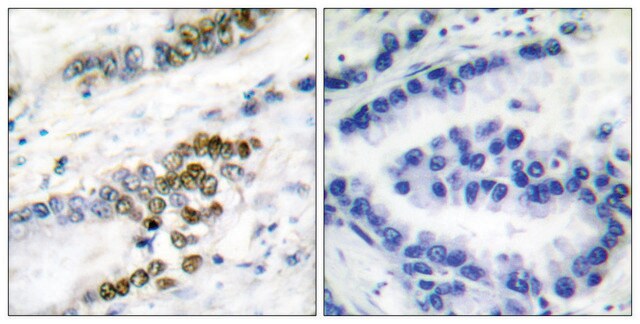
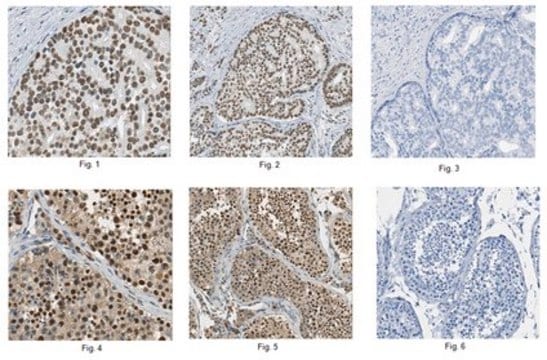
Anti-CSB (ERCC6), clone ICSB-3H8, Cat. No. MABE1831, is a highly specific mouse monoclonal antibody that targets DNA excision repair protein ERCC-6 and has been tested for use in Chromatin Immunoprecipitation (ChIP), Flow Cytometry, Immunocytochemistry, Immunoprecipitation, and Western Blotting.
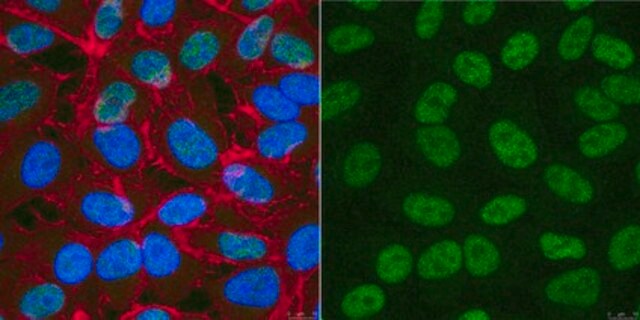
Immunocytochemistry Analysis: A representative lot detected CSB (ERCC6) in Immunocytochemistry applications (Bradsher, J., et. al. (2002). Mol Cell. 10(4):819-29).

Immunoprecipitation Analysis: A representative lot immunoprecipitated CSB (ERCC6) in Immunoprecipitation applications (Bradsher, J., et. al. (2002). Mol Cell. 10(4):819-29).

Chromatin Immunoprecipitation (ChIP) Analysis: A representative lot detected CSB (ERCC6) in Chromatin Immunoprecipitation applications (Kristensen, U., et. al. (2013). Proc Natl Acad Sci USA. 110(25):E2261-70; Velez-Cruz, R., et. al. (2012). Proc Natl Acad Sci USA. 110(3):E212-20).

Western Blotting Analysis: A representative lot detected CSB (ERCC6) in Western Blotting applications (Bradsher, J., et. al. (2002). Mol Cell. 10(4):819-29).
Research Category
Epigenetics & Nuclear Function

Biochem/physiol Actions

Clone 1CSB-3H8 specifically detects DNA excision repair protein ERCC-6 in human cells. It targets an epitope with in 22 amino acids from the C-terminal region.

Physical form

Purified mouse monoclonal antibody IgG1 in buffer containing 0.1 M Tris-Glycine (pH 7.4), 150 mM NaCl with 0.05% sodium azide.
Format: Purified
Protein G purified

Preparation Note

Stable for 1 year at 2-8°C from date of receipt.

Analysis Note

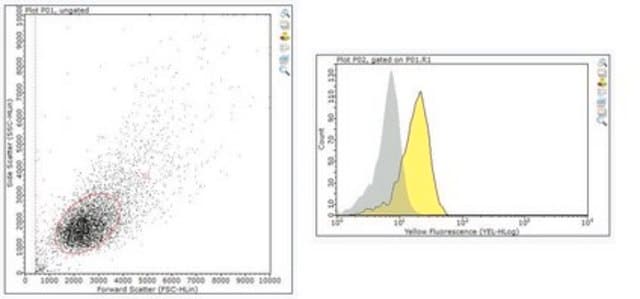
Evaluated by Flow Cytometry in A431 cells.

Flow Cytometry Analysis: 1 µg of this antibody detected CSB (ERCC6) in one million A431 cells.

Other Notes

Concentration: Please refer to lot specific datasheet.

Disclaimer

Unless otherwise stated in our catalog or other company documentation accompanying the product(s), our products are intended for research use only and are not to be used for any other purpose, which includes but is not limited to, unauthorized commercial uses, in vitro diagnostic uses, ex vivo or in vivo therapeutic uses or any type of consumption or application to humans or animals.

Ähnliche Artikel vergleichen

Vollständigen Vergleich anzeigen

Unterschiede anzeigen

1 of 1

Dieser Artikel
SAB4500795MABE1819ABE558
conjugate

unconjugated

conjugate

unconjugated

conjugate

unconjugated

conjugate

unconjugated

biological source

mouse

biological source

rabbit

biological source

mouse

biological source

rabbit

antibody form

purified antibody

antibody form

affinity isolated antibody

antibody form

purified antibody

antibody form

purified antibody

clone

1CSB-3H8, monoclonal

clone

polyclonal

clone

22TF2-2F6, monoclonal

clone

polyclonal

species reactivity

human

species reactivity

mouse, human

species reactivity

human

species reactivity

human

Gene Information

human ... ERCC6(2074)

Gene Information

human ... ERCC1(2067)

Gene Information

human ... ERCC2(2068)

Gene Information

human ... XRCC6(2547)


Still not finding the right product?

Probieren Sie unser Produkt-Auswahlhilfe, um Ihre Auswahl einzugrenzen


Analysenzertifikate (COA)

Suchen Sie nach Analysenzertifikate (COA), indem Sie die Lot-/Chargennummer des Produkts eingeben. Lot- und Chargennummern sind auf dem Produktetikett hinter den Wörtern ‘Lot’ oder ‘Batch’ (Lot oder Charge) zu finden.

Besitzen Sie dieses Produkt bereits?

In der Dokumentenbibliothek finden Sie die Dokumentation zu den Produkten, die Sie kürzlich erworben haben.

Die Dokumentenbibliothek aufrufen


Questions

Reviews

No rating value

Active Filters