Direkt zum Inhalt
Merck

Fortfahren mit

IM35

Anti-MMP-1 (Ab-1) Mouse mAb (41-1E5)

liquid, clone 41-1E5, Calbiochem®

Anmelden zur Ansicht der Organisations- und Vertragspreise.

Größe auswählen

Ansicht ändern
PackungsgrößeSKUVerfügbarkeitPreis
100 μg
Warenkorb auf Verfügbarkeit prüfen
€ 443,00

Über diesen Artikel

NACRES:
NA.41
UNSPSC Code:
12352203
Clone:
41-1E5, monoclonal
Species reactivity:
human
Application:
Citations:
10

€ 443,00


Warenkorb auf Verfügbarkeit prüfen

Großbestellung anfragen
Technischer Dienst
Benötigen Sie Hilfe? Unser Team von erfahrenen Wissenschaftlern ist für Sie da.
Unterstützung erhalten


biological source

mouse

Quality Level

antibody form

purified antibody

antibody product type

primary antibodies

clone

41-1E5, monoclonal

form

liquid

contains

≤0.1% sodium azide as preservative

species reactivity

human

should not react with

bovine

manufacturer/tradename

Calbiochem®

storage condition

OK to freeze, avoid repeated freeze/thaw cycles

dilution

(Frozen sections
Immunoblotting (1 µg/mL)
Paraffin sections (2.5 µg/mL, pressure cooker pre-treatment required))

isotype

IgG2a

shipped in

wet ice

storage temp.

−20°C

target post-translational modification

unmodified

Gene Information

human ... MMP1(4312)

General description

Matrix metalloproteinases (MMPs) are a family of enzymes that are responsible for the degradation of extracellular matrix components such as collagen, laminin and proteoglycans. In addition to sequence homology, all MMPs share the following characteristics: the catalytic mechanism is dependent upon a zinc ion at the active center, they cleave one or more extracellular matrix components, they are secreted as zymogens which are activated by removal of an ~10 kDa segment from the N-terminus and they are inhibited by tissue inhibitor of metalloproteinases (TIMP). These enzymes are involved in normal physiological processes such as embryogenesis and tissue remodeling and may play an important role in arthritis, periodontitis, and metastasis.MMP-1 (interstitial collagenase, tissue collagenase, fibroblast collagenase) is secreted as a 57/52 kDa zymogen which is proteolytically processed to the 46/42 kDa active forms. This enzyme displays substrate specificity toward type I, II, III, VII, VIII and X collagens and gelatin. MMP-1 is thought to play an important role in pathophysiological degradation processes associated with conditions such as rheumatoid arthritis, osteoarthritis, and cancer cell invasion.
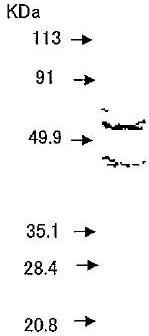
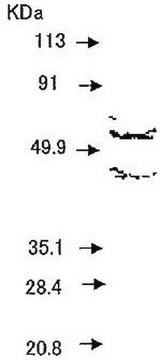
Purified mouse monoclonal antibody. Recognizes the ~55 kDa latent and the ~43 kDa active forms of MMP-1.
Recognizes the ~55 kDa latent and the ~43 kDa active forms of MMP-1.

Immunogen

Human
a synthetic peptide (VQGQNVLHGYPKDIYSSFG) corresponding to amino acids 332-350 of human MMP-1

Application


Frozen sections (see application references)
Immunoblotting (1 g/ml)
Paraffin sections (2.5 g/ml, pressure cooker pre-treatment required)

Packaging

Please refer to vial label for lot-specific concentration.

Physical form

In 100 mM sodium phosphate buffer, 0.1% BSA, pH 7.0

Preparation Note

Following initial thaw, aliquot and freeze (-20°C).

Other Notes

Cottam, D.W. and Rees, R.C. 1993. Intl. J. Oncol.2, 861.
Stetler-Stevenson, W.G., et al. 1993. FASEB7, 1434.
Zhang, J., et al. 1993. Clinica Chimica Acta.219, 1.
Woessner, J.F. 1991. FASEB5, 2145.
Liotta, L.A. and Stetler-Stevenson, W.G. 1990. in Seminars in Cancer Biology, ed. M. M. Gottesman. Vol. 1; 99-106.
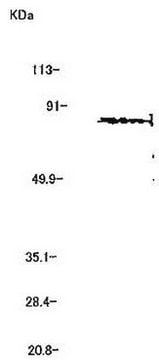
To prepare conditioned medium for positive control, incubate HT-1080 cells for 2 h at 37°C in serum-free media containing 100 nM PMA. Collect and centrifuge medium; concentrate as necessary. Does not cross-react with bovine. Will not cross-react with human MMP-2, MMP-3, MMP-8, MMP-9, or MMP-13. For best results with paraffin sections, pre-treat with a pressure cooker; however, heat, saponin or trypsin can be used in place of a pressure cooker. Antibody should be titrated for optimal results in individual systems.

Legal Information

Manufactured by Daiichi Fine Chemical Co., Ltd. Not available for sale in Japan.
CALBIOCHEM is a registered trademark of Merck KGaA, Darmstadt, Germany

Disclaimer

Toxicity: Standard Handling (A)

Ähnliche Artikel vergleichen

Vollständigen Vergleich anzeigen

Unterschiede anzeigen

1 of 1

Dieser Artikel
SAB1406131IM33IM09L
species reactivity

human

species reactivity

human

species reactivity

bovine, rat, mouse, human

species reactivity

human

clone

41-1E5, monoclonal

clone

polyclonal

clone

42-5D11, monoclonal

clone

6-6B, monoclonal

biological source

mouse

biological source

mouse

biological source

mouse

biological source

mouse

Gene Information

human ... MMP1(4312)

Gene Information

human ... MMP1(4312)

Gene Information

human ... MMP2(4313)

Gene Information

human ... MMP9(4318)

antibody form

purified antibody

antibody form

purified immunoglobulin

antibody form

purified antibody

antibody form

purified antibody

isotype

IgG2a

isotype

-

isotype

IgG1

isotype

IgG1


Still not finding the right product?

Probieren Sie unser Produkt-Auswahlhilfe, um Ihre Auswahl einzugrenzen


Lagerklasse

12 - Non Combustible Liquids

wgk

WGK 2

flash_point_f

Not applicable

flash_point_c

Not applicable


Analysenzertifikate (COA)

Suchen Sie nach Analysenzertifikate (COA), indem Sie die Lot-/Chargennummer des Produkts eingeben. Lot- und Chargennummern sind auf dem Produktetikett hinter den Wörtern ‘Lot’ oder ‘Batch’ (Lot oder Charge) zu finden.

Besitzen Sie dieses Produkt bereits?

In der Dokumentenbibliothek finden Sie die Dokumentation zu den Produkten, die Sie kürzlich erworben haben.

Die Dokumentenbibliothek aufrufen


Jennifer A Dixon et al.
Circulation, 124(11 Suppl), S35-S45 (2011-09-23)
Although localized delivery of biocomposite materials, such as calcium hydroxyapatite (CHAM), have been demonstrated to potentially attenuate adverse left ventricular (LV) remodeling after myocardial infarction (MI), the underlying biological mechanisms for this effect remain unclear. This study tested the hypothesis
Jennifer A Dixon et al.
Circulation, 120(11 Suppl), S220-S229 (2009-09-24)
Targeted delivery of mesenchymal precursor cells (MPCs) can modify left ventricular (LV) cellular and extracellular remodeling after myocardial infarction (MI). However, whether and to what degree LV remodeling may be affected by MPC injection post-MI, and whether these effects are
Patrick Meylan et al.
Scientific reports, 11(1), 7847-7847 (2021-04-14)
The thioredoxin system plays key roles in regulating cancer cell malignancy. Here we identify the Thioredoxin-interacting protein (TXNIP) as a gene, which expression is regulated by PPARγ in melanoma cells. We show that high TXNIP expression levels associate with benign


Global Trade Item Number

SKUGTIN
IM35-100UG04055977220568

Questions

Reviews

No rating value

Active Filters