Direkt zum Inhalt
Merck

Fortfahren mit

HTS092M

ChemiSCREEN EP3 Prostanoid Receptor Membrane Preparation

Human EP3 GPCR membrane preparation for Radioligand binding Assays & GTPgammaS binding.

Anmelden zur Ansicht der Organisations- und Vertragspreise.

Größe auswählen

Ansicht ändern
PackungsgrößeSKUVerfügbarkeitPreis

Über diesen Artikel

UNSPSC Code:
41106514
NACRES:
NA.41
eCl@ss:
32161000
Preise und Verfügbarkeit sind derzeit nicht verfügbar.
Technischer Dienst
Benötigen Sie Hilfe? Unser Team von erfahrenen Wissenschaftlern ist für Sie da.
Unterstützung erhalten


biological source

human

Quality Segment

recombinant

expressed in Chem-1 cells

manufacturer/tradename

ChemiScreen, Chemicon®

technique(s)

ligand binding assay: suitable (GTPγS), radioligand binding assay (RLBA): suitable

UniProt accession no.

shipped in

dry ice

storage temp.

-65 to -96°C

Gene Information

human ... PTGER3(5733)

General description

Full-length human PTGER3 cDNA encoding splice variant 6 of EP3
Prostanoids bind to a family of 8 GPCRs to exert their biological effects (Narumiya and FitzGerald, 2001). The prostaglandin PGE2 causes pain, vasodilation, immunosuppression of T cells, bone resorption and promotion of carcinogenesis. Four related GPCRs, EP1, EP2, EP3 and EP4, each bind to PGE2, but the different G protein coupling status of each receptor leads to distinct biological effects. Further diversity is generated by alternative splicing; the human gene for EP3 generates 9 alternatively spliced mRNAs encoding 8 isoforms of EP3 (Kotani et al., 1997). These isoforms of EP3 vary in sequence at their C-termini, and differ in their ability to couple to Gs, Gq or Gi (Kotani et al., 1995). EP3 is required for fever induced by pyrogens, a response long attributed to prostaglandins by the antipyretic action of aspirin and other COX inhibitors (Ushikubi et al., 1998). Chemicon′s EP3 membrane preparations are crude membrane preparations made from our proprietary stable recombinant cell lines to ensure high-level of GPCR surface expression; thus, they are ideal HTS tools for screening of antagonists of EP3 interactions and its ligands. The membrane preparations exhibit a Kd of 1.56 nM for [3H]-PGE2. With 1.5 nM [3H]-PGE2, 5 µg/well and 10 µg/well EP3 Membrane Prep typically yield greater than 10 and 20-fold signal-to-background ratios, respectively.

Application

Radioligand binding assay and GTPS binding.

Biochem/physiol Actions

GPCR Class: A
Protein Target: EP3
Target Sub-Family: Prostanoid

Features and Benefits

Inucbation Conditions
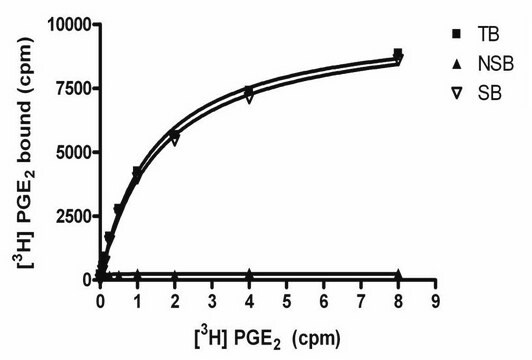
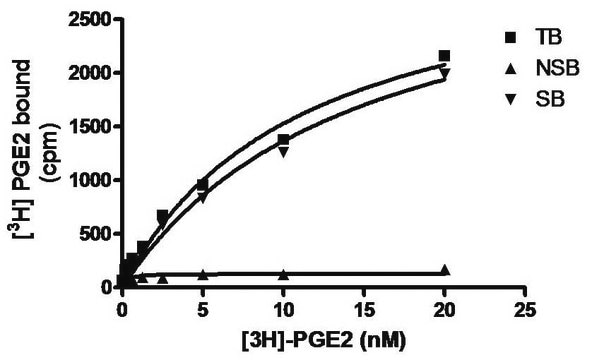
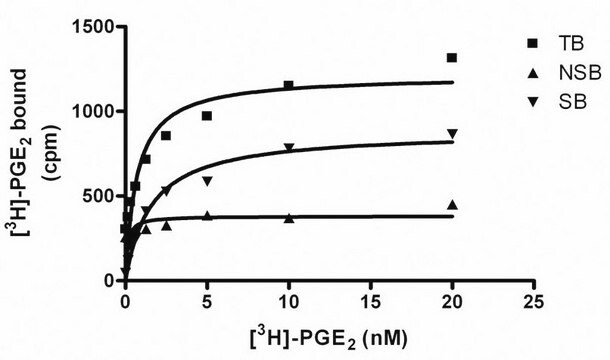
Membranes are mixed with radioactive ligand and unlabeled competitor (see Figures 1 and 2 for concentrations tested) in binding buffer in a nonbinding 96-well plate, and incubated for 1-2 h. Prior to filtration, a GF/C 96-well filter plate is coated with 0.33% polyethyleneimine for 30 min, then washed with 50mM HEPES, pH 7.4, 0.5% BSA. Binding reaction is transferred to the filter plate, and washed 3 times (1 mL per well per wash) with Wash Buffer. The plate is dried and counted.
Binding buffer: 50 mM Tris, pH 7.4, 10 mM MgCl2, 1 mM EDTA, filtered and stored at 4°C
Radioligand: [3H] PGE2 (Perkin Elmer#:NET-428 )
Wash Buffer: 50 mM Tris, pH 7.4 filtered and stored at 4°C.

Physical form

One package contains enough membranes for at least 200 assays (units), where a unit is the amount of membrane that will yield greater than 10-fold signal:background with 3H-labeled PGE2 at 1.5 nM

Liquid in packaging buffer: 50 mM Tris pH 7.4, 10% glycerol and 1% BSA no preservatives.
Packaging method: Membranes protein were adjusted to 0.5 mg/ml in 1 ml packaging buffer, rapidly frozen, and stored at -80°C.

Preparation Note

Maintain frozen at -70°C for up to 2 years. Do not freeze and thaw.

Analysis Note

Signal:background and specific binding values obtained in a competition binding assay with varying amounts of EP3 membrane prep:
10 µg/well5 µg/well
Signal:Background 38 21
Specific Binding (cpm) 6,386 4,053


Specifications:
1 unit = 10 μg
Bmax: 15.0 pmol/mg
Kd: 1.56 nM

Legal Information

CHEMICON is a registered trademark of Merck KGaA, Darmstadt, Germany

Disclaimer

Unless otherwise stated in our catalog or other company documentation accompanying the product(s), our products are intended for research use only and are not to be used for any other purpose, which includes but is not limited to, unauthorized commercial uses, in vitro diagnostic uses, ex vivo or in vivo therapeutic uses or any type of consumption or application to humans or animals.

Ähnliche Artikel vergleichen

Vollständigen Vergleich anzeigen

Unterschiede anzeigen

1 of 1

Dieser Artikel
HTS185MHTS142MHTS099M
shipped in

dry ice

shipped in

dry ice

shipped in

dry ice

shipped in

dry ice

UniProt accession no.

P43115

UniProt accession no.

P43116

UniProt accession no.

P35408

UniProt accession no.

P34995

recombinant

expressed in Chem-1 cells

recombinant

expressed in Chem-1 cells

recombinant

expressed in Chem-1 cells

recombinant

expressed in Chem-1 cells

biological source

human

biological source

human

biological source

human

biological source

human

storage temp.

-65 to -96°C

storage temp.

-65 to -96°C

storage temp.

-65 to -96°C

storage temp.

-65 to -96°C

Quality Level

100

Quality Level

100

Quality Level

100

Quality Level

100


Lagerklasse

12 - Non Combustible Liquids

wgk

WGK 2


Analysenzertifikate (COA)

Suchen Sie nach Analysenzertifikate (COA), indem Sie die Lot-/Chargennummer des Produkts eingeben. Lot- und Chargennummern sind auf dem Produktetikett hinter den Wörtern ‘Lot’ oder ‘Batch’ (Lot oder Charge) zu finden.

Besitzen Sie dieses Produkt bereits?

In der Dokumentenbibliothek finden Sie die Dokumentation zu den Produkten, die Sie kürzlich erworben haben.

Die Dokumentenbibliothek aufrufen


F Ushikubi et al.
Nature, 395(6699), 281-284 (1998-09-29)
Fever, a hallmark of disease, is elicited by exogenous pyrogens, that is, cellular components, such as lipopolysaccharide (LPS), of infectious organisms, as well as by non-infectious inflammatory insults. Both stimulate the production of cytokines, such as interleukin (IL)-1beta, that act
M Kotani et al.
Molecular pharmacology, 48(5), 869-879 (1995-11-01)
Five distinct cDNA clones encoding four different isoforms of human prostaglandin (PG) E receptor EP3 subtype were isolated from a human kidney cDNA library. Two cDNA clones differed only in their 3'-untranslated regions. The four isoforms, tentatively named EP3-I, EP3-II
M Kotani et al.
Genomics, 40(3), 425-434 (1997-03-15)
Prostaglandin EP3 receptor subtype is a seven-membrane-spanning protein with multiple C-terminal tails generated by alternative mRNA splicing. We report here the structural organization of the human EP3 gene (PTGER3). The human EP3 gene spanned more than 80 kb and was


Global Trade Item Number

SKUGTIN
HTS092M04053252363351

Questions

Reviews

No rating value

Active Filters