
ABS1028

Anti-GPR56, C-terminal Antibody
from rabbit, purified by affinity chromatography
Synonym(e):
GPR56 seven-transmembrane subunit, GPR56 7TM, GPR56 subunit beta, GPR56 CT, GPR56©, TM7XN1
Größe auswählen
| Packungsgröße | SKU | Verfügbarkeit | Preis |
|---|---|---|---|
| 100 μg | Warenkorb auf Verfügbarkeit prüfen | € 411,00 |
Über diesen Artikel
biological source
rabbit
Quality Level
conjugate
unconjugated
antibody form
affinity isolated antibody
antibody product type
primary antibodies
clone
polyclonal
purified by
affinity chromatography
species reactivity
rat, human
species reactivity (predicted by homology)
mouse (based on 100% sequence homology)
technique(s)
immunocytochemistry: suitable, immunoprecipitation (IP): suitable, western blot: suitable
NCBI accession no.
UniProt accession no.
shipped in
wet ice
target post-translational modification
unmodified
Gene Information
human ... GPR56(9289)
General description
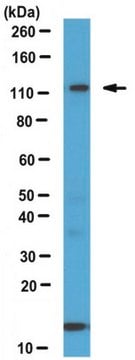
This receptor is heavily glycosylated in cells, and thus the apparent molecular mass of the full-length receptor in most cell types is around 90-120 kDa Moreover, this receptor is prone to extensive post-translational processing and proteolysis, and thus depending on the cell type the most prominent immunoreactive bands on Western blot are usually around 45 kDa, 25 kDa and/or 15 kDa in size
Immunogen
Application
Western Blot Analysis: A representative lot of this antibody detected GPR56 from rat kidney cell lysate (Paavola, K., et al. (2011). J. Biol. Chem. 2011, 286:28914-28921.)
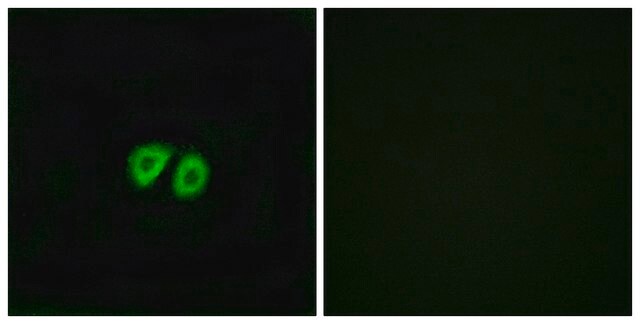
Immunocytochemistry Analysis: A representative lot of this antibody detected GPR56 from transfected HEK293 cells (Paavola, K., et al. (2011). J. Biol. Chem. 2011, 286:28914-28921.)
Analysis Note
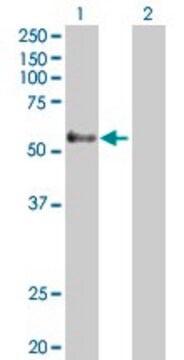
Western Blotting Analysis: 1 µg/ml of this antibody detected GPR56 in 10 µg of Hela cell lysate.
Other Notes
1 of 1
Dieser Artikel | |||
|---|---|---|---|
| antibody form affinity isolated antibody | antibody form purified immunoglobulin | antibody form affinity isolated antibody | antibody form affinity isolated antibody |
| conjugate unconjugated | conjugate unconjugated | conjugate unconjugated | conjugate unconjugated |
| biological source rabbit | biological source rabbit | biological source rabbit | biological source rabbit |
| Quality Level 100 | Quality Level 100 | Quality Level 100 | Quality Level - |
| clone polyclonal | clone polyclonal | clone polyclonal | clone polyclonal |
| UniProt accession no. | UniProt accession no. - | UniProt accession no. - | UniProt accession no. |
Still not finding the right product?
Probieren Sie unser Produkt-Auswahlhilfe, um Ihre Auswahl einzugrenzen
Lagerklasse
12 - Non Combustible Liquids
wgk
WGK 1
flash_point_f
Not applicable
flash_point_c
Not applicable
Analysenzertifikate (COA)
Suchen Sie nach Analysenzertifikate (COA), indem Sie die Lot-/Chargennummer des Produkts eingeben. Lot- und Chargennummern sind auf dem Produktetikett hinter den Wörtern ‘Lot’ oder ‘Batch’ (Lot oder Charge) zu finden.
Besitzen Sie dieses Produkt bereits?
In der Dokumentenbibliothek finden Sie die Dokumentation zu den Produkten, die Sie kürzlich erworben haben.
Global Trade Item Number
| SKU | GTIN |
|---|---|
| ABS1028 | 04053252993084 |