Direkt zum Inhalt
Merck

Fortfahren mit

ABN302

Anti-Complex I-75kD Antibody

from rabbit, purified by affinity chromatography

Synonym(e):

NADH-ubiquinone oxidoreductase 75 kDa subunit, mitochondrial, Complex I-75kD, CI-75kD

Anmelden zur Ansicht der Organisations- und Vertragspreise.

Größe auswählen

Ansicht ändern
PackungsgrößeSKUVerfügbarkeitPreis
100 μg
Warenkorb auf Verfügbarkeit prüfen
€ 416,00

Über diesen Artikel

UNSPSC Code:
12352203
NACRES:
NA.41
eCl@ss:
32160702
Conjugate:
unconjugated
Clone:
polyclonal
Application:
IHC, WB
Citations:
4

€ 416,00


Warenkorb auf Verfügbarkeit prüfen

Technischer Dienst
Benötigen Sie Hilfe? Unser Team von erfahrenen Wissenschaftlern ist für Sie da.
Unterstützung erhalten


biological source

rabbit

Quality Level

conjugate

unconjugated

antibody form

affinity isolated antibody

antibody product type

primary antibodies

clone

polyclonal

purified by

affinity chromatography

species reactivity

mouse, rat, human

species reactivity (predicted by homology)

bovine (based on 100% sequence homology), chimpanzee (based on 100% sequence homology)

technique(s)

immunohistochemistry: suitable (paraffin), western blot: suitable

NCBI accession no.

UniProt accession no.

shipped in

wet ice

target post-translational modification

unmodified

Gene Information

human ... NDUFS1(4719)

General description

Complex I-75kD (CI-75kD) is also called NADH-ubiquinone oxidoreductase 75 kDa subunit, mitochondrial (NDUFS1). Complex I-75kD is a core subunit of the mitochondrial membrane respiratory chain NADH dehydrogenase (Complex I), which transfers electrons from NADH to the respiratory chain, and is thought to be part of the minimal assembly required for catalysis. Complex I-75kD defects are thought to be a cause of Mitochondrial complex I deficiency (MT-C1D).
~75 kDa observed

Immunogen

KLH-conjugated linear peptide corresponding to 15 amino acids from the internal region of human Complex I-75kD.

Application

Anti-Complex I-75kD, Cat. No. ABN302, is a rabbit polyclonal antibody that detects Complex I-75kD and is tested for use in Western Blotting and Immunohistochemistry.
Research Category
Neuroscience
Research Sub Category
Developmental Signaling
Tested Applications

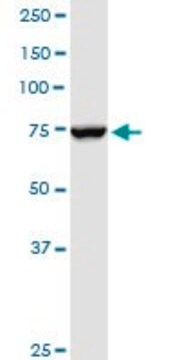
Western Blotting Analysis: A 1:5,000 dilution from a representative lot detected Complex I-75kD in rat brain, human brain, and human heart tissue lysates.

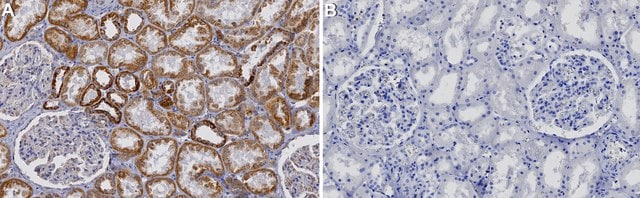
Immunohistochemistry (Paraffin) Analysis: A 1:1,000 dilution of this antibody detected Complex I-75kD in human kidney and human heart tissue sections.

Note: Actual optimal working dilutions must be determined by end user as specimens, and experimental conditions may vary with the end user.

Physical form

Affinity purified
Purified rabbit polyclonal antibody in buffer containing 0.1 M Tris-Glycine (pH 7.4), 150 mM NaCl with 0.05% sodium azide.

Preparation Note

Recommended storage: +2°C to +8°C.

Analysis Note

Evaluated by Western Blotting in mouse brain tissue lysate.

Western Blotting Analysis: A 1:5,000 dilution of this antibody detected Complex I-75kD in mouse brain tissue lysates.

Other Notes

Concentration: Please refer to the Certificate of Analysis for the lot-specific concentration.

Disclaimer

Unless otherwise stated in our catalog or other company documentation accompanying the product(s), our products are intended for research use only and are not to be used for any other purpose, which includes but is not limited to, unauthorized commercial uses, in vitro diagnostic uses, ex vivo or in vivo therapeutic uses or any type of consumption or application to humans or animals.

Ähnliche Artikel vergleichen

Vollständigen Vergleich anzeigen

Unterschiede anzeigen

1 of 1

Dieser Artikel
SAB1410830SAB1400182MABN643
Quality Level

100

Quality Level

-

Quality Level

-

Quality Level

100

antibody form

affinity isolated antibody

antibody form

purified immunoglobulin

antibody form

IgG fraction of antiserum

antibody form

purified immunoglobulin

conjugate

unconjugated

conjugate

unconjugated

conjugate

unconjugated

conjugate

unconjugated

biological source

rabbit

biological source

rabbit

biological source

mouse

biological source

mouse

technique(s)

immunohistochemistry: suitable (paraffin), western blot: suitable

technique(s)

western blot: 1 μg/mL

technique(s)

western blot: 1 μg/mL

technique(s)

immunohistochemistry: suitable (paraffin), western blot: suitable

UniProt accession no.

P28331

UniProt accession no.

P28331

UniProt accession no.

P28331

UniProt accession no.

O75489


Still not finding the right product?

Probieren Sie unser Produkt-Auswahlhilfe, um Ihre Auswahl einzugrenzen


Lagerklasse

12 - Non Combustible Liquids

wgk

WGK 1

flash_point_f

Not applicable

flash_point_c

Not applicable


Analysenzertifikate (COA)

Suchen Sie nach Analysenzertifikate (COA), indem Sie die Lot-/Chargennummer des Produkts eingeben. Lot- und Chargennummern sind auf dem Produktetikett hinter den Wörtern ‘Lot’ oder ‘Batch’ (Lot oder Charge) zu finden.

Besitzen Sie dieses Produkt bereits?

In der Dokumentenbibliothek finden Sie die Dokumentation zu den Produkten, die Sie kürzlich erworben haben.

Die Dokumentenbibliothek aufrufen


Vedavathi Madhu et al.
Journal of bone and mineral research : the official journal of the American Society for Bone and Mineral Research, 35(8), 1504-1524 (2020-04-07)
Nucleus pulposus (NP) cells reside in an avascular and hypoxic microenvironment of the intervertebral disc and are predominantly glycolytic due to robust HIF-1 activity. It is generally thought that NP cells contain few functional mitochondria compared with cells that rely
Leena P Bharath et al.
Cell metabolism, 32(1), 44-55 (2020-05-14)
Age is a non-modifiable risk factor for the inflammation that underlies age-associated diseases; thus, anti-inflammaging drugs hold promise for increasing health span. Cytokine profiling and bioinformatic analyses showed that Th17 cytokine production differentiates CD4+ T cells from lean, normoglycemic older and
Lauren G Buss et al.
Scientific reports, 14(1), 845-845 (2024-01-09)
Salivary glands are indirectly damaged during radiotherapy for head and neck cancer, resulting in acute and chronic hyposalivation. Current treatments for radiation-induced hyposalivation do not permanently restore function to the gland; therefore, more mechanistic understanding of the damage response is


Global Trade Item Number

SKUGTIN
ABN30204053252923302

Questions

Reviews

No rating value

Active Filters