Direkt zum Inhalt
Merck

Fortfahren mit

ABN240

Anti-Beta (β)-Amyloid antibody

rabbit polyclonal

Synonym(e):

Amyloid beta A4 protein, ABPP, APPI, APP, Alzheimer disease amyloid protein, Cerebral vascular amyloid peptide, CVAP, PreA4, Protease nexin-II, PN-II, 1.N-APP2.Soluble APP-alpha, S-APP-alpha3.Soluble APP-beta, S-APP-beta4.C995.Beta-amyloid protein 42, Be

Anmelden zur Ansicht der Organisations- und Vertragspreise.

Größe auswählen

Ansicht ändern
PackungsgrößeSKUVerfügbarkeitPreis
100 μL
Warenkorb auf Verfügbarkeit prüfen
€ 478,00

Über diesen Artikel

UNSPSC Code:
12352203
eCl@ss:
32160702
NACRES:
NA.41
Clone:
polyclonal
Species reactivity:
human
Application:
ELISA, IHC, WB
Citations:
2

€ 478,00


Warenkorb auf Verfügbarkeit prüfen
Für Ihr Target ist ein rekombinanter, konservierungsmittelfreier Antikörper verfügbar. Probieren Sie ZMS1012

Großbestellung anfragen
Technischer Dienst
Benötigen Sie Hilfe? Unser Team von erfahrenen Wissenschaftlern ist für Sie da.
Unterstützung erhalten


Produktname

Anti-Amyloid, β 1-40, aβ Antibody, from rabbit, purified by affinity chromatography

biological source

rabbit

Quality Level

antibody form

affinity isolated antibody

antibody product type

primary antibodies

clone

polyclonal

purified by

affinity chromatography

species reactivity

human

species reactivity (predicted by homology)

bovine (based on 100% sequence homology), rat (based on 100% sequence homology), mouse (based on 100% sequence homology)

technique(s)

ELISA: suitable, immunohistochemistry: suitable (paraffin), western blot: suitable

NCBI accession no.

UniProt accession no.

shipped in

wet ice

target post-translational modification

unmodified

Gene Information

human ... APP(351)

General description

Amyloid β 1-40 is one of several functional peptides (39 to 43 amino acids in length) formed from proteolytic cleavage of the amyloid-beta precursor protein (APP) by the family of secretase enzymes. Although the APP protein is required for a number of biological functions including axonal transport, cell adhesion, and transcription, the amyloid β 1-40 peptide has been studied mostly for its role in neurotoxicity, particularly in the context of Alzheimer’s disease. Previous studies have reported that expression of amyloid β 1-40 increases in Alzheimer’s disease and correlate with the occurrence of aberrant synaptic structure and cognitive dysfunction. These detrimental effects on neural function may be related to aggregation of this peptide (formation of neurite plaques), as neurite plaques been shown to disrupt multiple neurotransmitter systems, and synaptic events such as long-term potentiation.
~4 kDa observed. An uncharacterized band appears at ~19 kDa in some lysates.

Immunogen

Epitope: P3(40) peptide
KLH-conjugated linear peptide corresponding to the P3(40) peptide of human Amyloid, B 1-40.

Application

Anti-Amyloid, β 1-40, aβ Antibody is an antibody against Amyloid, β 1-40, aβ for use in Western Blotting, IHC(P), ELISA.
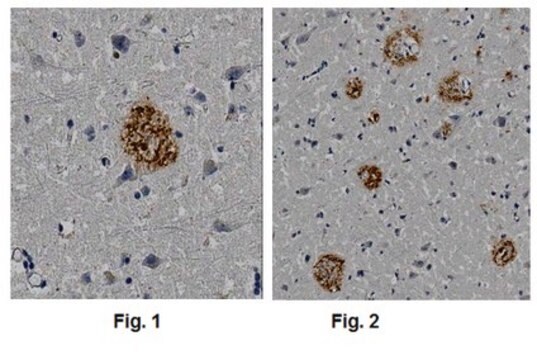
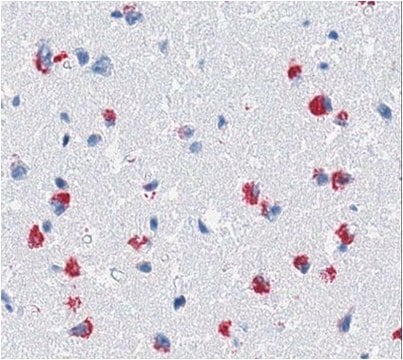
Immunohistochemistry Analysis: A 1:1,000 dilution from a representative lot detected Amyloid, B 1-40 in human Alzheimer′s diseased brain tissue.

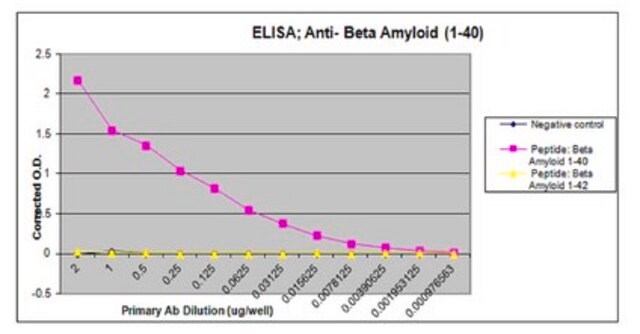
ELISA: A representative lot detected Amyloid, B 1-40 in ELISA (Direct).
Research Category
Neuroscience
Research Sub Category
Neurodegenerative Diseases

Biochem/physiol Actions

This antibody recognizes the P3(40) peptide of Amyloid, β 1-40.

Physical form

Affinity purified
Purified rabbit polyclonal serum in buffer containing 0.1 M Tris-Glycine (pH 7.4), 150 mM NaCl with 0.05% sodium azide.

Preparation Note

Stable for 1 year at 2-8°C from date of receipt.

Analysis Note

Control
Human Alzhiemer brain tissue lysate
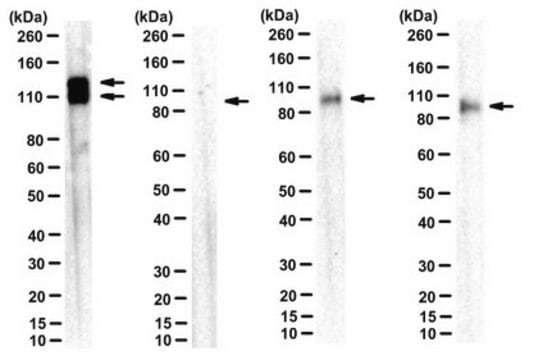
Evaluated by Western Blot in human Alzheimer brain tissue lysate.

Western Blot Analysis: 0.5 µg/mL of this antibody detected Amyloid, B 1-40 on 10 µg of human Alzheimer brain tissue lysate.

Other Notes

Replaces: AB5737

Disclaimer

Unless otherwise stated in our catalog or other company documentation accompanying the product(s), our products are intended for research use only and are not to be used for any other purpose, which includes but is not limited to, unauthorized commercial uses, in vitro diagnostic uses, ex vivo or in vivo therapeutic uses or any type of consumption or application to humans or animals.

Ähnliche Artikel vergleichen

Vollständigen Vergleich anzeigen

Unterschiede anzeigen

1 of 1

Dieser Artikel
MABN639MABN2295MABN687
Quality Level

100

Quality Level

100

Quality Level

100

Quality Level

100

biological source

rabbit

biological source

mouse

biological source

rat

biological source

camel

antibody form

affinity isolated antibody

antibody form

affinity purified immunoglobulin

antibody form

purified antibody

antibody form

purified immunoglobulin

species reactivity

human

species reactivity

human

species reactivity

mouse, human

species reactivity

human

UniProt accession no.

P05067

UniProt accession no.

P05067

UniProt accession no.

P05067

UniProt accession no.

P05067

clone

polyclonal

clone

1E8, monoclonal

clone

2E9, monoclonal

clone

B10, monoclonal


Still not finding the right product?

Explore all of our products under

oder

Probieren Sie unser Produkt-Auswahlhilfe, um Ihre Auswahl einzugrenzen


Lagerklasse

12 - Non Combustible Liquids

wgk

WGK 1

flash_point_f

Not applicable

flash_point_c

Not applicable


Analysenzertifikate (COA)

Suchen Sie nach Analysenzertifikate (COA), indem Sie die Lot-/Chargennummer des Produkts eingeben. Lot- und Chargennummern sind auf dem Produktetikett hinter den Wörtern ‘Lot’ oder ‘Batch’ (Lot oder Charge) zu finden.

Besitzen Sie dieses Produkt bereits?

In der Dokumentenbibliothek finden Sie die Dokumentation zu den Produkten, die Sie kürzlich erworben haben.

Die Dokumentenbibliothek aufrufen


Verwandter Inhalt

Alzheimer’s Disease: Amyloid Cascade and Beyond Product Focus


Amanda B Chai et al.
International journal of molecular sciences, 22(1) (2021-01-02)
Defective clearance mechanisms lead to the accumulation of amyloid-beta (Aβ) peptides in the Alzheimer's brain. Though predominantly generated in neurons, little is known about how these hydrophobic, aggregation-prone, and tightly membrane-associated peptides exit into the extracellular space where they deposit
Xike Qin et al.
The Journal of biological chemistry, 291(42), 22276-22287 (2016-09-01)
Accumulation of amyloid-β peptide (Aβ) in the brain is regarded as central to Alzheimer's disease (AD) pathogenesis. Aβ is generated by a sequential cleavage of amyloid precursor protein (APP) by β-secretase 1 (BACE-1) followed by γ-secretase. BACE-1 cleavage of APP


Global Trade Item Number

SKUGTIN
ABN24004053252648830

Questions

Reviews

No rating value

Active Filters