
ABE387

Anti-ATF4-Antikörper
serum, from rabbit
Synonym(e):
Cyclic AMP-dependent transcription factor ATF-4, cAMP-dependent transcription factor ATF-4, Activating transcription factor 4, Cyclic AMP-responsive element-binding protein 2, CREB-2, cAMP-responsive element-binding protein 2
DNA-binding protein
Größe auswählen
| Packungsgröße | SKU | Verfügbarkeit | Preis |
|---|---|---|---|
| 100 μL | Warenkorb auf Verfügbarkeit prüfen | € 453,00 |
Über diesen Artikel
€ 453,00
biological source
rabbit
Quality Level
conjugate
unconjugated
antibody form
serum
antibody product type
primary antibodies
clone
polyclonal
species reactivity
human
technique(s)
ChIP: suitable, western blot: suitable
isotype
IgG
NCBI accession no.
UniProt accession no.
shipped in
wet ice
target post-translational modification
unmodified
Gene Information
human ... ATF4(468)
General description
Immunogen
Application
Analyse mittels Chromatin-Immunpräzipitation: Eine repräsentative Charge aus einem unabhängigen Labor wies ATF4 in HepG2- und MEF-Zelllysaten nach (Shan, J., et al. (2012). J Biol Chem. 287(43): 36393-36403.).
Epigenetik & Zellkernfunktion
Chromatin-Biologie
Physical form
Preparation Note
Handhabungsempfehlungen: Das Fläschchen nach Empfang und vor dem Abnehmen der Kappe zentrifugieren und die Lösung vorsichtig mischen. In Mikrozentrifugenröhrchen aliquotieren und bei -20 °C aufbewahren. Wiederholte Einfrier-/Auftauzyklen sind zu vermeiden, da sie das IgG beschädigen und die Produktleistung beeinträchtigen können.
Analysis Note
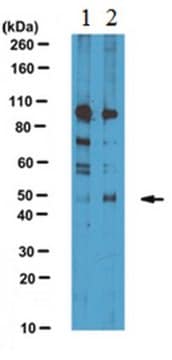
Western-Blot-Analyse: Eine 1:2.000-Verdünnung aus einer repräsentativen Charge wies ATF4 in 10 µg Lysat von mit HisOH behandelten HepG2-Zellen nach (HisOH wurde verwendet, um die durch zellulären Stress vermittelte eIF2a-Phosphorylierung zu induzieren, was einen nachfolgenden Nachweis von ATF4 ermöglicht. Zur Erhöhung der Leistung können Endanwender höhere Verdünnungen dieses Antikörpers ausprobieren. Für bessere Ergebnisse wurde während der Inkubation des Sekundärantikörpers 1 % SDS verwendet.)
Lysat von mit HisOH behandelten HepG2-Zellen
Disclaimer
1 of 1
Dieser Artikel | |||
|---|---|---|---|
| conjugate unconjugated | conjugate Atto 488 conjugate | conjugate peroxidase conjugate | conjugate unconjugated |
| antibody form serum | antibody form purified immunoglobulin | antibody form purified immunoglobulin | antibody form purified immunoglobulin |
| biological source rabbit | biological source mouse | biological source mouse | biological source mouse |
| Quality Level 100 | Quality Level 100 | Quality Level 100 | Quality Level 100 |
| Gene Information human ... ATF4(468) | Gene Information human ... ATF4(468) | Gene Information human ... ATF4(468) | Gene Information human ... ATF4(468) |
| shipped in wet ice | shipped in wet ice | shipped in wet ice | shipped in wet ice |
Still not finding the right product?
Probieren Sie unser Produkt-Auswahlhilfe, um Ihre Auswahl einzugrenzen
Lagerklasse
10 - Combustible liquids
wgk
WGK 1
Analysenzertifikate (COA)
Suchen Sie nach Analysenzertifikate (COA), indem Sie die Lot-/Chargennummer des Produkts eingeben. Lot- und Chargennummern sind auf dem Produktetikett hinter den Wörtern ‘Lot’ oder ‘Batch’ (Lot oder Charge) zu finden.
Besitzen Sie dieses Produkt bereits?
In der Dokumentenbibliothek finden Sie die Dokumentation zu den Produkten, die Sie kürzlich erworben haben.
Verwandter Inhalt
Cancer is a complex disease manifestation. At its core, it remains a disease of abnormal cellular proliferation and inappropriate gene expression. In the early days, carcinogenesis was viewed simply as resulting from a collection of genetic mutations that altered the gene expression of key oncogenic genes or tumor suppressor genes leading to uncontrolled growth and disease (Virani, S et al 2012). Today, however, research is showing that carcinogenesis results from the successive accumulation of heritable genetic and epigenetic changes. Moreover, the success in how we predict, treat and overcome cancer will likely involve not only understanding the consequences of direct genetic changes that can cause cancer, but also how the epigenetic and environmental changes cause cancer (Johnson C et al 2015; Waldmann T et al 2013). Epigenetics is the study of heritable gene expression as it relates to changes in DNA structure that are not tied to changes in DNA sequence but, instead, are tied to how the nucleic acid material is read or processed via the myriad of protein-protein, protein-nucleic acid, and nucleic acid-nucleic acid interactions that ultimately manifest themselves into a specific expression phenotype (Ngai SC et al 2012, Johnson C et al 2015). This review will discuss some of the principal aspects of epigenetic research and how they relate to our current understanding of carcinogenesis. Because epigenetics affects phenotype and changes in epigenetics are thought to be key to environmental adaptability and thus may in fact be reversed or manipulated, understanding the integration of experimental and epidemiologic science surrounding cancer and its many manifestations should lead to more effective cancer prognostics as well as treatments (Virani S et al 2012).
Global Trade Item Number
| SKU | GTIN |
|---|---|
| ABE387 | 04053252850769 |