Direkt zum Inhalt
Merck

Fortfahren mit

ABC1691

Anti-PEPCK

from rabbit, purified by affinity chromatography

Synonym(e):

Phosphoenolpyruvate carboxykinase, cytosolic, PEPCK-C

Anmelden zur Ansicht der Organisations- und Vertragspreise.

Größe auswählen

Ansicht ändern
PackungsgrößeSKUVerfügbarkeitPreis

Über diesen Artikel

UNSPSC Code:
12352203
NACRES:
NA.41
eCl@ss:
32160702
Conjugate:
unconjugated
Clone:
polyclonal
Application:
IF, IHC, WB
Citations:
1
Preise und Verfügbarkeit sind derzeit nicht verfügbar.
Technischer Dienst
Benötigen Sie Hilfe? Unser Team von erfahrenen Wissenschaftlern ist für Sie da.
Unterstützung erhalten


biological source

rabbit

Quality Level

conjugate

unconjugated

antibody form

affinity isolated antibody

antibody product type

primary antibodies

clone

polyclonal

purified by

affinity chromatography

species reactivity

human

technique(s)

immunofluorescence: suitable, immunohistochemistry: suitable (paraffin), western blot: suitable

NCBI accession no.

UniProt accession no.

shipped in

ambient

target post-translational modification

unmodified

Gene Information

human ... PCK1(5105)

General description

Phosphoenolpyruvate carboxykinase, cytosolic (UniProt: also known as PEPCK, PEPCK-C) is encoded by the PCK1 (also known as PEPCK1) gene (Gene ID: 5105) in human. PEPCK catalyzes the conversion of oxaloacetate (OAA) to phosphoenolpyruvate (PEP), which is a rate-limiting step in gluconeogenesis. It requires manganese as a cofactor. It is expressed in higher levels in liver of fasting subjects. Kidney and adipocytes exhibit lower expression levels. Two isozymes of PEPCK have been identified, cytosolic and mitochondrial. PEPCK consists of an N-terminal and a catalytic C-terminal domain, with the active site and metal ions located in a cleft between them. Upon binding to substrate, PEPCK undergoes a conformational change that accelerates the catalysis process. Expression of PEPCK can be controlled by cAMP, glucocorticoids, and by insulin. Its expression is induced by glucagon, catecholamines, and glucocorticoids during periods of fasting and in response to stress and is diminished following glucose-induced and by the action of insulin. PEPCK-C is absent in fetal liver but appears at birth, concomitant with the capacity for gluconeogenesis. Deficiency of PEPCK-C is a rare metabolic disorder results in fatty infiltration of liver and kidney, hypoglycemia, hepatomegaly, and failure to thrive.
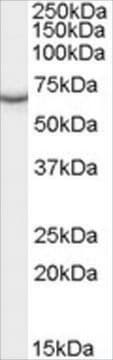
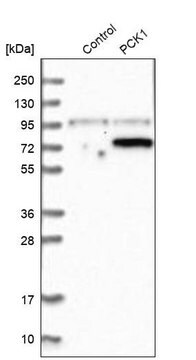
~65 kDa observed; 69.19 kDa calculated. Uncharacterized bands may be observed in some lysate(s).

Immunogen

KLH-conjugated linear peptide corresponding to 15 amino acids from the C-terminal half of human phosphoenolpyyruvate carboxykinase (PEPCK).

Application

Detect Phosphoenolpyruvate carboxykinase, cytosolic [GTP] using this rabbit polyclonal Anti-PEPCK, Cat. No. ABC1691, tested in Immunohistochemistry (Paraffin) and Western Blotting.
Immunohistochemistry Analysis: A 1:1,000 dilution from a representative lot detected PEPCK in human kidney, human pancreas, human skeletal muscle, and human placental tissue.

Immunofluorescence Analysis: A 1:500 dilution from a representative lot detected PEPCK in human small intestine and differentiated duodenum intestinal organoid tissue sections.

Western Blotting Analysis: 2 µg/mL from a representative lot detected PEPCK in 10 µg of human kidney tissue.
Research Category
Apoptosis & Cancer

Biochem/physiol Actions

This polyclonal antibody detects cytosolic phosphoenolpyruvate carboxykinase in human kidney.

Physical form

Affinity Purified
Purified rabbit polyclonal antibody in buffer containing 0.1 M Tris-Glycine (pH 7.4), 150 mM NaCl with 0.05% sodium azide.

Preparation Note

Stable for 1 year at 2-8°C from date of receipt.

Analysis Note

Evaluated by Immunohistochemistry in human liver tissue

Immunohistochemistry Analysis: A 1:1,000 dilution of this antibody detected PEPCK in human liver tissue.

Other Notes

Concentration: Please refer to lot specific datasheet.

Disclaimer

Unless otherwise stated in our catalog or other company documentation accompanying the product(s), our products are intended for research use only and are not to be used for any other purpose, which includes but is not limited to, unauthorized commercial uses, in vitro diagnostic uses, ex vivo or in vivo therapeutic uses or any type of consumption or application to humans or animals.

Ähnliche Artikel vergleichen

Vollständigen Vergleich anzeigen

Unterschiede anzeigen

1 of 1

Dieser Artikel
SAB1404176SAB2500759HPA006507
antibody form

affinity isolated antibody

antibody form

purified immunoglobulin

antibody form

affinity isolated antibody

antibody form

affinity isolated antibody

conjugate

unconjugated

conjugate

unconjugated

conjugate

unconjugated

conjugate

unconjugated

biological source

rabbit

biological source

mouse

biological source

goat

biological source

rabbit

Quality Level

100

Quality Level

-

Quality Level

-

Quality Level

100

shipped in

ambient

shipped in

dry ice

shipped in

dry ice

shipped in

wet ice

Gene Information

human ... PCK1(5105)

Gene Information

human ... PCK1(5105)

Gene Information

human ... PCK1(5105)

Gene Information

human ... PCK1(5105)


Still not finding the right product?

Probieren Sie unser Produkt-Auswahlhilfe, um Ihre Auswahl einzugrenzen


Lagerklasse

12 - Non Combustible Liquids

wgk

WGK 1

flash_point_f

Not applicable

flash_point_c

Not applicable


Analysenzertifikate (COA)

Suchen Sie nach Analysenzertifikate (COA), indem Sie die Lot-/Chargennummer des Produkts eingeben. Lot- und Chargennummern sind auf dem Produktetikett hinter den Wörtern ‘Lot’ oder ‘Batch’ (Lot oder Charge) zu finden.

Besitzen Sie dieses Produkt bereits?

In der Dokumentenbibliothek finden Sie die Dokumentation zu den Produkten, die Sie kürzlich erworben haben.

Die Dokumentenbibliothek aufrufen


Su-Ryun Jung et al.
The Korean journal of physiology & pharmacology : official journal of the Korean Physiological Society and the Korean Society of Pharmacology, 28(1), 31-38 (2023-12-29)
As in type 1 diabetes, the loss of pancreatic β-cells leads to insulin deficiency and the subsequent development of hyperglycemia. Exercise has been proposed as a viable remedy for hyperglycemia. Lithium, which has been used as a treatment for bipolar


Global Trade Item Number

SKUGTIN
ABC169104054839189128

Questions

Reviews

No rating value

Active Filters