
AB5188

Anti-Potassium Channel Kv3.1b Antibody
Chemicon®, from rabbit
Synonym(e):
Anti-EPM7, Anti-KV3.1, Anti-KV4, Anti-NGK2
Größe auswählen
| Packungsgröße | SKU | Verfügbarkeit | Preis |
|---|---|---|---|
| 200 μL | Warenkorb auf Verfügbarkeit prüfen | € 703,00 |
Über diesen Artikel
biological source
rabbit
Quality Level
conjugate
unconjugated
antibody form
affinity purified immunoglobulin
antibody product type
primary antibodies
clone
polyclonal
purified by
affinity chromatography
species reactivity
mouse, rat
manufacturer/tradename
Chemicon®
technique(s)
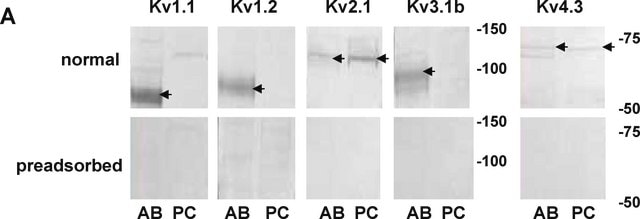
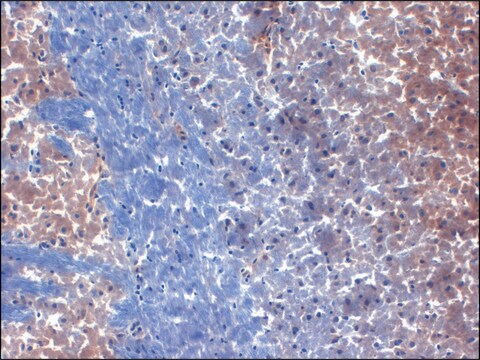
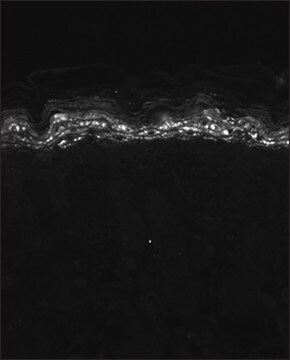
immunohistochemistry: suitable, immunoprecipitation (IP): suitable, western blot: suitable
NCBI accession no.
UniProt accession no.
shipped in
dry ice
target post-translational modification
unmodified
Gene Information
mouse ... Kcnc1(16502)
Immunogen
Application
Immunohistochemistry on rat brain sections.
Immunoprecipitation
Dilutions should be made using a carrier protein such as BSA (1-3%)
Optimal working dilutions must be determined by the end user.
PROTOCOL FOR IMMUNOHISTOCHEMISTRY
Sacrifice and tissue processing:
Rats are deeply anesthetized with pentobarbital sodium (Pental). Brain is fixed by transcardial perfusion, first with 50 mL of phosphate buffered saline (0.02M PBS, pH 7.4) containing heparin (5U/ml), then with 220 mL of ice-cold 4% paraformaldehyde in 0.1M PBS, pH 7.5 containing sucrose 4%. Brain is cut in coronal blocks and further fixed by immersion in the same fixative, refrigerated, for 1-2 hours. Brain blocks are transferred to 10% sucrose in 0.1M PBS and sectioned in a cryostat within 3 days. Brain sections, 30 μm thick, are floated in 0.1M PBS and then preserved in a cryopreservation buffer at -20°C. The cryopreservation buffer contains 40% ethylene glycol and 1% polyvinylpyrrolidone in 0.1M potassium acetate buffer, pH 6.5.
Staining procedure:
1. Floating sections are rinsed in 0.02M PBS, 2x 5 minutes.
2. Endogenous peroxidase activity is quenched by incubation with 0.2 % hydrogen peroxide in 0.1M phosphate buffer pH 7.3 containing 0.2% Triton X-100 for 25 minutes at room temperature.
3. Sections are rinsed in 0.02M PBS, 2x 5 minutes.
4. Sections are incubated with the primary antiserum in a medium containing 0.3% Triton X-100, 0.05% Tween 20, 4% normal donkey serum (NDS), for 1 hour at room temperature and then overnight refrigerated.
5. Sections are rinsed in 0.02M PBS, containing 4% NDS, 2x 5 minutes.
Sections are incubated with biotinylated donkey anti-rabbit (from Chemicon USA, catalog number AP182B) diluted 1:400 in 0.02M PBS, containing 0.3% Triton X-100, 0.05% Tween 20, and 4% NDS, for 1 hour at room temperature and then overnight refrigerated.
1. Sections are rinsed in 0.02M PBS containing 4% NDS, 2x 5 min.
2. Sections are incubated with extravidin-peroxidase (Sigma Catalog number E2886) diluted 1:100 in 0.02M PBS, for 45 minutes at room temperature.
3. Sections are rinsed in 0.02M PBS, 3x 5 minutes.
Color development:
1. Sections are incubated with a solution of diaminobenzidine at the concentration of 0.0125% and containing 0.05% nickel ammonium sulfate for 10 minutes at room temperature.
2. Sections are transferred to the same DAB solution but with added hydrogen peroxide at a final concentration of 0.0015%. Duration of incubation should be adjusted by the end user.
3. Sections are rinsed in 0.02M PBS, 4x 10 minutes.
4. Sections are mounted on glass slides (gelatinized or coated by any other type of adhesive material) and allowed to dry.
5. Sections are dehydrated in ascending series of ethanol concentrations (70%, 90%, 100%, 5 minutes in each), delipidated in xylene (10 minutes) and coverslipped in Permount (or any other xylene diluted adhesive).
Biochem/physiol Actions
Analysis Note
CONTROL ANTIGEN: Included free of charge with the antibody is 40 μg of control antigen (lyophilized powder in phosphate buffered saline, pH 7.4, containing 5% sucrose and 0.025% sodium azide). The stock solution of the antigen can be made up using 200 μL of sterile deionized water. For negative control, preincubate 1 μg of peptide with 1 μg of antibody for one hour at room temperature. Optimal concentrations must be determined by the end user.
Other Notes
Legal Information
1 of 1
Dieser Artikel | |||
|---|---|---|---|
| biological source rabbit | biological source rabbit | biological source mouse | biological source mouse |
| Quality Level 100 | Quality Level 100 | Quality Level 100 | Quality Level - |
| conjugate unconjugated | conjugate unconjugated | conjugate unconjugated | conjugate unconjugated |
| antibody form affinity purified immunoglobulin | antibody form IgG fraction of antiserum | antibody form purified immunoglobulin | antibody form purified immunoglobulin |
| UniProt accession no. | UniProt accession no. | UniProt accession no. | UniProt accession no. |
| species reactivity mouse, rat | species reactivity rat, horse, bovine, guinea pig, mouse, dog, rabbit, human | species reactivity human, rat, mouse | species reactivity mouse, rat, human |

Still not finding the right product?
Probieren Sie unser Produkt-Auswahlhilfe, um Ihre Auswahl einzugrenzen
Lagerklasse
11 - Combustible Solids
wgk
WGK 3
Analysenzertifikate (COA)
Suchen Sie nach Analysenzertifikate (COA), indem Sie die Lot-/Chargennummer des Produkts eingeben. Lot- und Chargennummern sind auf dem Produktetikett hinter den Wörtern ‘Lot’ oder ‘Batch’ (Lot oder Charge) zu finden.
Besitzen Sie dieses Produkt bereits?
In der Dokumentenbibliothek finden Sie die Dokumentation zu den Produkten, die Sie kürzlich erworben haben.
Global Trade Item Number
| SKU | GTIN |
|---|---|
| AB5188 | 04053252670770 |
| AB5188-50UL | 04053252510717 |