Direkt zum Inhalt
Merck

Fortfahren mit

AB3071

Anti-Aquaporin 0 Antibody

Chemicon®, from rabbit

Synonym(e):

AQP0, MIP, Major Intrinsic Protein

Anmelden zur Ansicht der Organisations- und Vertragspreise.

Größe auswählen

Ansicht ändern
PackungsgrößeSKUVerfügbarkeitPreis
50 μg
Warenkorb auf Verfügbarkeit prüfen
€ 453,00

Über diesen Artikel

UNSPSC Code:
12352203
NACRES:
NA.41
eCl@ss:
32160702
Conjugate:
unconjugated
Clone:
polyclonal
Application:
ELISA, WB
Citations:
18

€ 453,00


Warenkorb auf Verfügbarkeit prüfen

Großbestellung anfragen
Technischer Dienst
Benötigen Sie Hilfe? Unser Team von erfahrenen Wissenschaftlern ist für Sie da.
Unterstützung erhalten


biological source

rabbit

Quality Level

conjugate

unconjugated

antibody form

affinity purified immunoglobulin

antibody product type

primary antibodies

clone

polyclonal

purified by

affinity chromatography

species reactivity

human

manufacturer/tradename

Chemicon®

technique(s)

ELISA: suitable, western blot: suitable

NCBI accession no.

UniProt accession no.

shipped in

dry ice

target post-translational modification

unmodified

Gene Information

human ... MIP(4284)

Immunogen

A 17 AA synthetic peptide within the carboxy terminal domain of human Aquaporin-0 (Shiels et al. 1988; Kent et al. 1990; Pisano et al. 1991; Shiels et al. 1996) was selected for antibody production. This domain is predicted to be cytoplasmic.

Application

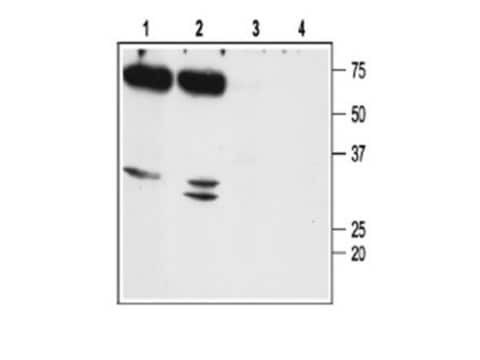
Detect Aquaporin 0 using this Anti-Aquaporin 0 Antibody validated for use in ELISA & WB.
We recommend the use of 0.5-1% milk in all primary/secondary dilutions in order to suppress non-specific bands.

Western blot: 1-10 μg/mL using Chemiluminescence technique

ELISA: 0.5-1.0 μg/mL

Optimal working dilutions must be determined by end user.

Biochem/physiol Actions

Water is a critical component of all living cells. Interestingly, tissue membranes show a great degree of water permeability. Mammalian red cells, renal proximal tubules, and descending thin limb of Henle are extraordinarily permeable to water. Water crosses hydrophobic plasma membranes either by simple diffusion or through a facilitative transport mechanism mediated by special protein "aquaporin". Over the last decade, genes for several members of aquaporin family have been cloned, expressed, and their distribution studied in many tissues. Aquaporin-0 or MIP26 (major intrinsic protein 26 kDa), and Aquaporin-1 (purified from red cells) also called CHIP-28 (channel forming integral protein, 28 kDa; 268 AA; gene locus 7p14) has been the foundation of the growing family of aquaporins. The lens specific Aquaporin-0 represents up to 80% of total lens membrane protein. Defects in MIP26 are a cause of autosomal dominant cataract. The cataract Fraser mutation (CAT-FR or Shriveled) is a transposon-induced splicing error that substitutes a long terminal repeat sequence for the c-terminus of MIP. The lens opacity mutation (LOP) is an AA substitution that inhibits targeting of MIP to the cell membrane. Human Aquaporin-0 is a 263 amino acid transmembrane protein belonging to the MIP family. Aquaporin families of proteins are predicted to contain six transmembrane domains. The N and C-terminus are predicted to be cytoplasmic.

Other Notes

Concentration: Please refer to the Certificate of Analysis for the lot-specific concentration.

Legal Information

CHEMICON is a registered trademark of Merck KGaA, Darmstadt, Germany

Ähnliche Artikel vergleichen

Vollständigen Vergleich anzeigen

Unterschiede anzeigen

1 of 1

Dieser Artikel
AB3066AB15568AB3091
antibody form

affinity purified immunoglobulin

antibody form

affinity purified immunoglobulin

antibody form

affinity isolated antibody

antibody form

affinity purified immunoglobulin

conjugate

unconjugated

conjugate

unconjugated

conjugate

unconjugated

conjugate

unconjugated

Quality Level

100

Quality Level

100

Quality Level

100

Quality Level

100

biological source

rabbit

biological source

rabbit

biological source

rabbit

biological source

chicken

UniProt accession no.

P30301

UniProt accession no.

P41181

UniProt accession no.

O14520

UniProt accession no.

O43315

clone

polyclonal

clone

polyclonal

clone

polyclonal

clone

polyclonal


Still not finding the right product?

Probieren Sie unser Produkt-Auswahlhilfe, um Ihre Auswahl einzugrenzen


Lagerklasse

12 - Non Combustible Liquids

wgk

WGK 2

flash_point_f

Not applicable

flash_point_c

Not applicable


Analysenzertifikate (COA)

Suchen Sie nach Analysenzertifikate (COA), indem Sie die Lot-/Chargennummer des Produkts eingeben. Lot- und Chargennummern sind auf dem Produktetikett hinter den Wörtern ‘Lot’ oder ‘Batch’ (Lot oder Charge) zu finden.

Besitzen Sie dieses Produkt bereits?

In der Dokumentenbibliothek finden Sie die Dokumentation zu den Produkten, die Sie kürzlich erworben haben.

Die Dokumentenbibliothek aufrufen


Yuefang Zhou et al.
Differentiation; research in biological diversity, 102, 1-9 (2018-05-26)
Ephrin type-A receptor 2 (EPHA2) and one of its ligands, ephrin-A5 (EFNA5), have been associated with loss of eye lens transparency, or cataract, - an important cause of visual impairment. Here we show that mice functionally lacking EPHA2 (Epha2-null), EFNA5
Yichen Wang et al.
Investigative ophthalmology & visual science, 58(10), 3896-3922 (2017-08-02)
Previous research showed that the absence of β1-integrin from the mouse lens after embryonic day (E) 13.5 (β1MLR10) leads to the perinatal apoptosis of lens epithelial cells (LECs) resulting in severe microphthalmia. This study focuses on elucidating the molecular connections
Mallika Pathania et al.
TheScientificWorldJournal, 2014, 524929-524929 (2014-02-15)
We report analysis of the ocular lens phenotype of the recessive, larval lethal zebrafish mutant, lama1 (a69/a69). Previous work revealed that this mutant has a shortened body axis and eye defects including a defective hyaloid vasculature, focal corneal dysplasia, and


Global Trade Item Number

SKUGTIN
AB307104053252674815

Questions

Reviews

No rating value

Active Filters