Direkt zum Inhalt
Merck

Fortfahren mit

444264

MMP Inhibitor III

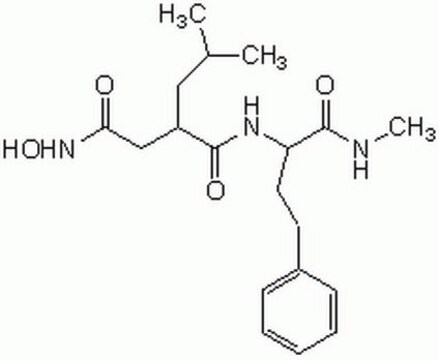
The MMP Inhibitor III, also referenced under CAS 927827-98-3, controls the biological activity of MMP. This small molecule/inhibitor is primarily used for Protease Inhibitors applications.

Synonym(e):

MMP Inhibitor III

Anmelden zur Ansicht der Organisations- und Vertragspreise.

Größe auswählen

Ansicht ändern
PackungsgrößeSKUVerfügbarkeitPreis
1 mg
Warenkorb auf Verfügbarkeit prüfen
€ 194,00

Über diesen Artikel

Empirische Formel (Hill-System):
C19H29N3O4
CAS-Nummer:
Molekulargewicht:
363.45
MDL number:
NACRES:
NA.77
UNSPSC Code:
12352200
Assay:
≥90% (TLC)
Form:
lyophilized solid
Quality level:
Storage condition:
OK to freeze, desiccated

€ 194,00


Warenkorb auf Verfügbarkeit prüfen

Technischer Dienst
Benötigen Sie Hilfe? Unser Team von erfahrenen Wissenschaftlern ist für Sie da.
Unterstützung erhalten


Quality Level

assay

≥90% (TLC)

form

lyophilized solid

manufacturer/tradename

Calbiochem®

storage condition

OK to freeze, desiccated

color

off-white

solubility

DMSO: 5 mg/mL

shipped in

ambient

storage temp.

−20°C

General description

A homophenylalanine-hydroxamic acid based broad-spectrum cell-permeable, reversible inhibitor of matrix metalloproteinases (supplied as a racemic mixture). Inhibits MMP-1 (IC50 = 7.4 nM), MMP-2 (IC50 = 2.3 nM), MMP-3 (IC50 = 135 nM), MMP-7 (IC50 = 10-100 nM), and MMP-13 (IC50 = 1-10 nM).

Biochem/physiol Actions

Cell permeable: yes
Primary Target
MMP-1
Product does not compete with ATP.
Reversible: yes
Target IC50: 7.4 nM, 2.3 nM, 135 nM, 10-100 nM, 1-10 nM, against MMP-1, MMP-2, MMP-3, MMP-7, and MMP-13, respectively

Preparation Note

Following reconstitution, aliquot and freeze (-20°C). Stock solutions are stable for up to 6 months (-20°C).

Other Notes

Covington, M.D., et al. 2006, Am. J. Physiol. Renal. Physiol.290, F43.

Legal Information

CALBIOCHEM is a registered trademark of Merck KGaA, Darmstadt, Germany

Disclaimer

Toxicity: Standard Handling (A)

Ähnliche Artikel vergleichen

Vollständigen Vergleich anzeigen

Unterschiede anzeigen

1 of 1

Dieser Artikel
444218444225444288
assay

≥90% (TLC)

assay

≥90% (HPLC)

assay

≥98% (TLC)

assay

≥95% (HPLC)

form

lyophilized solid

form

solid

form

solid

form

solid

manufacturer/tradename

Calbiochem®

manufacturer/tradename

Calbiochem®

manufacturer/tradename

Calbiochem®

manufacturer/tradename

Calbiochem®

Quality Level

100

Quality Level

100

Quality Level

100

Quality Level

100

storage temp.

−20°C

storage temp.

−20°C

storage temp.

10-30°C

storage temp.

2-8°C

storage condition

OK to freeze, desiccated

storage condition

OK to freeze, desiccated (hygroscopic)

storage condition

OK to freeze

storage condition

OK to freeze, protect from light


Lagerklasse

11 - Combustible Solids

wgk

WGK 1

flash_point_f

Not applicable

flash_point_c

Not applicable


Analysenzertifikate (COA)

Suchen Sie nach Analysenzertifikate (COA), indem Sie die Lot-/Chargennummer des Produkts eingeben. Lot- und Chargennummern sind auf dem Produktetikett hinter den Wörtern ‘Lot’ oder ‘Batch’ (Lot oder Charge) zu finden.

Besitzen Sie dieses Produkt bereits?

In der Dokumentenbibliothek finden Sie die Dokumentation zu den Produkten, die Sie kürzlich erworben haben.

Die Dokumentenbibliothek aufrufen


Verwandter Inhalt

Select different protease inhibitor types based on your needs to prevent protein degradation during isolation and characterization and safeguard proteins in sample prep.


Søren B van Witteloostuijn et al.
Journal of peptide science : an official publication of the European Peptide Society, 23(12), 845-854 (2017-10-24)
Bariatric surgery is currently the most effective treatment of obesity, which has spurred an interest in developing pharmaceutical mimetics. It is thought that the marked body weight-lowering effects of bariatric surgery involve stimulated secretion of appetite-regulating gut hormones, including glucagon-like
Elina Siljamäki et al.
Oncogene, 42(49), 3633-3647 (2023-10-21)
Cutaneous squamous cell carcinoma (cSCC) is the most common metastatic skin cancer. The prognosis of patients with metastatic cSCC is poor emphasizing the need for new therapies. We have previously reported that the activation of Ras/MEK/ERK1/2 and transforming growth factor


Global Trade Item Number

SKUGTIN
444264-1MG07790788050382

Questions

Reviews

No rating value

Active Filters